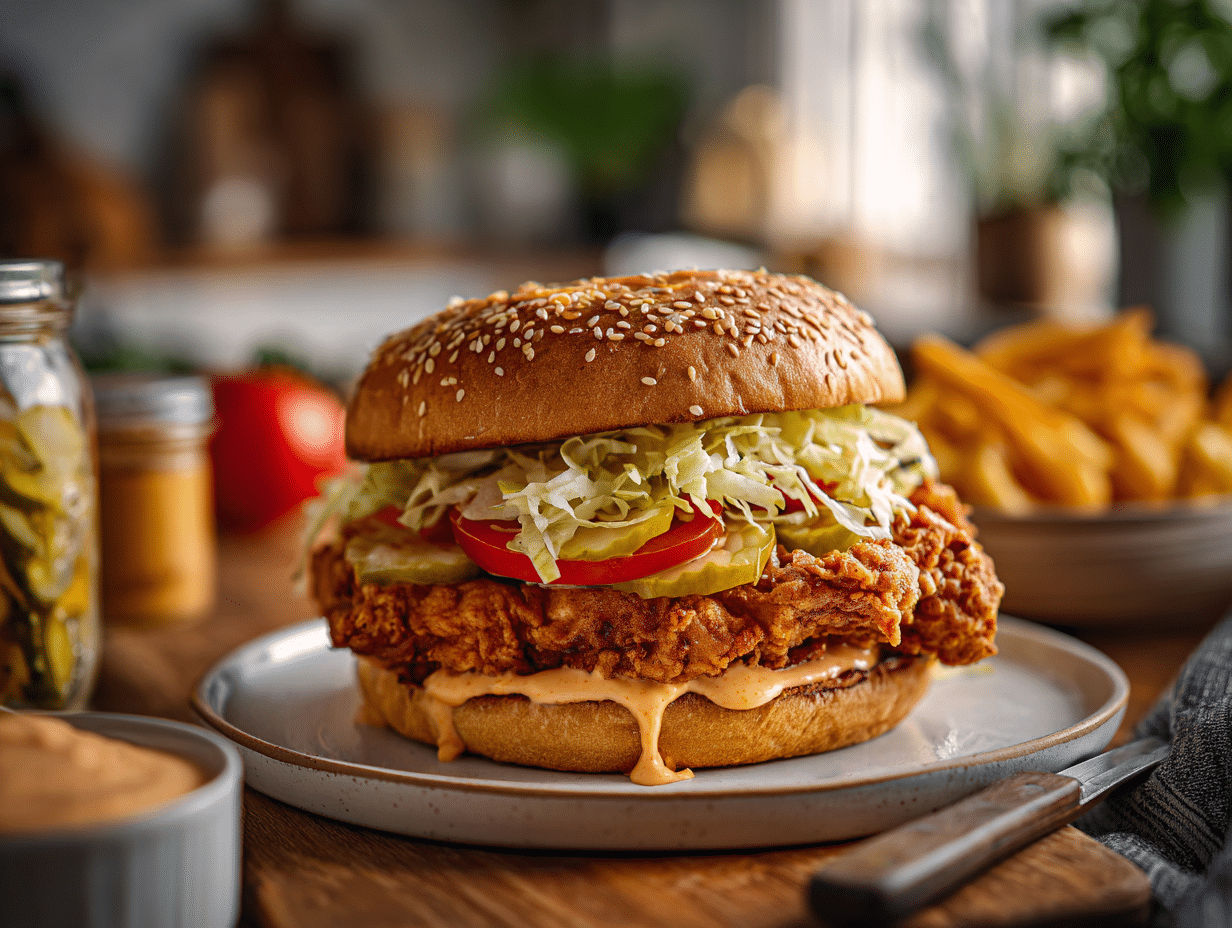
This is a homemade take on McDonald’s Spicy McChicken Deluxe — a buttermilk-marinated, cayenne-breaded chicken thigh on a sesame seed bun with shredded lettuce, tomato, and mayo. The real reason to make it at home is control: you pick the heat level, you use real chicken thighs instead of processed patties, and you can fry a batch that covers lunches for several days without a single drive-thru trip.
What makes this version work
Two things actually move the needle here. First, the buttermilk marinade — the acid loosens the muscle fibers so the chicken stays juicy at the 165°F (74°C) internal temp you need to hit, not just at the moment it comes out of the oil. Second, the double-dredge: flour, back into the buttermilk, flour again. That second pass builds a thicker, craggier crust that holds up when you wrap the sandwich or store it in the fridge, instead of turning into a soggy shell by the time you eat it. Skip the egg in the dredge mix — it makes the coating gummy rather than crisp.
Shopping notes
- Chicken thighs: Boneless, skinless. They stay moist through frying and reheating in a way breast meat simply doesn’t. Buy them in a family pack if you’re planning multiple servings.
- White pepper: Worth tracking down separately from black pepper. It delivers a slower, throat-level heat that blends into the breading differently. Most grocery stores carry it in the spice aisle; if not, any Asian market will have it.
- Sesame seed buns: Standard hamburger buns work fine, but the sesame ones are closer to the original and hold up better to the chicken’s weight. Brioche buns go soft fast — avoid them if you’re packing these ahead.
- Neutral frying oil: Vegetable, canola, or peanut oil all work. Avoid olive oil — its smoke point is too low for the temperature you need.
Storage and reheating
Fried chicken thighs keep well in the fridge for up to 4 days in an airtight container — store them separately from the buns and toppings. To reheat, use an oven or air fryer at 375°F (190°C) for 8 to 10 minutes; this brings the crust back to something close to fresh-fried without drying out the meat. A microwave will technically work but the breading goes limp. For longer storage, freeze the cooked, cooled chicken pieces on a baking sheet first, then transfer to a freezer bag — they’ll keep for up to 2 months. Reheat from frozen at 375°F for 15 to 18 minutes, flipping once halfway through. Assemble the sandwich fresh each time; pre-assembled sandwiches with lettuce and tomato don’t survive storage.
Mistakes to avoid
- Oil that isn’t hot enough: If the oil is below 350°F when the chicken goes in, the breading absorbs fat instead of crisping. Use a thermometer and let the oil recover between batches.
- Crowding the pan: More than two thighs at once drops the oil temperature sharply. Fry in batches and keep finished pieces on a wire rack in a 200°F oven, not stacked on paper towels, which trap steam.
- Skipping the rest after marinating: Pulling the chicken straight from a short marinade and frying immediately means uneven seasoning. Even 30 minutes in the buttermilk makes a difference; overnight is better.
- Slicing into the chicken to check doneness: Cutting the thigh releases juices and dries it out. Use an instant-read thermometer — 165°F (74°C) at the thickest point is your target, every time.
- Toasting the buns too far ahead: Toast them right before you assemble. A bun that sits toasted for more than a few minutes gets hard on the inside and loses its ability to absorb the mayo without going soggy.
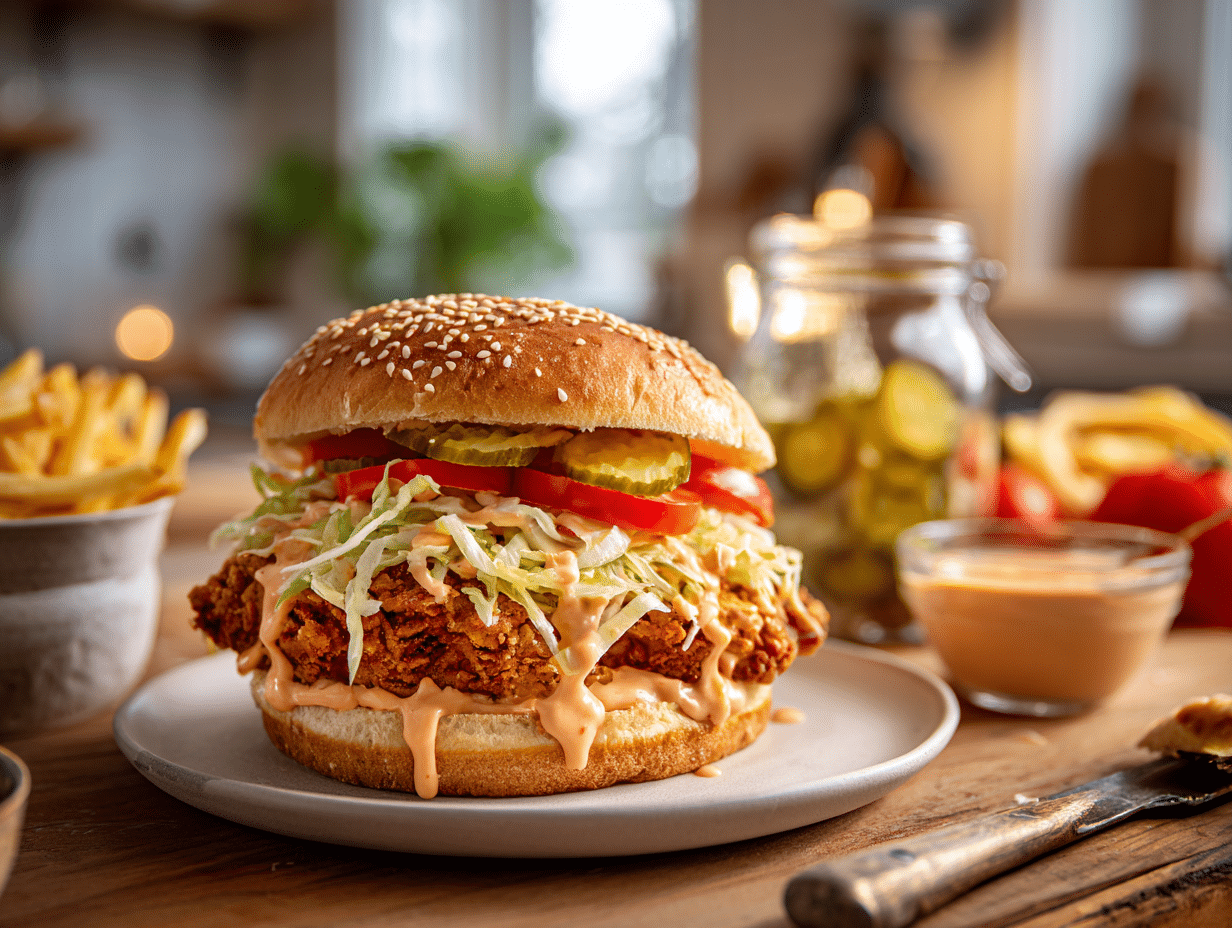
McDonalds Spicy McChicken Deluxe (Homemade Copycat)

Ingredients
For the Spicy Buttermilk Marinade:
- 1 cup buttermilk well-shaken; full-fat preferred for best tenderness
- 1 large egg room temperature
- 2 tablespoons hot sauce Louisiana-style (e.g., Crystal or Frank’s)
- 1 ½ teaspoons kosher salt
- 1 teaspoon granulated sugar balances heat
- 1 teaspoon garlic powder
- ½ teaspoon onion powder
For the Chicken:
- 4 pieces boneless skinless chicken thighs about 1 lb total; pounded to 1/2 inch thick for even cooking
For the Spicy Mayo:
- ½ cup mayonnaise full-fat; Kewpie recommended for extra richness
- 1 tablespoon hot sauce match the marinade’s brand for continuity
- 1 teaspoon fresh lemon juice or apple cider vinegar
- ½ teaspoon smoked paprika adds subtle smokiness
- ¼ teaspoon cayenne pepper adjust to taste
- ¼ teaspoon granulated sugar balances acidity
- ⅛ teaspoon kosher salt pinch, to taste
For the Dry Dredge:
- 1 ½ cups all-purpose flour unbleached preferred
- ½ cup cornstarch for extra crisp crust
- 1 teaspoon baking powder lightens the coating
- 2 teaspoons paprika sweet or Hungarian
- 1 teaspoon cayenne pepper reduce to 1/2 tsp for milder heat
- 1 teaspoon ground white pepper classic fast-food-style heat
- 1 teaspoon freshly ground black pepper
- 1 ½ teaspoons kosher salt
For Frying:
- 2 quarts neutral frying oil peanut, canola, or rice bran
- ½ teaspoon kosher salt for finishing the fried chicken
To Build:
- 4 whole sesame hamburger buns soft, bakery-quality
- 2 tablespoons unsalted butter softened, for toasting buns
- 2 cups shredded iceberg lettuce crisp and freshly shredded
- 2 medium ripe tomatoes sliced into 8 slices total
- 12 pieces dill pickle chips thick-cut for crunch
Instructions
- Prep the Chicken (2 minutes): Trim excess fat. Place each thigh between plastic wrap and gently pound to about 1/2 inch thick with a meat mallet or rolling pin. This ensures even cooking and a broad surface for maximum crunch.
- Make the Spicy Buttermilk Marinade (3 minutes) and marinate (30 minutes): In a bowl, whisk buttermilk, egg, hot sauce, kosher salt, sugar, garlic powder, and onion powder. The marinade should be smooth and lightly orange. Submerge chicken, cover, and refrigerate for at least 30 minutes (up to 12 hours for deeper flavor).
- Prepare the Spicy Mayo (5 minutes, during marination): In a small bowl, mix mayonnaise, hot sauce, lemon juice, smoked paprika, cayenne, sugar, and a pinch of salt until silky and salmon-colored. Cover and chill. Tip: If you don’t have a whisk, a fork works fine for emulsifying.
- Prep the Toppings (5 minutes): Shred the iceberg lettuce finely, slice tomatoes into 8 even slices, and set out pickle chips. Keep chilled for maximum crunch and contrast.
- Mix the Dry Dredge (3 minutes): In a shallow dish, whisk flour, cornstarch, baking powder, paprika, cayenne, white pepper, black pepper, and kosher salt. Use your fingers to break any clumps—an even blend gives a uniform, craggy crust.
- Heat the Oil (about 10 minutes): Pour 2 quarts of neutral oil into a heavy pot or deep skillet, at least 2 inches deep. Heat to 350°F (175°C). Use a clip-on thermometer; proper temperature is key to crispness without greasiness.
- Dredge for Maximum Crunch (10 minutes including rest): Remove chicken from marinade, letting excess drip off. Press firmly into the dry dredge to coat all sides. Set on a rack and rest 5 minutes so the flour hydrates (it should look slightly damp). For an extra craggy crust, dip back into the marinade, then into the dredge again, pressing to create flakey bits, and rest another 5 minutes.
- Fry the Chicken (first batch 6–7 minutes, second batch 6–7 minutes): Fry 2 pieces at a time at 350°F (175°C), adjusting heat to keep oil between 325°F and 350°F (163–175°C). Flip once midway. Cook until deep golden and the thickest part reaches 165°F (74°C). Transfer to a rack; immediately sprinkle a pinch of kosher salt for a bright, hot-from-the-fryer finish.
- Toast the Buns (2–3 minutes): Spread cut sides with softened butter and toast in a dry skillet over medium heat until golden, about 1–2 minutes, or broil cut-side-up until just browned (keep a close eye).
- Assemble the Deluxe: Spread 1 tablespoon spicy mayo on the bottom bun. Layer 3 pickle chips, a fried chicken thigh, a generous handful of shredded lettuce, and 2 tomato slices. Spread another tablespoon of spicy mayo on the top bun and cap the sandwich.
- Rest Briefly and Serve: Let the sandwich sit 1–2 minutes so the juices settle and the bun warms from the chicken. Serve immediately while the crust crackles.
Notes
Chef’s Tips:
- Crispier Coating: Rest dredged chicken 5–10 minutes before frying. For ultra-craggy crust, double-dip as described.
- Spice Level: Reduce cayenne in the dredge to 1/2 teaspoon for gentle heat, or add 1/2 teaspoon more for a fiery kick.
- Gluten-free: Swap flour for a 1:1 gluten-free blend and use potato starch or rice flour instead of cornstarch for exceptional crispness.
- No Deep-fry? Air-fryer at 375°F (190°C) for 14–18 minutes, flipping halfway, lightly misting with oil. Or oven-bake on a wire rack at 425°F (220°C) for 20–25 minutes, flipping once; mist with oil for better browning.
- Breasts vs. Thighs: Use 4 thin chicken breast cutlets (about 1/2 inch thick) if preferred; monitor to 160–165°F (71–74°C).
- Hold Crisp: Keep fried chicken on a rack in a 200°F (95°C) oven while finishing batches.
- Oil Savvy: Skim crumbs between batches to prevent bitterness; maintain oil heat for a non-greasy result.
Nutrition
FAQ
Can I use chicken breast instead of thighs?
You can, but the sandwich will be drier, especially if you’re reheating it later in the week. If you go with breast, pound it to an even thickness before marinating so it cooks through without the outside over-browning.
How spicy is this compared to the actual McDonald’s sandwich?
At the recipe’s default amounts, it’s noticeably hotter than the fast-food version. Cut the cayenne by half if you want a closer match, or increase it if you want real heat.
Can I air-fry instead of deep-fry?
Yes — spray the breaded chicken generously with oil and cook at 400°F (200°C) for 18 to 22 minutes, flipping halfway, until the internal temp hits 165°F (74°C). The crust won’t be quite as craggy, but it’s a solid result and much easier to clean up.
What’s the best way to keep the breading from falling off during frying?
Let the dredged chicken rest on a wire rack for 10 to 15 minutes before it goes into the oil — this gives the coating time to hydrate and stick. Pressing the flour firmly into the chicken during each dredge pass also helps.
Can I marinate the chicken the night before?
Yes, and it’s actually the better approach if you’re prepping for the week. The chicken can sit in the buttermilk marinade in the fridge for up to 24 hours without any texture problems — beyond that, the acid starts to break down the meat too much.
Try these next
- Wendy’s Spicy Chicken Copycat
- Spicy McCrispy Copycat Recipe
- Nashville Hot Chicken Perfected
- Better Than BK’s Spicy Chicken