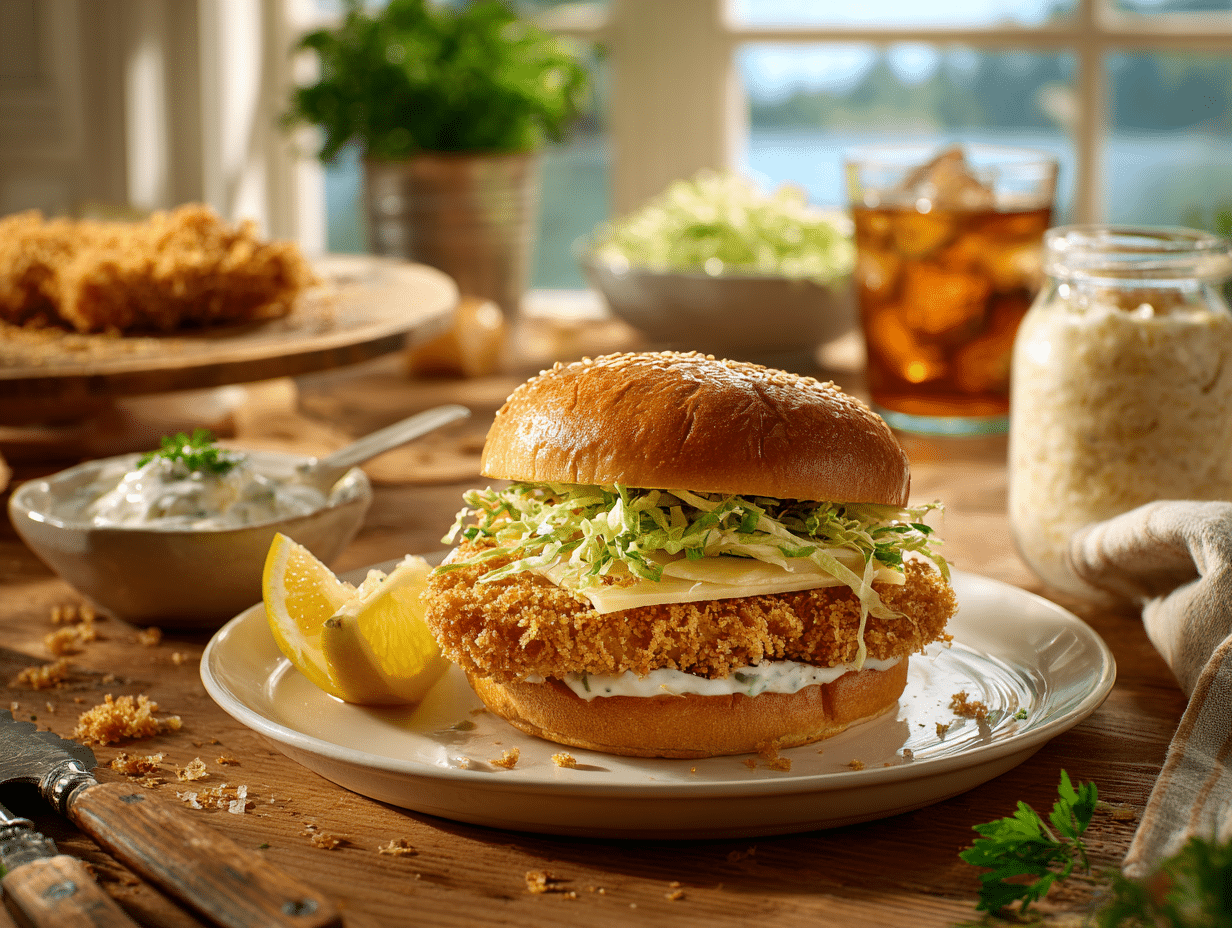
This is a homemade take on the BK Big Fish — a rectangular fillet of breaded white fish, tartar sauce, shredded lettuce, and pickles on a sesame bun. The honest reason to make it at home is control: you choose the fish, you control the oil temperature, and you end up with a crispier crust than anything sitting under a heat lamp. It also reheats surprisingly well, which makes it worth cooking in a bigger batch.
What makes this version work
Two things matter most here. First, the double-dredge — flour, egg wash, then a wheat-and-corn flour blend — is what gives the crust its crunch and keeps it from turning soggy once the tartar sauce goes on. Skip one pass and the coating slides right off the fish. Second, oil temperature is everything with fish. Pollock or cod is lean and cooks fast, so if your oil drops below 350°F the crust absorbs grease before the fish is done, and if it climbs above 375°F the outside burns while the center is still cold. A clip-on thermometer is the only reliable way to hold that window steady across multiple fillets.
If something goes sideways
- Coating falls off in the fryer: The fish was wet. Pat each fillet completely dry before dredging, and let the coated fillets rest on a wire rack for five minutes before they hit the oil — that rest lets the breading bond.
- Crust is pale and greasy: Oil was too cool. Bring it back to 350°F and fry in smaller batches. Crowding the pan drops the temperature fast.
- Fish is cooked through but crust is already dark: Your fillets are too thin, or the oil is running hot. Cut thicker portions, or reduce heat slightly and accept a slightly longer fry time.
- Tartar sauce makes the bottom bun soggy immediately: Put a leaf of lettuce directly on the bottom bun before the sauce goes on. It acts as a barrier and buys you several minutes of structural integrity — useful if you’re wrapping these for later.
- Reheated fish turns rubbery: You used the microwave. An air fryer at 375°F for 4 minutes or a hot oven on a wire rack keeps the crust alive. The microwave steams the coating and there’s no coming back from that.
Make-ahead notes
Breaded, uncooked fillets can be arranged in a single layer on a parchment-lined sheet, frozen solid (about two hours), then transferred to a zip bag and kept frozen for up to six weeks — fry straight from frozen, adding two to three minutes to the cook time and verifying the internal temperature hits 145°F for fish. Already-fried fillets keep in the fridge for up to three days; reheat in an air fryer at 375°F for four to five minutes or on a wire rack in a 400°F oven for eight minutes. The tartar sauce holds refrigerated for five days in a sealed jar, so make a full batch on Sunday and the assembly for each sandwich during the week takes under two minutes. Skip the egg in the tartar sauce mix — it makes the sauce loose and prone to weeping into the bun. Build and wrap individual sandwiches in parchment if you’re packing them for lunch; the wrapping holds everything together and slows the sog.
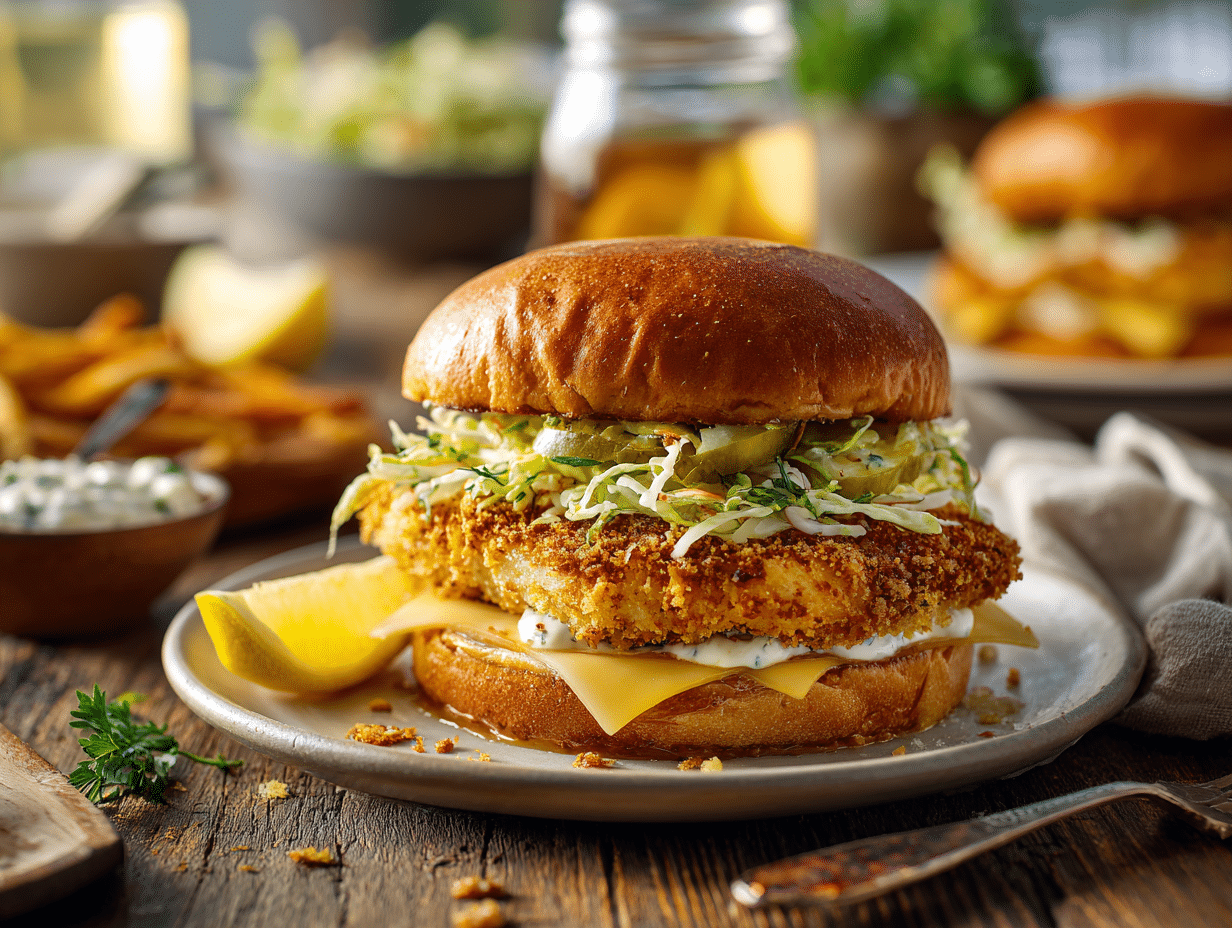
Crispy Fish King-Style Burger (Copycat)

What makes it special
Ultra-crispy, airy panko coating that stays crunchyBriny, herb-forward tartar sauce with dill, capers, and lemonButtered, toasted sesame brioche for softness and aromaBalanced layers: creamy, crisp, tangy, and richIngredients
Tartar Sauce
- ½ cup mayonnaise Full-fat for best texture
- ¼ cup dill pickles, finely chopped Cold and very finely chopped for even texture
- 1 tbsp capers, minced Rinsed to temper saltiness
- 1 tbsp fresh lemon juice Freshly squeezed for brightness
- 1 tsp Dijon mustard
- 1 tbsp fresh dill, finely chopped Flat-leaf dill for best aroma
- 1 tbsp shallot, minced Very fine mince for a smooth sauce
- ¼ tsp freshly ground black pepper
- 1 pinch granulated sugar Optional, to balance acidity
Panko-Crusted Fish Fillets
- 4 fillets skinless cod fillets (about 4 oz each) Alternatively haddock or pollock; trimmed to bun size
- 1 ½ tsp kosher salt Diamond Crystal preferred; season fish and dredge
- ½ tsp ground white pepper Gentle heat without dark specks
- ½ tsp garlic powder
- ½ tsp sweet paprika Adds color and subtle warmth
- 1 cup all-purpose flour For initial dredge
- ¼ cup cornstarch Boosts crispness
- 2 large eggs For egg wash
- 2 tbsp cold water Loosens egg wash
- 1 tsp Dijon mustard Emulsifies egg wash and adds tang
- 2 cups panko breadcrumbs Japanese-style, unseasoned
- 1 ½ quarts neutral frying oil (canola, peanut, or rice bran) Enough to reach 1 1/2–2 inches depth
- 1 pinch fine sea salt, for finishing Optional, to season just-fried fillets
For Assembly
- 2 tbsp unsalted butter, softened For toasting buns
- 4 buns sesame brioche burger buns Soft, sturdy, and lightly sweet
- 4 slices American cheese Optional, for a classic touch
- 2 cups iceberg lettuce, finely shredded Extra cold and well-dried for crunch
- 8 chips dill pickle chips Thick-cut if possible
- 4 wedges lemon For serving
Instructions
- Make the tartar sauce (10 minutes active, 20–30 minutes to chill): In a small bowl, whisk together mayonnaise, chopped dill pickles, capers, lemon juice, Dijon, dill, shallot, black pepper, and a pinch of sugar. Taste and adjust salt if needed. Cover and refrigerate 20–30 minutes to meld flavors. Sensory cue: it should smell bright and herby with a gentle pickle brine aroma.
- Portion and dry the fish (5 minutes): Pat the cod fillets very dry with paper towels—dry surfaces equal better crust. Trim to bun-sized pieces if needed. Season both sides with 1 tsp of the kosher salt and the white pepper. You should see a light, even seasoning—no clumps.
- Set up a 3-bowl breading station (5 minutes): Bowl A: whisk flour, cornstarch, remaining 1/2 tsp kosher salt, garlic powder, and paprika. Bowl B: beat eggs with cold water and 1 tsp Dijon until smooth and slightly foamy. Bowl C: pour panko and gently crush a handful between your palms for a mix of coarse and medium flakes (this improves adhesion).
- Bread the fillets (10 minutes + 10 minutes rest): Working one piece at a time, dredge fish in Bowl A, shaking off excess; dip in Bowl B, letting excess drip; press firmly into panko until fully coated. Transfer to a wire rack and let rest 10 minutes—this hydrates the crumbs so they adhere and crisp evenly.
- Heat the oil to 350°F (175°C): In a heavy 5–6 qt pot or Dutch oven, add oil to 1 1/2–2 inches depth. Heat over medium-high until a thermometer reads 350°F (175°C). Maintain 340–360°F (171–182°C) during frying for even browning and minimal oil absorption. Safety: keep a sheet pan with rack ready for draining.
- Fry the fish (about 16 minutes total, 2 batches): Fry 2 fillets at a time, 3–4 minutes per side, until deeply golden and audible sizzling becomes a gentle crackle. Internal temperature should reach 145°F (63°C). Drain on the rack and immediately season lightly with finishing salt. Repeat with remaining fillets. Visual cue: the crust should be a rich amber-gold with craggy, crisp flakes.
- Toast the buns (2–4 minutes): Spread cut sides of buns with softened butter. Toast cut-side down on a preheated skillet over medium heat until golden, 1–2 minutes, or bake on a sheet at 350°F (175°C) for 3–4 minutes. Aromatic cue: you should smell warm butter and toasted sesame.
- Assemble the burgers (3–5 minutes): Spread 1–2 tbsp tartar sauce on the bottom bun, add a nest of shredded iceberg, an optional slice of American cheese, then the crispy fish fillet. Top with pickle chips and a spoonful more tartar sauce. Crown with the top bun.
- Serve with lemon: Plate immediately with a lemon wedge. A quick squeeze over the fish right before the first bite enlivens the whole sandwich.
- Alternative gear/methods: If you don’t have a deep pot, shallow-fry in 1/2 inch oil, flipping carefully; or air-fry at 400°F (200°C) for 8–10 minutes, flipping once, until 145°F (63°C) internal, lightly misting with oil for color. Texture will be slightly less craggy but still crisp.
Notes
Chef’s Tips
- Extra-crispy hack: Mix 1–2 tbsp oil into the panko before breading; it promotes even browning.
- Rice flour swap: Replace half the flour with rice flour for an even lighter crust.
- Gluten-free: Use gluten-free panko and rice flour; confirm condiments are GF.
- Dairy-free: Skip butter and cheese; toast buns dry and use dairy-free mayo.
- Fish choices: Cod, haddock, or pollock work best; aim for 1/2-inch thickness for balanced crust-to-flake ratio.
- Oil management: Fry in two batches and let oil return to 350°F (175°C) between batches for consistent color.
- Holding: Keep fried fillets on a rack in a 250°F (120°C) oven for up to 10 minutes to stay crisp while you toast buns.
Serving Suggestions
- Plate like a pro: Stack the burger slightly off-center, tilt the top bun to showcase the craggy crust and emerald lettuce. Drizzle a tiny ribbon of tartar on the plate and add a lemon wedge.
- Color & aroma cues: Deep golden fillet, bright green lettuce, glossy bun; aroma of toasted sesame, dill, and lemon.
- Sides & sips: Crisp shoestring fries or vinegar-slaw; pair with a light pilsner, iced tea, or lemon seltzer.
Culinary Context
American fast-food fish sandwiches surged in popularity in the mid-20th century—especially during Lent—offering a comforting, briny alternative to beef. This Fish King-inspired version honors that heritage while dialing up texture and freshness with chef techniques.Optional Advanced Instructions
- Make-ahead: Tartar sauce can be made 2 days ahead. Breaded, uncooked fillets can be refrigerated 4 hours or frozen up to 1 month; fry from frozen at 350°F (175°C) for 1–2 extra minutes.
- Two-stage fry (advanced): Fry at 325°F (165°C) for 2 minutes to set crust, rest 2 minutes, then finish at 375°F (190°C) for 60–90 seconds for maximum shatter.
- Beginner alternative: Bake on a rack at 425°F (220°C) for 12–15 minutes, flipping once; mist with oil for color. Not as craggy as frying, but cleaner and reliable.
Nutrition
Common questions
Can I use fresh cod instead of pollock?
Yes, and it works well. Cod has a slightly firmer texture and a cleaner flavor, which most people prefer when they’re cooking at home with fresh fish. Just cut it into rectangular portions of roughly equal thickness so they cook evenly, and pat them very dry — fresh cod holds more moisture than frozen pollock and the extra water will fight your crust.
What internal temperature should the fish reach?
The FDA recommends 145°F (63°C) for fish, and at that point the flesh will be opaque and flake easily. A thin instant-read thermometer inserted into the thickest part of the fillet is the only reliable check — color alone isn’t enough, especially with a dark crust hiding what’s underneath.
Can I bake these instead of frying?
You can, but the crust will be noticeably less crispy. If you go that route, place the breaded fillets on a wire rack set over a sheet pan, spray them generously with a neutral oil, and bake at 425°F for 18 to 22 minutes, flipping once halfway. An air fryer at 400°F for 12 to 14 minutes gets closer to the fried result than a conventional oven does.