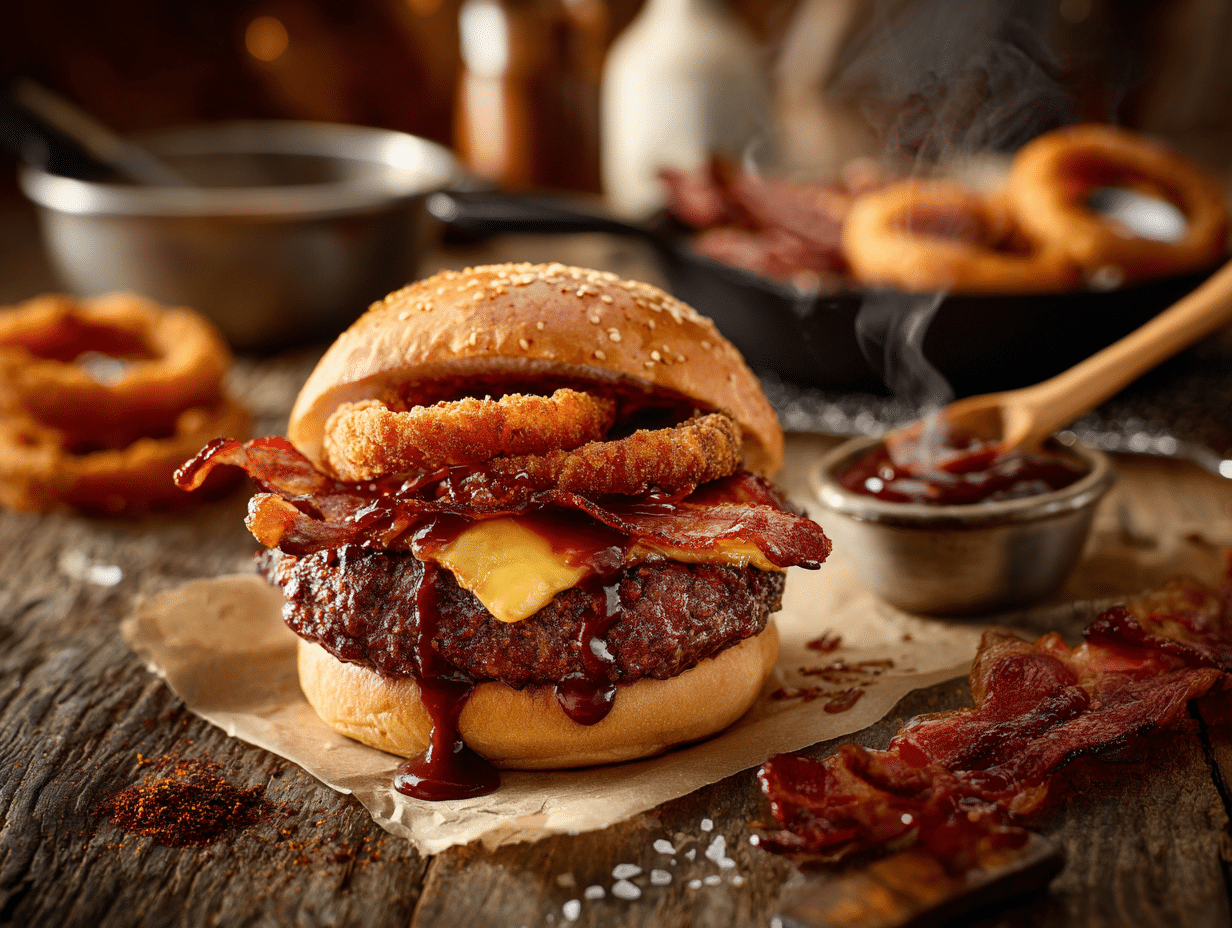
This is a copycat of Burger King’s Rodeo King — a double beef patty burger stacked with bacon, melted cheese, crispy onion rings, and BBQ sauce. The honest reason to make it at home is simple: the onion rings are always hot and crunchy, which is rarely true at the drive-through.
What makes this version work
Two things matter here. First, the onion rings go on right after frying — even two minutes of sitting turns them soft, and a soft onion ring is just a sad onion. Second, the BBQ sauce gets applied to the bottom bun only, not smeared on both sides. That one change keeps the top bun from going soggy before you’ve finished building the stack. Everything else is straightforward burger cooking; these two steps are where home versions usually fall apart.
Common problems and fixes
- Bacon curling and cooking unevenly: Lay strips in a cold pan, then bring the heat up gradually. Starting in a hot pan causes immediate curling. A fork pressed lightly on the strips for the first minute also helps.
- Cheese not fully melted by the time the patty hits 160°F: Add the cheese slice about 90 seconds before the patty is done and tent the pan loosely with a piece of foil. The trapped steam finishes the job without overcooking the beef.
- Onion rings going soggy inside the burger: Skip the egg in the batter mix — it makes the coating dense and it steams rather than stays crisp. A straight flour-and-beer or flour-and-sparkling-water batter holds its crunch longer.
- BBQ sauce sliding off the bun: Toast the bottom bun cut-side down in the same pan you used for bacon. The light fat coating helps the sauce grip instead of pool and drip.
- Stack collapsing when you pick it up: Press the onion rings gently into the cheese while it’s still warm and tacky. They’ll anchor to the patty instead of sliding out with the first bite.
Keeping and reheating
Cooked beef patties keep in the fridge for up to 3 days in an airtight container. Bacon keeps for 4 days. Store them separately from the buns and onion rings — assembled burgers don’t reheat well. To reheat the patties, use a skillet over medium heat with a splash of water and a lid; about 2 minutes per side brings them back without drying out. Reheat the onion rings in an oven or air fryer at 375°F for 5–6 minutes — a microwave will make them limp. Cooked patties can be frozen for up to 2 months; wrap individually and thaw overnight in the fridge before reheating.
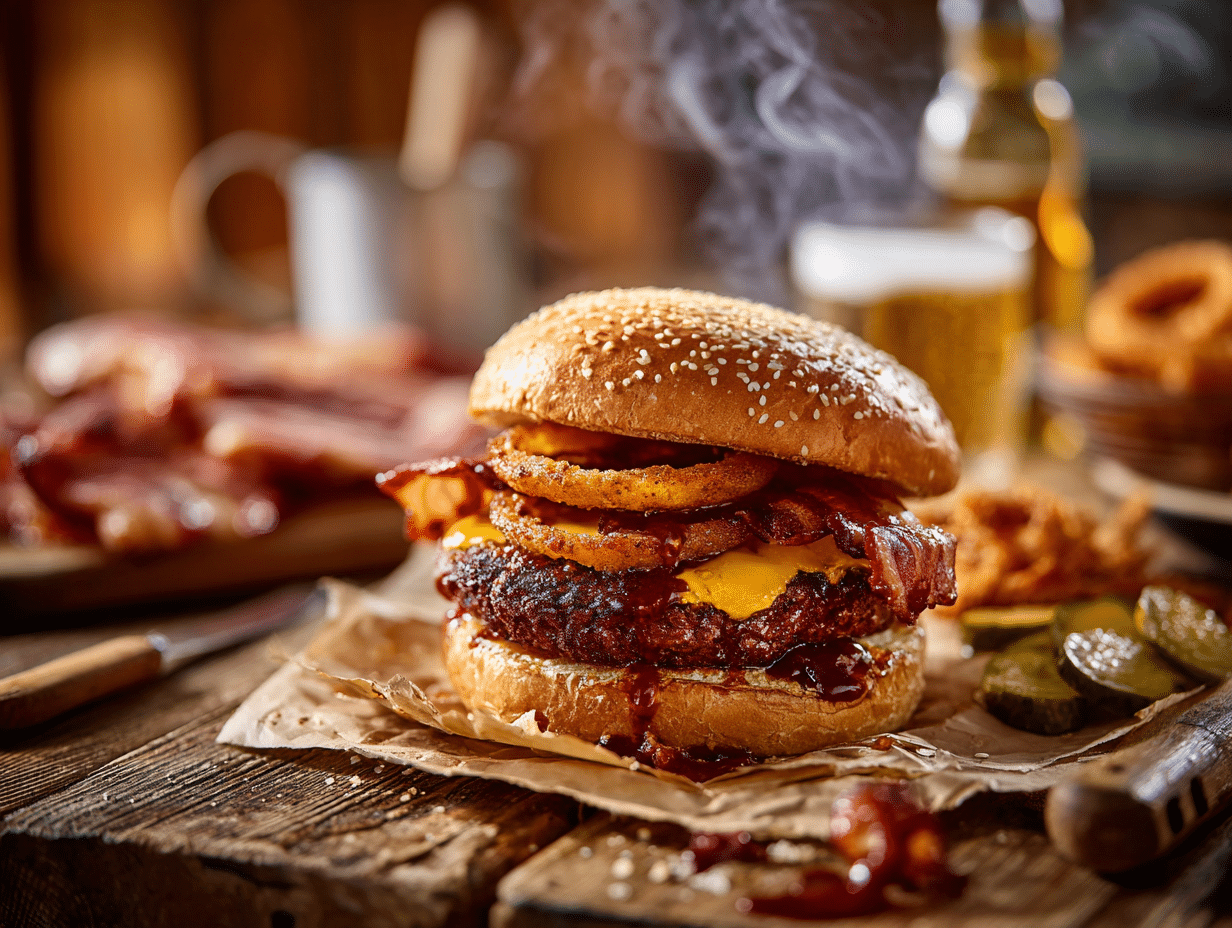
Copycat Burger King Rodeo King Burger

Ingredients
For the crispy onion rings
- 8 cups neutral frying oil (canola or peanut) Enough to fill a heavy pot by 2–3 inches
- 1 large sweet onion (Vidalia or Walla Walla) Peeled and cut into 1/2-inch rings
- 1 cup all-purpose flour Unbleached preferred
- ½ cup cornstarch For extra crispness
- 1 tsp baking powder
- 1 tsp kosher salt Diamond Crystal; use 1/2 tsp if using Morton
- ½ tsp smoked paprika Enhances the barbecue vibe
- ½ tsp garlic powder
- 1 cup club soda or light lager beer, chilled Cold liquid = lighter, crisper batter
- 2 tbsp all-purpose flour, for dusting rings Helps batter cling
For the bacon
- 6 slices thick-cut bacon Applewood-smoked recommended
For the burger patties
- 1 lb 80/20 ground chuck Chilled; 80/20 ensures juiciness
- 1 tsp kosher salt For seasoning patties
- ½ tsp freshly ground black pepper
- 1 tsp Worcestershire sauce Optional, for deeper savoriness
For assembly
- 2 buns sesame seed burger buns Bakery-style, sturdy
- 1 tbsp unsalted butter For toasting buns
- 4 slices American cheese Deli American melts beautifully
- ½ cup barbecue sauce Smoky-sweet; e.g., Sweet Baby Ray's or Stubb's
Instructions
- Set yourself up for success: place a wire rack over a sheet pan for draining, line a second sheet pan with foil for bacon, and have tongs, a spider skimmer, and paper towels at the ready.
- Preheat and set stations: Preheat oven to 400°F (205°C). Set a heavy pot or Dutch oven over medium heat with 2–3 inches of oil; bring to 350°F (175°C). Preheat a grill to medium-high (450°F/232°C) or a cast-iron skillet over medium-high heat (about 400°F/205°C).
- Mix the onion-ring batter: In a bowl, whisk flour, cornstarch, baking powder, salt, smoked paprika, and garlic powder. Whisk in chilled club soda/beer until the batter is the consistency of heavy cream. Let it rest 5 minutes—the bubbles lighten the crust.
- Bake the bacon (12–15 min): Lay bacon on the foil-lined pan. Bake at 400°F (205°C) until deeply browned and crisp at the edges, 12–15 minutes. Drain on the rack. Aroma cue: sweet smokiness with sizzle subsiding when done.
- Fry the onion rings (about 6–8 min total): Separate onion slices into rings. Lightly dust with 2 tbsp flour, dip into batter, let excess drip, then fry at 350°F (175°C) until deep golden, 2–3 minutes per batch. Drain on the rack and season with a pinch of salt. Sound cue: a lively, steady fizz; if it roars violently, the oil is too hot.
- Form the patties: Divide the beef into 4 equal portions (4 oz each). Gently shape into 4 1/2-inch rounds, about 1/2-inch thick. Press a shallow dimple in the center to prevent doming. Season both sides with salt and pepper; splash Worcestershire on one side if using.
- Cook the patties (7–8 min): Grill or sear 3–4 minutes per side. In the last 30 seconds, top two patties with cheese and cover to melt. Visual cue: browned crust with tiny rendered fat beads at the edges. For food safety, cook ground beef to 160°F (71°C).
- Toast the buns (1–2 min): Halve buns, spread cut sides lightly with butter, and toast on the grill or skillet until golden at the edges, 1–2 minutes. Aroma cue: nutty, buttery toastiness.
- Warm the sauce: Gently warm the barbecue sauce in a small pan over low heat until glossy and pourable (2–3 minutes). Alternatively, use at room temperature for a thicker layer.
- Assemble the Rodeo King: Spread 1–2 tbsp BBQ sauce on each bottom bun. Stack a cheese-topped patty, then a plain patty (or cheese both, your call). Drape 3 bacon slices over each burger, crown with 3–4 onion rings, spoon on more BBQ sauce, and close with the top bun. Rest 1 minute so the juices settle.
- Serve: The perfect bite should be hot, smoky, crunchy, and saucy. If the onion rings still crackle and the cheese has a glossy melt, you’ve nailed it.
Notes
Professional Notes
- Heat control is flavor control: Keep frying oil at 350°F (175°C). Too cool yields greasy rings; too hot burns before crisping.
- Season in layers: Salt the rings out of the oil, season patties just before searing, and taste your BBQ sauce—adjust with vinegar, salt, or a pinch of sugar to balance.
- Juiciness insurance: Don’t overwork the beef. Gentle shaping keeps patties tender.
- Rest and stack: A 1-minute rest after assembly allows juices to settle and cheese to marry into the patties.
Chef’s Tips
- Shortcut onion rings: Use high-quality frozen rings; bake at 425°F (220°C) per package and season lightly with salt while hot.
- Air-fryer option: Onion rings at 380°F (193°C) for 8–10 minutes, shaking once. Bacon at 350°F (175°C) for 7–9 minutes.
- Bun upgrade: Brioche or potato buns add sweetness; toast well to resist sauces.
- Sauce twist: Stir 1 tsp apple cider vinegar and a pinch of cayenne into your BBQ sauce for extra snap.
- Dairy-free: Swap American cheese for a meltable plant-based slice; toast buns with oil instead of butter.
- Gluten-free: Use a 1:1 GF flour blend for the batter, GF buns, and confirm your BBQ sauce is GF.
- Grill flavor indoors: Add a few drops of liquid smoke to the patties or choose a smoked paprika-forward rub.
Serving Suggestions
Plate the burger on a warm, wide plate. Spoon a light smear of BBQ sauce under the burger to anchor it, then lean a few extra onion rings to one side for height and drama. Serve with crisp fries or a tangy slaw to cut the richness. Pair with a cold lager, an iced tea with lemon, or a cola. Visual cues: molten cheese sheen, lacquered sauce, and onion rings the color of deep amber.Culinary Context
This burger channels classic American barbecue flavors: smoke, sweet molasses notes, and char. It’s inspired by the fast-food favorite, but made with chefly attention to texture—airy-crisp onion rings and a beef blend cooked just to the point of bouncy juiciness. I first riffed on it after a road trip through the Midwest, where every pit stop served some fusion of charred beef, bacon, and BBQ.Optional Advanced Instructions
- Make-ahead: Mix dry batter ingredients up to 2 days ahead. Slice onions and refrigerate in a sealed container with a paper towel. Form patties up to 8 hours ahead; keep chilled.
- Parallel cooking plan (to hit a 25-minute cook): Start bacon first (12–15 min). While it bakes, fry onion rings in two quick batches (6–8 min total) and sear patties (7–8 min). Toast buns during the last minute. Everything lands hot at once.
- Beginner alternative: Cook steps sequentially to reduce juggling—expect total cook closer to 35 minutes.
Nutrition
FAQ
Can I use store-bought frozen onion rings instead of making them from scratch?
Yes, and they work fine for a weeknight build. Cook them according to the package directions but pull them about 1 minute early so they finish crisping on top of the hot patty rather than going rubbery.
What internal temperature should the beef patties reach?
Ground beef patties need to hit 160°F (71°C) internal temperature. Use an instant-read thermometer — color alone isn’t a reliable indicator with ground beef.
Which BBQ sauce works best — smoky, sweet, or tangy?
A smoky-sweet sauce closest to the original, something like a Kansas City style. A very thin, vinegary sauce will soak into the bun too fast and the flavor gets lost under the bacon and cheese.
Can I cook the patties on a grill instead of a skillet?
Absolutely. Grill over direct medium-high heat and still verify 160°F with a thermometer. Add the cheese with about 90 seconds left and close the lid briefly to melt it.
What’s the best way to keep everything hot while I build multiple burgers?
Keep finished patties on a wire rack set over a baking sheet in a 200°F oven while you finish the rest. Don’t stack them or cover tightly — trapped steam softens the crust on the patty.
If you liked this one
- BK Bacon Cheeseburger Clone
- BBQ Bacon Whopper Copycat
- Cheddar Bacon King Copycat
- BBQ Cheeseburger Recipe