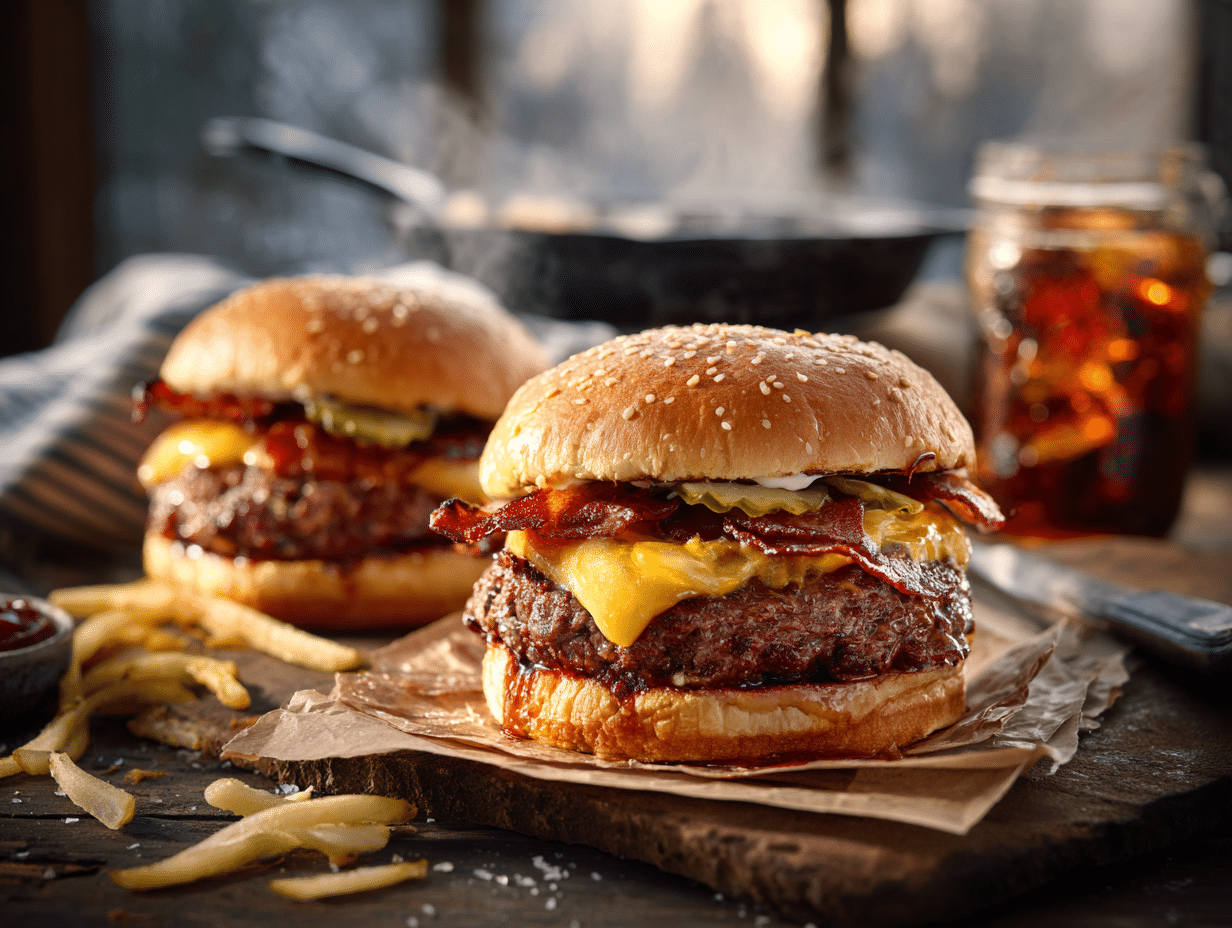
This is a home-cooked clone of the BK Bacon Cheeseburger — two smash-style beef patties, crispy bacon, American cheese, pickles, onion, ketchup, and mustard on a sesame bun. The honest reason to make it: you get a noticeably better burger than the drive-through, and the patties cook fast enough that you can knock out a week’s worth in one session.
Before you start
Two things actually move the needle here. First, your pan or griddle needs to be genuinely hot before the beef hits it — not warm, not medium-high, but screaming hot. That’s what gives you the crust that does the work a flame broiler would otherwise do. A cast-iron skillet holds heat better than anything else for this. Second, use 80/20 ground chuck and keep it cold right up until it goes in the pan. Warm fat smears instead of rendering cleanly, and you lose the crust before it even forms. Everything else in this recipe is forgiving; these two steps are not.
Mistakes to avoid
- Pressing the patty after the first smash: One firm press at the start is the move. Keep pressing as it cooks and you’re squeezing out the fat and juice you want to keep.
- Cooking bacon in the same pan right before the patties: The leftover bacon grease will smoke aggressively and can make the pan too hot to control. Cook bacon first, wipe the pan, then get it back up to temp.
- Skipping the lid when melting cheese: American cheese melts fast with a little trapped steam. Without a lid or foil tent, you’ll pull the patty before the cheese is fully melted, especially on a second patty stack.
- Adding sauce to the top bun too early: If you’re building multiple burgers for a group or prepping ahead, sauce on a warm bun turns it soggy within minutes. Sauce goes on right before serving.
- Under-seasoning the beef: Fast-food patties are seasoned more aggressively than most home cooks expect. Salt and pepper the surface of each ball just before smashing — not mixed in, just on the outside.
Substitutions that actually work
- Liquid smoke: Optional but useful if you want to close the gap with BK’s flame-grilled flavor. A few drops go into the beef before portioning — a little goes a long way, so start with less than you think you need.
- American cheese: Don’t swap this for cheddar or Swiss if you want the right melt and mild flavor. If you genuinely can’t use American, a white American or mild provolone comes closest. Skip the egg in the mix — it makes the patty mushy — and similarly, don’t try to “upgrade” the cheese here; the processed melt is the point.
- Sesame seed buns: Standard grocery sesame buns work fine. Brioche buns are too sweet and too soft for this build — they compress under the double stack and fall apart.
- Bacon: Regular-cut strips work better than thick-cut here. Thick bacon stays chewy and slides out of the burger when you bite it. Regular-cut crisps up and stays put.
Leftovers and meal prep
Cooked patties keep well in the fridge for up to 4 days in an airtight container — stack them with a small square of parchment between each one so they don’t stick. Reheat in a dry skillet over medium heat for about 90 seconds per side; the microwave works in a pinch but softens the crust. For longer storage, freeze cooked patties for up to 3 months, individually wrapped in plastic then bagged together. Thaw overnight in the fridge before reheating. Bacon can be cooked in a full batch at the start of the week and refrigerated separately — it reheats in 30 seconds in a dry pan. Build the burgers fresh each time; assembled burgers don’t hold well. Ground beef must reach 160°F (71°C) internal temperature — use a thermometer if you’re cooking a large batch and timing gets hard to track.
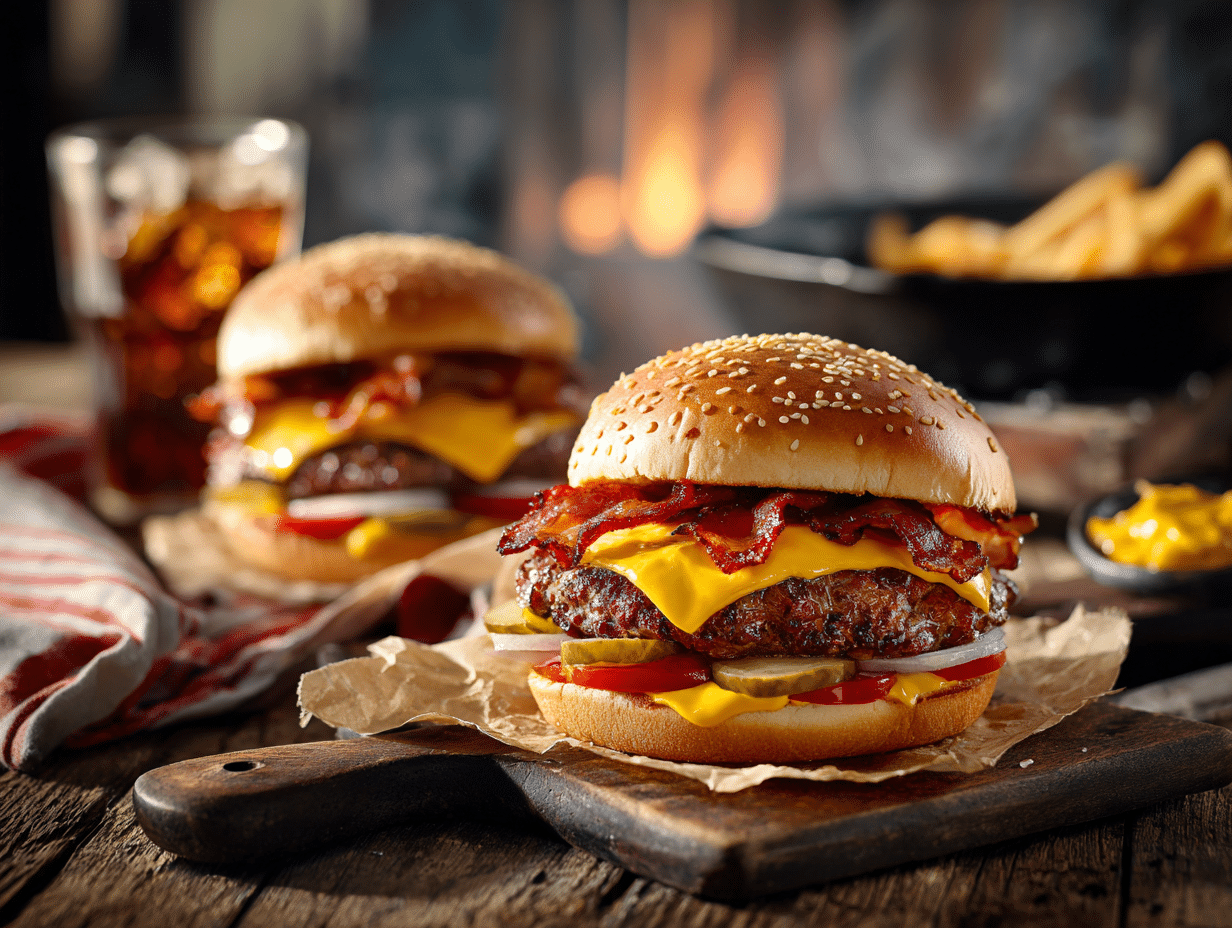
Copycat Burger King Bacon Double Cheeseburger

Ingredients
- 4 slices bacon Regular-cut for classic fast-food texture
- 2 whole burger buns Soft white or sesame buns, 4 to 4.5 in wide
- 1 tablespoon unsalted butter For toasting buns
- 10 ounces 80/20 ground chuck Cold; divide into 4 portions (2.5 oz each)
- ¾ teaspoon kosher salt Diamond Crystal preferred; adjust if using table salt
- ½ teaspoon freshly ground black pepper Fine grind mimics classic fast-food seasoning
- 1 teaspoon neutral oil Canola or vegetable, for the griddle
- 4 slices American cheese Processed American melts best; deli-style if possible
- 6–8 chips dill pickle slices Thin, crinkle-cut preferred
- 2 tablespoons ketchup Classic style
- 2 teaspoons yellow mustard Bright, tangy counterpoint
- 2 tablespoons white onion Finely diced; rinse briefly to tame bite (optional)
- ¼ teaspoon liquid smoke Optional; for a subtle flame-grilled note
- 1 teaspoon mayonnaise Optional; softens the ketchup-mustard blend
Instructions
- Prep the bacon (6 minutes): Place bacon in a cold skillet over medium heat and cook until crisp, 6 minutes, turning as needed. Drain on paper towels. Alternative: Bake on a rack over a sheet pan at 400°F/205°C for 12–14 minutes.
- Toast the buns (1 minute): Split buns. Warm a skillet or griddle over medium heat (about 350–375°F / 175–190°C). Add butter and toast cut-sides down until lightly golden, about 45–60 seconds. Set aside.
- Portion and season the beef: Divide ground beef into 4 equal balls (about 2.5 oz each). Keep them cold. Season the tops with half the salt and pepper.
- Heat the cooking surface (to 400°F/205°C): Preheat a cast-iron skillet, flat-top, or outdoor griddle over medium-high. Lightly oil the surface with neutral oil. For a flame-kissed aroma, brush a tiny amount of liquid smoke onto the pan or add a drop to the oil.
- Sear the patties (4–5 minutes total): Place two beef balls on the hot surface, seasoned-side down. Immediately press firmly with a flat spatula (or a burger press) to about 1/4-inch thickness—pressing creates deep browning and a lacy edge. Season the exposed side with some of the remaining salt and pepper. Cook until the edges are mahogany and the top shows bead-like juices, 60–90 seconds.
- Flip and melt: Scrape under each patty with a sharp metal spatula to capture the crust and flip. Top each with a slice of American cheese. Add a few drops of water to the pan and cover briefly to steam-melt, 30–45 seconds. Transfer to a warm plate. Repeat with remaining two patties. Target internal temp: 150–155°F (65–68°C) for juicy medium-well, classic fast-food style.
- Dress the buns: Spread ketchup and yellow mustard across the bottom buns (about 1 tablespoon ketchup + 1 teaspoon mustard per burger). If using, smear a little mayonnaise on the top buns.
- Build the stack: Arrange pickles over the sauced bottom buns. Add a pinch of diced onion. Place the first cheesy patty, then two bacon slices, then the second cheesy patty. Crown with the top bun.
- Rest and serve: Let burgers rest 1 minute so juices settle. The cheese should be glossy and flowing, the bacon crisp, and the bun lightly squishy with a golden sheen.
- Grill alternative: Preheat a gas grill to high (500°F/260°C). Grill patties over direct heat, lid closed, about 1–2 minutes per side. Aim for quick char; move to indirect heat to finish if needed. Melt cheese off-heat, covered, for 30 seconds.
Notes
Chef’s Tips
- Keep it cold: Cold beef + hot surface = superior crust and juiciness.
- Don’t overwork the meat: Handle just enough to portion. Overmixing compacts and dries the patty.
- Press once: For smash-style crust, press firmly immediately after the beef hits the surface, then stop—no further pressing.
- Onion finesse: Briefly rinse diced onion in cold water and pat dry for a cleaner bite.
- Sauce tweak: For a creamier profile, whisk ketchup, mustard, and 1 teaspoon mayo together.
- Char boost: A cast-iron pan preheated to about 400°F/205°C gives a BK-like sear; a drop of liquid smoke amplifies the flame-grilled vibe.
- Melt mastery: Steam-melt cheese with a few drops of water under a lid—silky and even.
Serving Suggestions
- Plating: Present on a small tray or board lined with parchment. Cut in half to showcase the double-cheese strata and crisp bacon.
- Garnish: A few extra pickle chips and a sprinkle of diced onion on the side add aroma and color contrast.
- Perfect doneness cues: Deep brown lacy edges on patties, glossy melted cheese, vibrant red ketchup, sunshine-yellow mustard, and bright green pickles.
- Sides & drinks: Crispy shoestring fries or onion rings; pair with an ice-cold cola or a light lager.
Culinary Context
Born from mid-century American drive-in culture, the double cheeseburger became a symbol of abundance and speed. The signature “flame-grilled” aroma associated with chains like Burger King defined a generation’s burger memory. This copycat version leans into that nostalgia while giving you chef-driven control over seasoning, sear, and assembly.Optional Advanced Instructions
- Make-ahead bacon: Cook bacon in the oven at 400°F/205°C, 12–14 minutes. Cool, then re-crisp 30 seconds on the griddle during burger sear.
- DIY grind: Blend 80% chuck and 20% brisket; cube, chill to 32–34°F (0–1°C), and grind once coarse.
- Quick pickles: Toss cucumber slices with 1/4 cup vinegar, 1 tablespoon sugar, and 1 teaspoon salt; rest 15 minutes.
- Bun upgrade: Brush cut sides with a thin layer of mayo before toasting for extra browning.
Timing
- Prep time: 20 minutes (0 hr 20 min)
- Cook time: 12 minutes (0 hr 12 min)
- Total time: 32 minutes (0 hr 32 min)
Course & Origin
- Course: Dinner
- Cuisine (Origin): American
Nutrition
Frequently asked questions
Can I use a grill instead of a cast-iron skillet?
Yes, but you’ll lose some of the smash-crust effect since grill grates don’t give you full surface contact. If you go that route, press the balls down firmly with a spatula as soon as they hit the grates and cook over direct high heat — it gets you closer to the right texture than a gentle grill cook would.
How do I keep the patties from sticking together when I store a batch?
Put a small square of parchment paper between each cooked patty before stacking them in your container. This works for both fridge and freezer storage and means you can pull exactly the number you need without thawing the whole batch.
What internal temperature should the beef patties reach?
Ground beef needs to hit 160°F (71°C) internal temperature — this is non-negotiable with ground meat because grinding distributes any surface bacteria throughout the patty. A cheap instant-read thermometer takes the guesswork out, especially when you’re cooking multiple patties at once.
Can I make the patties ahead and refrigerate them raw?
Yes — portion and loosely ball the beef, then refrigerate on a parchment-lined tray for up to 24 hours before cooking. Don’t smash them in advance; you want them as cold as possible when they hit the hot pan so the fat renders properly instead of just melting out.