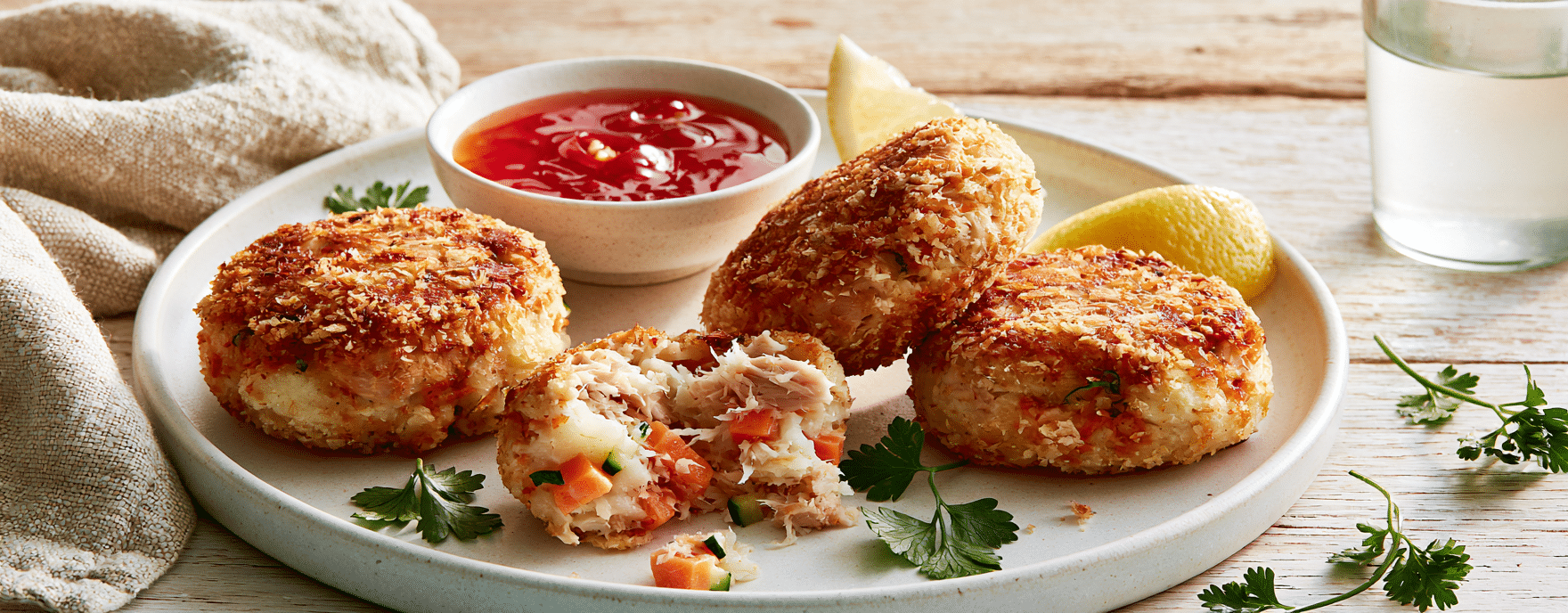
Tuna patties are pan-fried cakes built from canned tuna, mashed potato, grated vegetables, egg, and breadcrumbs — ready in 35 minutes from a mostly stocked pantry. They hold together well, they fill people up, and the ingredient list is cheap enough that this is a genuinely useful weeknight option rather than a novelty.
The technique that matters
The single thing that decides whether these patties hold together or fall apart is moisture control. Mashed potato that is too wet turns the mix into a paste that slides around the pan. Microwave the potatoes without butter or milk, drain them thoroughly, and let the steam escape for a minute before mashing — dry potato absorbs the moisture from the tuna and egg instead of adding to it. The second technique is heat management in the pan. Medium heat with the oil-and-butter combination gives you a golden crust before the inside overcooks; too high and the outside browns before the center sets, too low and the patties absorb oil and go greasy. Once you flip and both sides are golden, finishing in a 165°F (74°C) oven is the reliable way to cook them through without burning the crust.
Shopping notes
- Canned tuna vs. salmon: The recipe card lists both. Tuna in springwater works better here than tuna in oil — oil-packed adds extra moisture that fights the binding. Drain it well either way.
- Chutney: If you don’t keep chutney on hand, mayonnaise is the straightforward swap. A mild mango chutney adds a slight sweetness that works well; a very vinegary chutney can make the mix taste sharp.
- Breadcrumbs: Store-bought plain breadcrumbs are a direct substitute for the blitzed bread and save washing the food processor. Panko works but produces a slightly looser bind — use a little less.
Make-ahead notes
Form the raw patties, place them on a plate lined with baking paper, cover with plastic wrap, and refrigerate for up to 24 hours before cooking — chilling actually firms them up and makes flipping easier. Cooked patties keep in an airtight container in the fridge for 3 days. To freeze, layer raw or cooked patties between sheets of baking paper and freeze for up to 2 months; thaw overnight in the fridge before cooking or reheating. Reheat cooked patties in a dry non-stick pan over medium-low heat for about 3 minutes per side, or in a 350°F (175°C) oven for 10 minutes — the oven method keeps them from going soggy.
What can go wrong
- Patties fall apart when flipping: The mix is too wet or the patties haven’t had enough time to form a crust. Press the patties firmly when shaping, refrigerate for 20 minutes before cooking if time allows, and don’t try to flip until the bottom is visibly golden and releases cleanly from the pan.
- Mix is too sticky to shape: Add a tablespoon of extra breadcrumbs and give it a minute to absorb. Wet hands help with shaping without adding more flour or crumbs.
- Patties taste bland: Canned tuna and plain potato are both mild. Season the mix with salt and pepper before forming — tasting the raw mix is fine here since the egg is fully cooked through later.
- Crust burns before center is cooked: The patties are too thick or the heat is too high. Keep patties to about ¾-inch thick and move them to the oven rather than trying to finish them entirely on the stovetop.
- Vegetables make the mix watery mid-cook: Zucchini releases water as it heats. After processing, squeeze the grated zucchini in a clean cloth or paper towel before adding it to the bowl — skip this step and the extra liquid can break the patty apart in the pan.
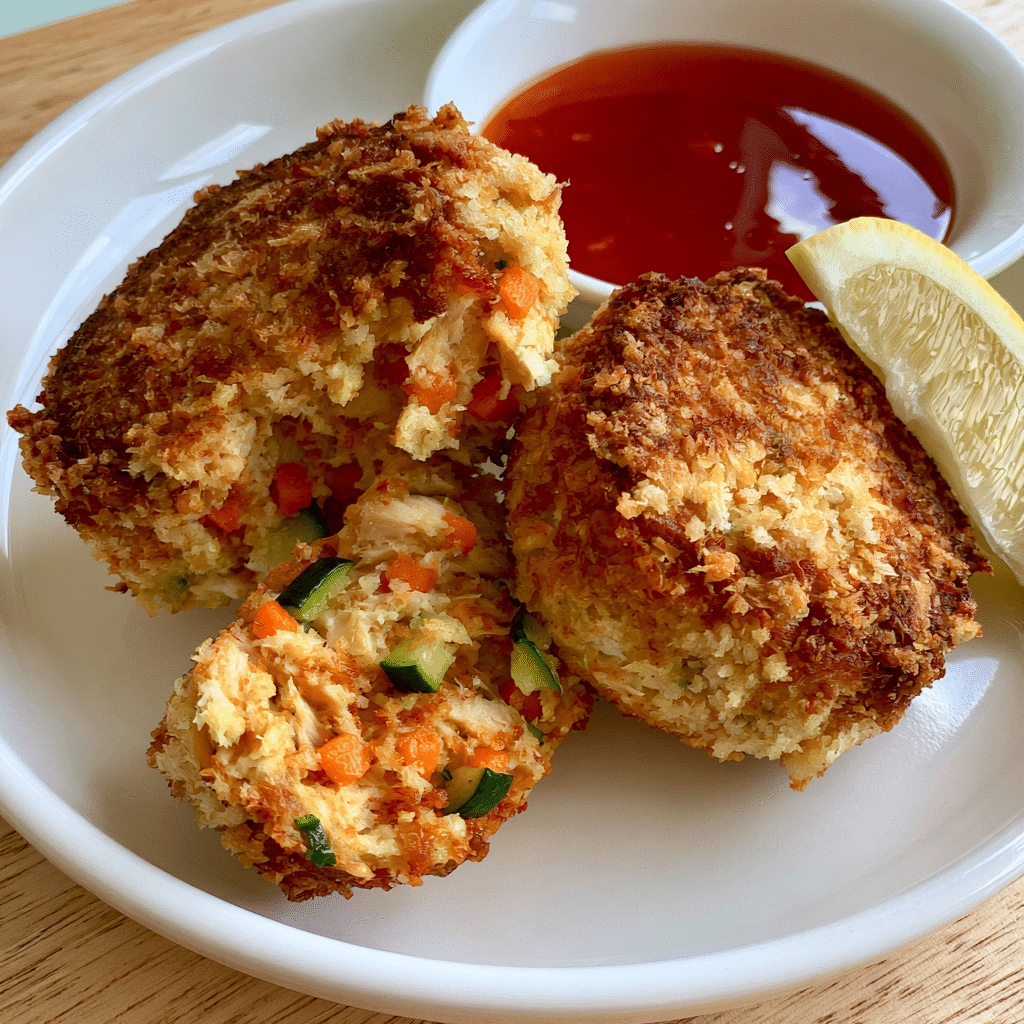
Easy Tuna Patties – Crispy, Budget-Friendly & Kid-Approved

Equipment
- Large microwave-safe dish with lid
- Potato masher or large fork
- Food processor
- Large mixing bowl
- 10-inch non-stick skillet
- Baking tray (for oven finishing)
- Fish spatula or thin flexible spatula
Ingredients
- 3 large potatoes approximately 1.5 lb / 680g, peeled and cut into large cubes
- ½ large carrot approximately 75g / 2.5oz, peeled
- ½ large zucchini approximately 100g / 3.5oz
- 1 small can tuna in springwater 5oz / 140g, drained
- 1 large egg approximately 50g
- 2 tablespoons chutney or mayonnaise 30ml
- 2 slices white bread approximately 60g / 2oz, or 1 cup (60g) fine breadcrumbs
- 1 teaspoon neutral oil vegetable or canola
- 1 teaspoon butter
- ¼ cup water 60ml, for microwaving potatoes
Instructions
- Peel the potatoes and cut into 2-inch (5cm) cubes. Place in a large microwave-safe dish, add ¼ cup (60ml) water, and cover with the lid. Microwave on high for 8 minutes. Check with a fork — if not completely tender, microwave for another 2 minutes.3 large potatoes, 1/4 cup water
- Drain the potatoes thoroughly and let them steam in the colander for 1 minute to release excess moisture. Transfer to a large mixing bowl and mash with a potato masher or fork until smooth. Do not add butter, milk, or seasoning — the mash needs to stay dry so it can absorb the moisture from the tuna and egg.3 large potatoes
- Using a food processor, whizz up the bread into fine breadcrumbs and add to the bowl.2 slices white bread
- Also, whizz up the zucchini and carrot until finely chopped. Add to the bowl.1/2 large carrot, 1/2 large zucchini
- Add the tuna, egg and mayonnaise or chutney to the bowl and mix together until well combined.1 small can tuna in springwater, 1 large egg, 2 tablespoons chutney or mayonnaise
- Divide the mixture into 6 equal portions (about ½ cup / 100g each). Shape each into a patty approximately 3 inches (7.5cm) wide and ¾ inch (2cm) thick. Press firmly so they hold together. If the mixture feels too wet, add an extra tablespoon of breadcrumbs.
- Heat 1 teaspoon of neutral oil and 1 teaspoon of butter in a 10-inch (25cm) non-stick skillet over medium heat. When the butter is foaming but not brown, carefully add 3–4 patties to the pan — do not overcrowd. Cook in batches if needed, adding a little more oil and butter between batches.1 teaspoon neutral oil, 1 teaspoon butter
- Cook for 3–4 minutes on the first side until the bottom is golden brown. Carefully flip with a thin spatula and cook for another 3–4 minutes until both sides are evenly golden.
- Transfer the browned patties to a baking tray and place in a preheated oven at 330°F / 165°C (145°C fan-forced) for 8–10 minutes until the internal temperature reaches 165°F / 74°C and the patties are cooked through.
Notes
Nutrition
Common questions
Can I use fresh tuna instead of canned?
Canned tuna is the right call for this recipe. Fresh tuna has a much lower fat content and different texture — it won’t bind the same way and the patties tend to be dry and crumbly. Save fresh tuna for a different preparation.
Do I have to use the oven step, or can I just pan-fry them all the way through?
You can finish them entirely in the pan if you keep the heat on medium-low and cover the pan loosely with a lid for the last few minutes. The oven step just gives you more control and frees up the stovetop.
What can I serve these on or with to make them a proper burger?
A soft brioche or potato bun works well — the patty is mild so it doesn’t need a sturdy roll. Coleslaw, sliced cucumber, and a smear of mayonnaise or tartare sauce are the most practical toppings.
Can I make these without egg?
The egg is the main binder, so leaving it out makes the patties fragile. A tablespoon of plain Greek yogurt or a flax egg (1 tablespoon ground flaxseed mixed with 3 tablespoons water, rested 5 minutes) are workable substitutes if eggs are off the table.
How do I know when the patties are cooked through?
Because these are made with cooked potato and canned tuna, the main concern is that the egg is fully set — no translucent or wet center when you cut one open. An internal temperature of 160°F (71°C) confirms it; in practice, a golden crust on both sides plus 10 minutes in a 165°F oven gets you there reliably.
What to cook next
- Crispy Fish King Burger
- Hawaiian Teriyaki Burger Recipe
- Korean Rice Bulgogi Burger
- Veggie Sauce Burger Perfection