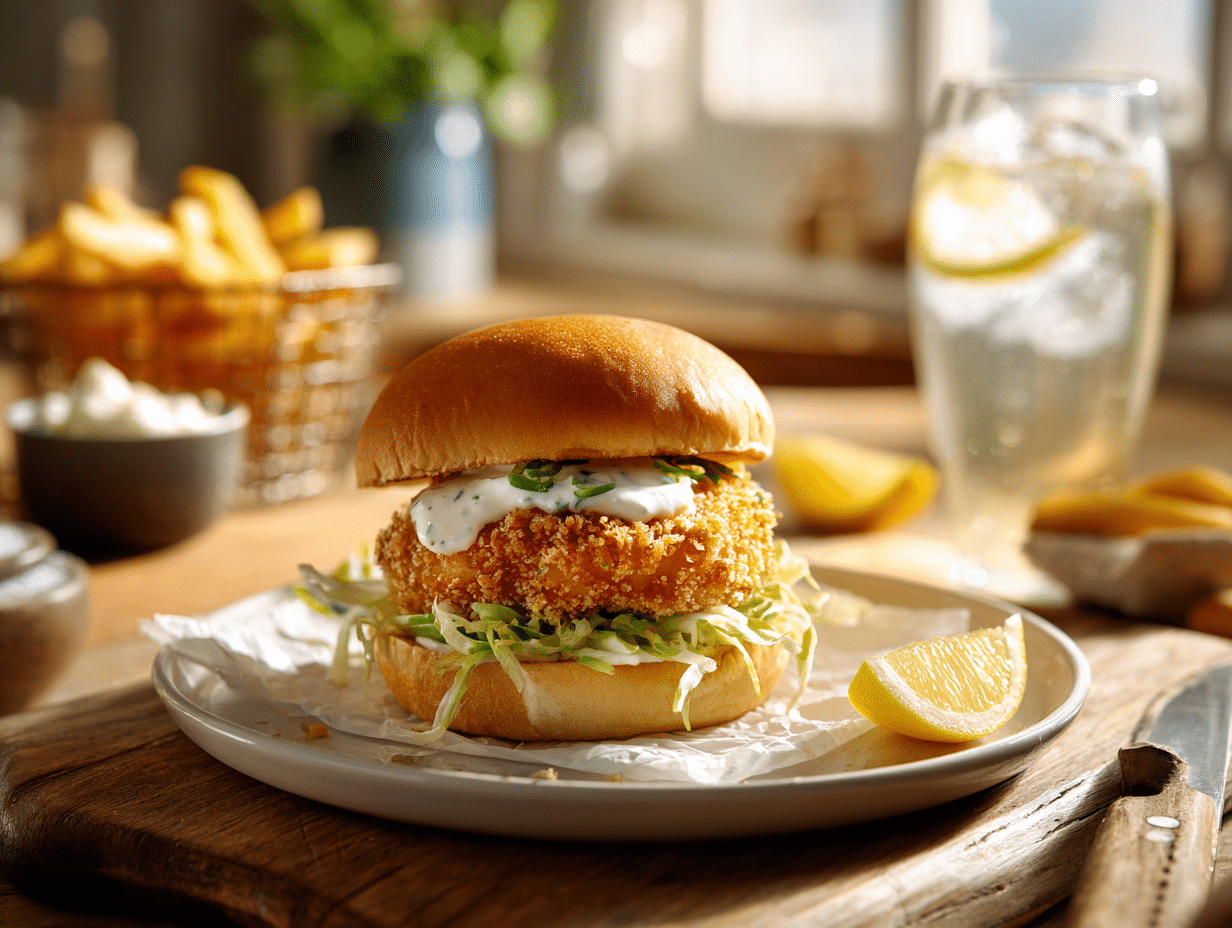
This is a panko-crusted shrimp patty burger inspired by the Lotteria version popular across South Korea — chunky shrimp pieces bound together, fried until genuinely crispy, and served with a bright, tangy tartar-style sauce. It takes about 40 minutes start to finish, and the patties hold up well in the fridge for several days, making it one of the more practical seafood burgers you can add to a weeknight rotation.
What makes this version work
Two things matter most here. First, keeping roughly a third of the shrimp in larger chunks rather than chopping everything fine — that uneven texture is what separates this from a fish stick. Uniform mince turns rubbery and dense once fried. Second, the panko coating needs to go on in a proper dry-wet-dry sequence and the oil needs to be at temperature before the first patty goes in. Panko drains oil better than regular breadcrumbs, which is why the crust stays light instead of turning greasy as it cools — useful when you’re packing these for lunch the next day. Skip the egg in the mix — it makes the patty mushy. The mayonnaise already provides enough moisture and binding.
What can go wrong
- Patties fall apart in the oil: The mix was too warm when you shaped them. Refrigerate the shaped patties for at least 20 minutes before frying — cold fat in the mix firms everything up and the patty holds its shape under heat.
- Coating slides off: You skipped the resting step after breading. Let breaded patties sit on a rack for 5 minutes before they hit the oil so the panko adheres properly.
- Shrimp overcooks and turns rubbery: The oil wasn’t hot enough, so the patty spent too long in the pan. Use a thermometer — 350°F (175°C) is the target. At that temperature the crust sets fast and the shrimp inside finishes gently.
- Patties stored overnight turn soggy: Don’t stack them in a container. Layer them between sheets of parchment and store the sauce separately. Reheat on a wire rack in a 375°F (190°C) oven for 8 minutes rather than microwaving.
- Sauce is flat and heavy: Kewpie mayo is noticeably different from standard American mayo — it’s richer and slightly sweeter. If you substitute regular mayo, add a small splash of rice vinegar and a pinch of sugar to get closer to the right balance.
Shopping notes
- Kewpie mayonnaise: Available at most Asian grocery stores and increasingly at mainstream supermarkets. It comes in a soft squeeze bottle. Don’t substitute regular mayo 1:1 without adjusting — see the fix above.
- Panko breadcrumbs: Use Japanese-style panko, not Italian-seasoned breadcrumbs. The coarser flake is what creates the open, crispy crust. Store the open bag in a zip-lock — panko absorbs humidity quickly and stale panko fries up flat.
- Shrimp size: Medium shrimp (41–50 count per pound) work better than large for this patty — they chop into the right range of chunk sizes without needing much knife work. Frozen is fine; thaw completely and pat very dry before chopping or the mix will be waterlogged.
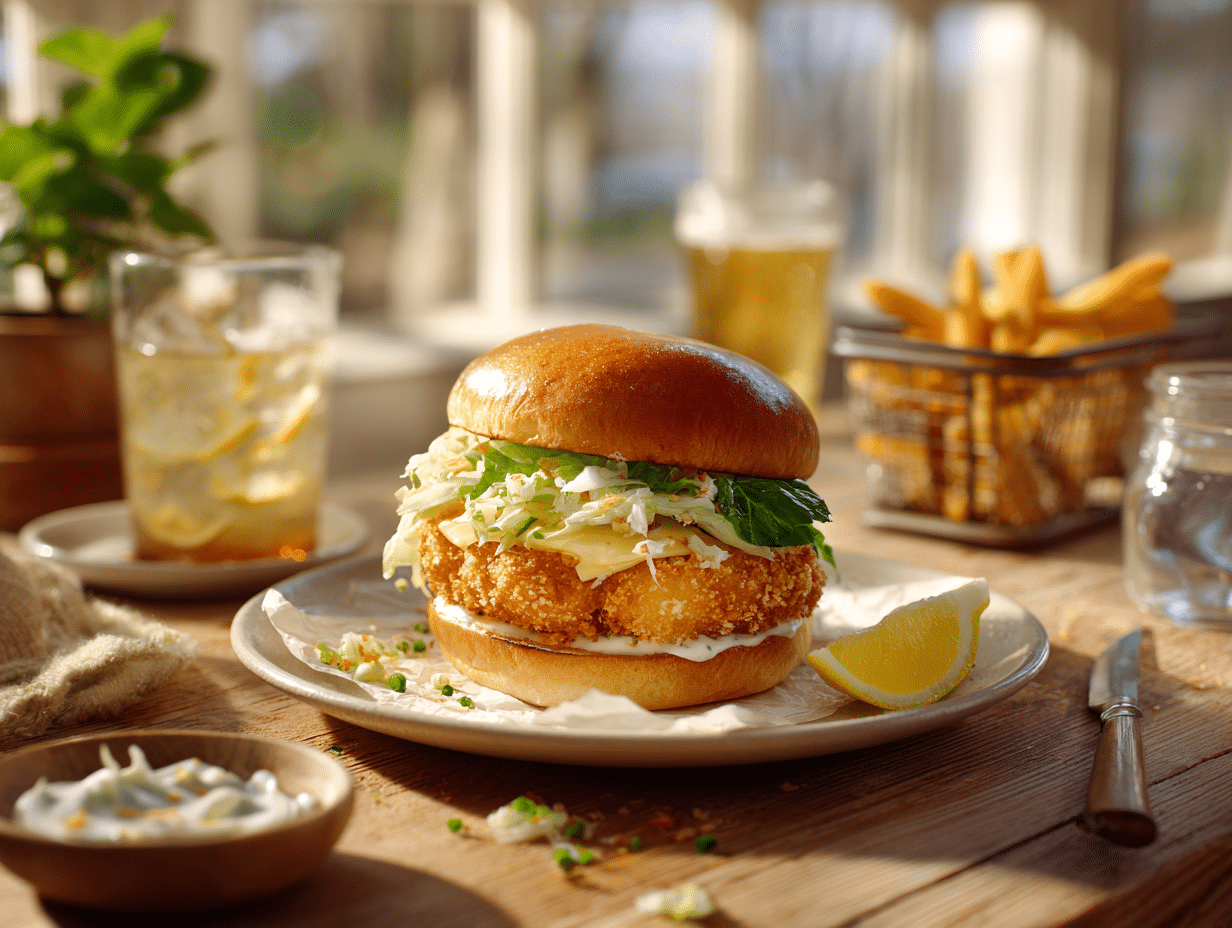
Lotteria-Style Shrimp Burger

Ingredients
For the Tartar–Citrus Sauce:
- ½ cup Kewpie mayonnaise Japanese-style mayo adds depth and umami; use Kewpie brand for authenticity
- 2 tbsp dill pickles, finely chopped choose crisp, high-quality pickles
- 1 tbsp capers, rinsed and chopped nonpareil capers preferred
- 2 tbsp shallot, minced or sweet onion, very finely minced
- 1 tsp lemon zest, finely grated from a fresh, unwaxed lemon
- 1 tbsp fresh lemon juice adjust to taste for brightness
- 1 tsp rice vinegar unseasoned; adds gentle acidity
- 1 tsp granulated sugar balances acidity
- ¼ tsp kosher salt use Diamond Crystal; halve if using Morton
For the Optional Quick Pickled Cabbage:
- 2 cups green cabbage, very thinly shredded ice-cold, crisp leaves give best texture
- ½ tsp kosher salt for quick curing; Diamond Crystal preferred
- 1 tbsp rice vinegar unseasoned
- 1 tsp granulated sugar
- 1 tsp toasted sesame seeds optional garnish for pickles
For the Shrimp Patties:
- 1 lb raw shrimp, peeled and deveined large or medium; pat very dry for best binding
- 1 large egg room temperature helps emulsify
- 2 tbsp Kewpie mayonnaise adds juiciness to the patty
- 1 tbsp Dijon mustard for a gentle bite; Korean yellow mustard also works
- 1 tbsp soy sauce naturally brewed
- 1 tsp granulated sugar rounds the savoriness
- 1 tsp kosher salt Diamond Crystal; reduce to 1/2–3/4 tsp if using Morton
- ½ tsp white pepper classic Korean-style seasoning; black pepper works in a pinch
- 2 cloves garlic, finely minced microplane for a smoother mix
- 1 tsp fresh ginger, finely grated brightens seafood flavors
- 2 tbsp scallions, finely sliced green parts preferred for freshness
- 1 tbsp cornstarch for tender binding without toughness
- ¼ cup panko breadcrumbs Japanese-style; keeps the patty juicy
- 1 tsp toasted sesame oil a few drops add a Korean accent—don’t overdo it
For the Crispy Breading & Frying:
- ½ cup all-purpose flour for initial dredge
- ½ tsp paprika adds gentle color to the crust
- 2 large eggs, beaten with 1 tbsp water lightly beaten for an even coating
- 1 ½ cups panko breadcrumbs coarse panko for maximum crunch
- 4 cups neutral frying oil canola, rice bran, or peanut oil; enough for 1 1/2 inches depth
For the Buns & Assembly:
- 4 whole soft milk buns or brioche burger buns light, fluffy buns mimic the fast-food classic
- 2 tbsp unsalted butter, softened for toasting buns
- 8 leaves crisp iceberg or romaine lettuce well-dried leaves keep the bun from sogging
- 4 slices tomato optional; choose firm, ripe slices
- 4 slices American cheese optional; for a melty fast-food vibe
Instructions
- Make the Tartar–Citrus Sauce (10 minutes): In a small bowl, whisk together Kewpie mayonnaise, chopped pickles, capers, shallot, lemon zest, lemon juice, rice vinegar, sugar, and salt until creamy. Taste for balance—look for a bright, lightly tangy aroma with a savory backbone. Cover and chill.
- Optional Quick Pickled Cabbage (10 minutes): Toss shredded cabbage with kosher salt and let sit 5 minutes to weep. Rinse quickly, squeeze dry, then toss with rice vinegar, sugar, and sesame seeds. The leaves should look glossy and smell fresh and lightly vinegared. Set aside.
- Prep the Shrimp (12 minutes): Pat the shrimp very dry. Hand-chop about 70% of the shrimp into a coarse mince (rice-grain sized pieces) and the remaining 30% into larger chunks (pea-sized) for a bouncy texture. If you don’t want to hand-chop, pulse half the shrimp in a food processor 3–4 times, then roughly chop the rest by hand to avoid a pastey texture.
- Mix and Chill the Patty Base (20 minutes, mostly inactive): In a mixing bowl, whisk egg, Kewpie mayo, Dijon, soy sauce, sugar, salt, white pepper, garlic, ginger, scallions, cornstarch, and panko. Fold in the chopped shrimp until evenly coated. Form 4 equal patties about 3 1/2–4 inches wide and 3/4 inch thick; they should feel slightly tacky but hold together. Place on a parchment-lined tray, cover, and chill 20 minutes to firm. The mixture will look glossier and more cohesive after chilling.
- Set Up Breading and Coat (5 minutes): In one shallow dish, combine flour and paprika. In a second, beat eggs with 1 tbsp water. In a third, add panko. Working gently, dredge each patty in flour (shake off extra), dip in egg, then press into panko, ensuring full coverage. The surface should look evenly snowed with panko for maximum crunch.
- Fry the Patties (about 12 minutes total): Pour oil to 1 1/2 inches depth in a heavy skillet or pot and heat to 350°F (175°C). Fry patties in batches, 3–4 minutes per side (6–8 minutes total), until deep golden and the center reaches 145°F (63°C). Listen for a steady, lively sizzle—not aggressive splattering. Drain on a rack; sprinkle a pinch of salt while hot.
- Toast the Buns (3 minutes): Split buns, spread the cut sides lightly with butter, and toast cut-side down in a skillet over medium heat until golden at the edges, about 2–3 minutes. They should smell buttery and feel crisp but springy.
- Assemble and Serve (5 minutes): Spread tartar sauce on both bun halves. Layer lettuce on the bottom bun, add the hot shrimp patty (top with cheese now if using so it softens), spoon on a little more sauce, then add pickled cabbage or tomato if desired. Crown with the top bun and serve immediately while the crust is audibly crisp.
Notes
Chef’s Tips:
- Texture is King: Keep some shrimp in larger chunks for a bouncy, Lotteria-style bite. Avoid over-processing.
- Crispier Crust: After breading, rest patties 5–10 minutes or refrigerate briefly so the panko adheres better.
- Oil Temperature: Fry at 350°F (175°C). Too cool and patties absorb oil; too hot and the crust over-browns before the center cooks.
- Bake or Air-Fry: For a lighter version, spray patties with oil and bake at 425°F (220°C) on a rack for 12–15 minutes, or air-fry at 390°F (200°C) for 8–10 minutes, flipping once—still aim for 145°F (63°C) internal.
- Allergy/Diet Swaps: Use gluten-free panko and flour for GF; replace mayo with vegan mayo and use a plant-based egg substitute for a pescatarian-friendly tweak.
- Flavor Twists: Add 1–2 tsp gochujang to the tartar for a gentle heat, or a few drops of yuzu juice for a bright citrus lift.
Nutrition
Your questions, answered
Can I make the shrimp patties ahead of time and freeze them?
Yes — freeze them after breading, before frying. Arrange shaped and breaded patties on a parchment-lined tray, freeze until solid (about 2 hours), then transfer to a zip-lock bag. Fry straight from frozen at 325°F (163°C) for an extra 2–3 minutes to make sure the center reaches a safe 145°F (63°C) for shrimp.
How do I know when the shrimp patty is fully cooked?
The safest check is a instant-read thermometer — shrimp patties should reach 145°F (63°C) at the center. Visually, the interior should be opaque throughout with no translucent grey patches when you cut one open to check.
Can I air-fry these instead of deep-frying?
Air-frying works, though the crust won’t be quite as even. Spray the breaded patties generously with oil, cook at 390°F (200°C) for 10–12 minutes, flipping once halfway through. Make sure internal temperature hits 145°F (63°C).
What’s the best way to reheat leftover patties without wrecking the crust?
A wire rack set over a baking sheet in a 375°F (190°C) oven for 8 minutes is the most reliable method. The rack lets hot air circulate underneath so the bottom doesn’t steam and go soft the way it does in a microwave.
Can I use pre-cooked shrimp to save time?
It’s not recommended — pre-cooked shrimp will overcook during frying and turn tough and dry. Raw shrimp cook through quickly in the hot oil and stay tender, which is the whole point of the patty’s texture.
Try these next
- Korean Fried Chicken Burger
- Korean Rice Bulgogi Burger
- Crispy Fish King Burger
- Hawaiian Teriyaki Burger Recipe