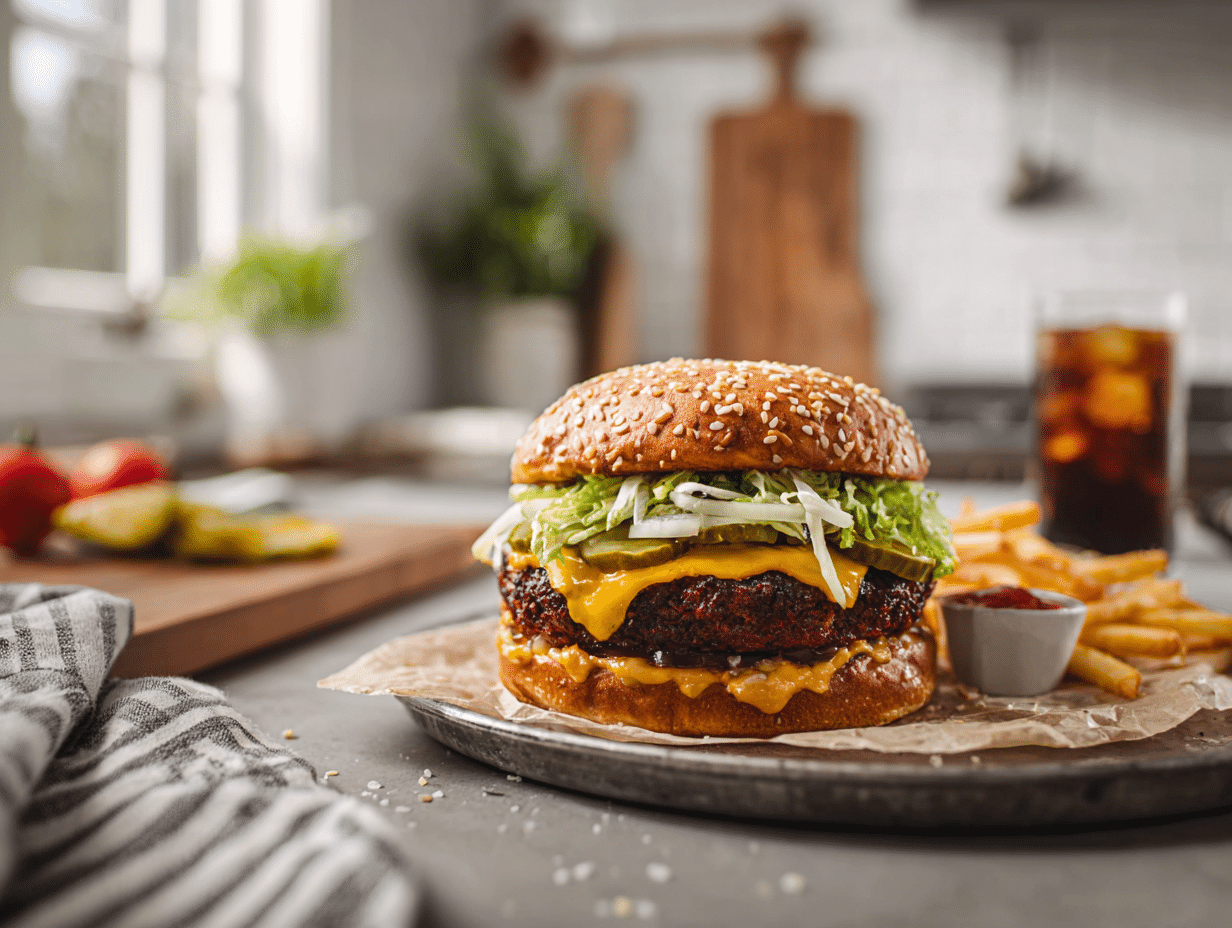
This is a homemade take on McDonald’s McPlant — a Beyond Meat patty dressed with vegan cheese, shredded lettuce, pickles, onions, and a smoky special sauce on a sesame bun. If the McPlant isn’t available at your local McDonald’s right now, this recipe gets you there at home with better control over every component. It also scales up cleanly, so making four is barely more work than making one.
What makes this version work
Two things actually move the needle here. First, keeping the Beyond Meat patties cold right up until they hit the pan. Plant-based patties are more fragile than beef — warm them up before cooking and they lose structure, turn soft in the middle, and won’t hold a proper sear. Pull them from the fridge and go straight to a hot griddle at 400°F. Second, the sauce needs to rest for 10 minutes before you use it. The smoked paprika and other dry ingredients bloom into the mayo base during that time, and the flavor difference between a freshly mixed sauce and a rested one is noticeable. Skip the urge to make the sauce while the patties cook — mix it first, set it aside, then start the heat.
Make-ahead notes
The sauce keeps well in a sealed jar in the fridge for up to five days, so make a double batch on Sunday and you’re set for the week. Raw Beyond Meat patties can be stacked with parchment between them and refrigerated for up to three days, or frozen for up to a month — thaw overnight in the fridge before cooking, not on the counter. Cooked patties reheat best in a dry skillet over medium heat for about two minutes per side; the microwave works in a pinch but softens the crust. Prepping the lettuce and slicing the onions ahead and storing them separately in the fridge means assembly on a weeknight takes under five minutes once the patty is hot.
Mistakes to avoid
- Using a cold pan: A pan that isn’t fully preheated gives you a steamed, grey patty instead of a seared one. Let the griddle or skillet get hot before the patty touches it — a drop of water should evaporate on contact.
- Pressing the patty while it cooks: It’s tempting, but pressing squeezes out moisture and fat, which are doing the work of mimicking a beef burger. Leave it alone after it goes down.
- Adding cheese too late: Vegan cheese needs more time to melt than dairy cheese. Place it on the patty in the last 60–90 seconds of cooking and cover the pan with a lid or foil tent to trap heat.
- Overloading the bun before it’s toasted: A soft sesame bun goes soggy fast under wet toppings. Toast the cut sides in the same pan after the patty comes off — 30 to 45 seconds is enough to create a barrier that holds up through the meal.
- Cutting the patties to check doneness: Beyond Meat patties are safe to eat once they reach 165°F internal temperature; use an instant-read thermometer rather than slicing, which breaks the crust and lets steam escape.
McDonalds McPlant Burger (Chef-Style, Homemade)

Ingredients
Burger Sauce (Vegan)
- ¼ cup vegan mayonnaise Choose a neutral, creamy brand for best texture
- 1 tbsp ketchup Classic American style
- 1 tsp yellow mustard Bright, tangy counterpoint
- 1 tbsp sweet pickle relish Fine-chopped for a smooth sauce
- ½ tsp white wine vinegar For brightness; distilled white works too
- ¼ tsp onion powder Rounds out the sauce
- ⅛ tsp smoked paprika A whisper of smokiness
- 1 pinch kosher salt To taste
- 1 pinch granulated sugar Balances acidity
Patties & Cheese
- 2 patties Beyond Meat plant-based burger patties 4 oz each; keep chilled until cooking
- ½ tsp kosher salt For seasoning patties
- ¼ tsp freshly ground black pepper To taste
- 1 tbsp neutral oil Canola or grapeseed for high heat searing
- 2 slices vegan American-style cheese Good melt brands: Violife or Follow Your Heart
Assembly & Toppings
- 2 buns sesame seed burger buns (vegan) Soft, classic fast-food style
- 1 tbsp vegan butter For toasting buns
- 1 cup iceberg lettuce, finely shredded Shred extra-fine for classic bite
- 2 tbsp white onion, finely chopped Rinse or soak to mellow, if desired
- 8 slices dill pickle chips Thin cut for even layering
- 2 slices ripe tomato About 1/4-inch thick
- 2 tsp yellow mustard 1 tsp per burger
- 2 tsp ketchup 1 tsp per burger
Instructions
- Make the sauce (10 minutes rest): In a small bowl, whisk together vegan mayo, ketchup, yellow mustard, sweet relish, white wine vinegar, onion powder, smoked paprika, a pinch of salt, and a pinch of sugar until smooth. Cover and let it sit for 10 minutes so the flavors bloom.
- Prep the produce (5–7 minutes): Finely shred the iceberg (think confetti-fine), finely chop the white onion, and slice the tomato into two neat 1/4-inch rounds. If you prefer a milder onion, soak the chopped onion in ice water for 5 minutes, then drain and pat dry.
- Toast the buns (3–4 minutes): Preheat a cast-iron skillet or griddle over medium heat—surface temp about 350°F/175°C. Lightly butter the cut sides of the sesame buns with vegan butter and toast cut-side down until golden at the edges and fragrant. Set aside, keeping warm.
- Preheat for patties: Raise heat to medium-high; the griddle should read about 400°F/205°C. Lightly oil the surface with neutral oil. Season the chilled patties on both sides with kosher salt and black pepper. Tip: Chilled patties sear better and develop a flavorful crust.
- Sear and melt (5–6 minutes): Place patties on the hot griddle. Sear the first side 2–3 minutes until deeply browned with crisp, lacy edges and a savory aroma. Flip, top each with a slice of vegan American-style cheese, and cover with a lid or metal bowl to trap steam. Cook another 2–3 minutes until the cheese is melty and the patty is heated through (target 160°F/71°C per many manufacturer guidelines). Remove from heat and rest 1 minute.
- Assemble (2–3 minutes): Spread 1–1 1/2 tablespoons of sauce across the top bun. On the bottom bun, add 1 teaspoon yellow mustard and 1 teaspoon ketchup, then layer pickles and half the chopped onion. Add the cheesy patty, top with a tomato slice and a generous tuft of shredded iceberg. Cap with the sauced top bun and press gently to set.
- Serve: Present immediately while the bun is warm and the cheese is soft. You should see gleaming sauce, crisp lettuce edges, and steam rising as you lift the top bun—classic fast-food theater, chef-quality execution.
- Alternative cooking methods: Air fryer at 400°F/205°C for 7–8 minutes, flipping halfway; or outdoor grill at 450–500°F/230–260°C for 3–4 minutes per side. Always aim for a deep brown crust and a hot center.
Notes
Chef’s Tips
- Melt insurance: For ultra-melty vegan cheese, add a teaspoon of water to the pan before covering; the steam accelerates melting without overcooking the patty.
- Shred like the pros: Use the fine side of a box grater for iceberg to achieve that airy, fast-food texture.
- Sauce balance: Taste your relish; if it’s very sweet, reduce sugar to a tiny pinch. If your sauce needs more pop, add 1–2 drops of vinegar.
- Gluten-free: Use gluten-free sesame buns; ensure patties and condiments are certified GF.
- Soy-free: Choose soy-free mayo and cheese if needed.
- Heat tweak: A dash of hot sauce or minced pickled jalapeño in the sauce adds a gentle kick.
Serving Suggestions
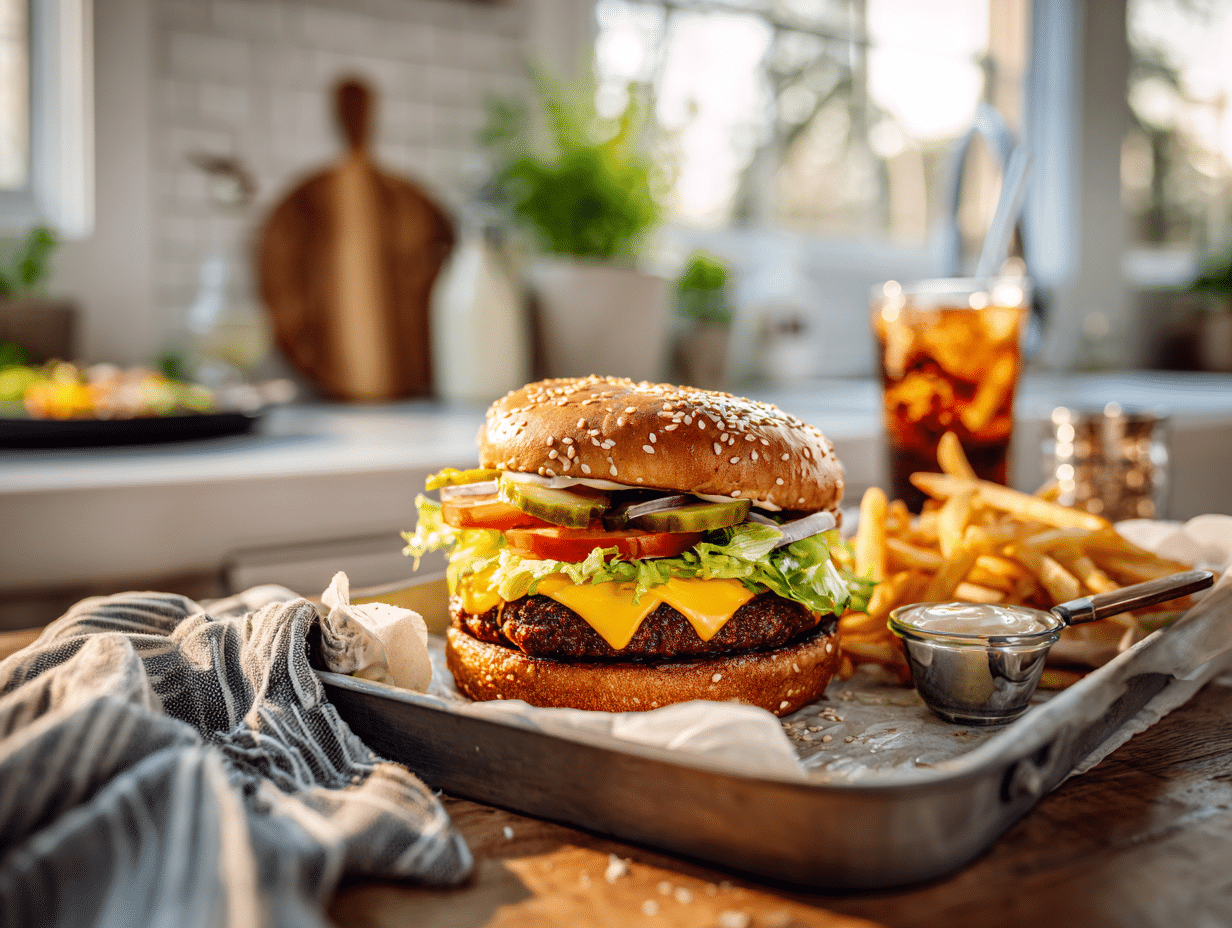
Plate the burger on a small metal tray or matte plate lined with parchment for a fast-casual look. Pair with shoestring fries or sweet potato fries, and a cold cola or a malted vanilla oat-milk shake. Visual cues of perfection: a glossy, sesame-studded bun; emerald-fresh lettuce; ruby ketchup ribbons; and a melted, golden cheese veil.Culinary Context
The McPlant marked McDonald’s foray into mainstream plant-based dining, developed with Beyond Meat in select markets. This chef’s version celebrates that shift by emphasizing technique—proper griddle heat, fine shredding, and a balanced sauce—to capture the nostalgic fast-food flavor profile in a plant-forward format. Not affiliated with McDonald’s—just a delicious homage.Optional Advanced Instructions
- Make-ahead: Sauce can be made up to 3 days ahead and refrigerated; flavors improve overnight.
- Parallel prep: While the sauce rests, shred lettuce, chop onions, and slice tomato to streamline timing.
- Batch service: Keep toasted buns in a 200°F/95°C oven for up to 10 minutes; cook patties to order for best texture.
- No cast iron? A heavy stainless skillet works; preheat longer to ensure even browning.
Timing
- Prep Time: 20 minutes (0 hours 20 minutes) including sauce rest and produce prep.
- Cook Time: 10 minutes (0 hours 10 minutes) for buns and patties, as outlined.
- Total Time: 30 minutes (0 hours 30 minutes).
Nutrition
Your questions, answered
Can I use a different brand of plant-based patty instead of Beyond Meat?
Yes, but results will vary. Beyond Meat is specifically engineered to sear and brown similarly to beef, so it’s the closest match for this recipe. Other patties like Impossible Burger also work well; brands with a higher water content or a bean-heavy base tend to steam rather than sear and won’t give you the same crust.
How do I know when the Beyond Meat patty is actually done?
Cook it to an internal temperature of 165°F (74°C) — the same target as poultry. Beyond Meat’s packaging also recommends this temperature, and unlike beef, there’s no safe option for serving it undercooked or pink in the center.
Can I cook these patties from frozen if I forgot to thaw them?
You can, but lower the heat slightly and add about two extra minutes per side to ensure the center reaches 165°F. Cooking from frozen at full high heat risks a burnt exterior and a cold middle, so use a thermometer rather than relying on color or time alone.
More burger recipes to try
- Beyond Western Bacon Cheeseburger
- Beyond Famous Star Copycat
- Veggie Whopper Copycat Recipe
- Five Guys Veggie Sandwich Style