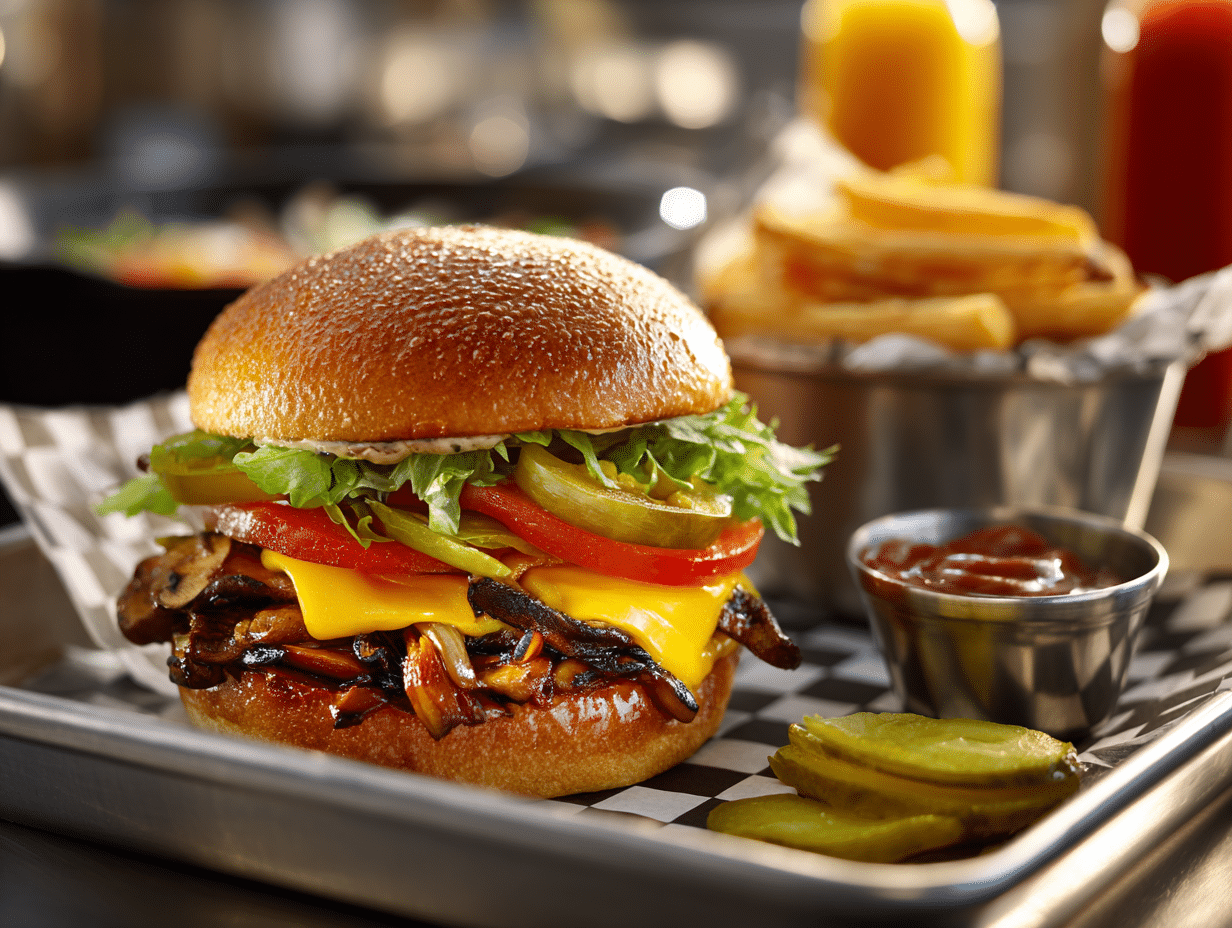
This is a griddle-cooked vegetable sandwich built the same way Five Guys builds their burgers — high heat, a buttered bun, and a smoky diner-style sauce. There’s no meat substitute here, just mushrooms, onions, and peppers cooked until they actually taste good. It’s a genuinely satisfying option that holds up well when you make a big batch at the start of the week.
Before you start
The one thing that separates a good veggie sandwich from a soggy mess is moisture management. Mushrooms and peppers release a lot of water when they hit a hot pan, so you need real heat — a cast-iron skillet or a heavy stainless pan works better than nonstick here because it holds temperature when the vegetables go in. Don’t crowd the pan; cook in batches if needed so the vegetables sear rather than steam. The second thing that matters is the bun toast. Butter the cut sides and press them flat on the dry skillet for about 60 seconds until golden — that crust is what keeps the sauce from soaking straight through, especially if you’re packing these for later in the week.
Mistakes to avoid
- Skipping the dry pan for the bun: Toast the bun on a dry skillet, not under a broiler. A broiler dries the bun out unevenly and you lose the slight chew you want.
- Adding cheese too early: Lay the cheese over the hot vegetables in the pan and cover with a lid for 30 seconds to melt it. Adding it during assembly means it never fully melts and slides off with the first bite.
- Using pre-sliced mushrooms: Pre-sliced mushrooms have more surface moisture and brown unevenly. Slice them yourself about a quarter-inch thick so they hold their shape on the griddle.
- Dressing the bun too far ahead: If you’re prepping these for the week, store the sauce separately and spread it at assembly time. Sauce sitting on the bun overnight turns it gummy even with a toasted crust.
- Under-seasoning the vegetables: Season the vegetables in the pan, not just at the end. A pinch of salt when the mushrooms go in draws out moisture faster and helps them brown rather than stew.
Ingredient notes
- Cremini mushrooms: These are the right call — they have less water than white button mushrooms and a firmer texture that survives reheating without turning to mush. Portobello caps work too; just slice them thick.
- Smoked paprika in the sauce: Regular paprika won’t give you the same depth. If you only have hot smoked paprika, use half the amount and taste as you go.
- Potato buns: Skip the egg in the mix — it makes the patty mushy. For the bun, a standard sesame potato bun is the right texture; brioche is too rich and falls apart with wet vegetables. Martin’s brand is widely available and holds up well.
- Jalapeños: Fresh jalapeños give a cleaner heat than pickled here because they go on the griddle. If you only have pickled, add them cold at assembly instead of cooking them.
Storage and reheating
Cook a full batch of the vegetables and store them in an airtight container in the fridge for up to four days. Keep the sauce in a separate small container — it stays fresh for five days refrigerated. Toasted buns don’t store well, so toast fresh at assembly. To reheat the vegetables, a dry skillet over medium heat for two to three minutes gets them back to the right texture; the microwave works in a pinch but makes the mushrooms rubbery. The assembled sandwich doesn’t freeze well because of the vegetable moisture, but the cooked vegetable mix on its own freezes fine for up to six weeks — portion it into sandwich-sized amounts before freezing so you can pull out exactly what you need.
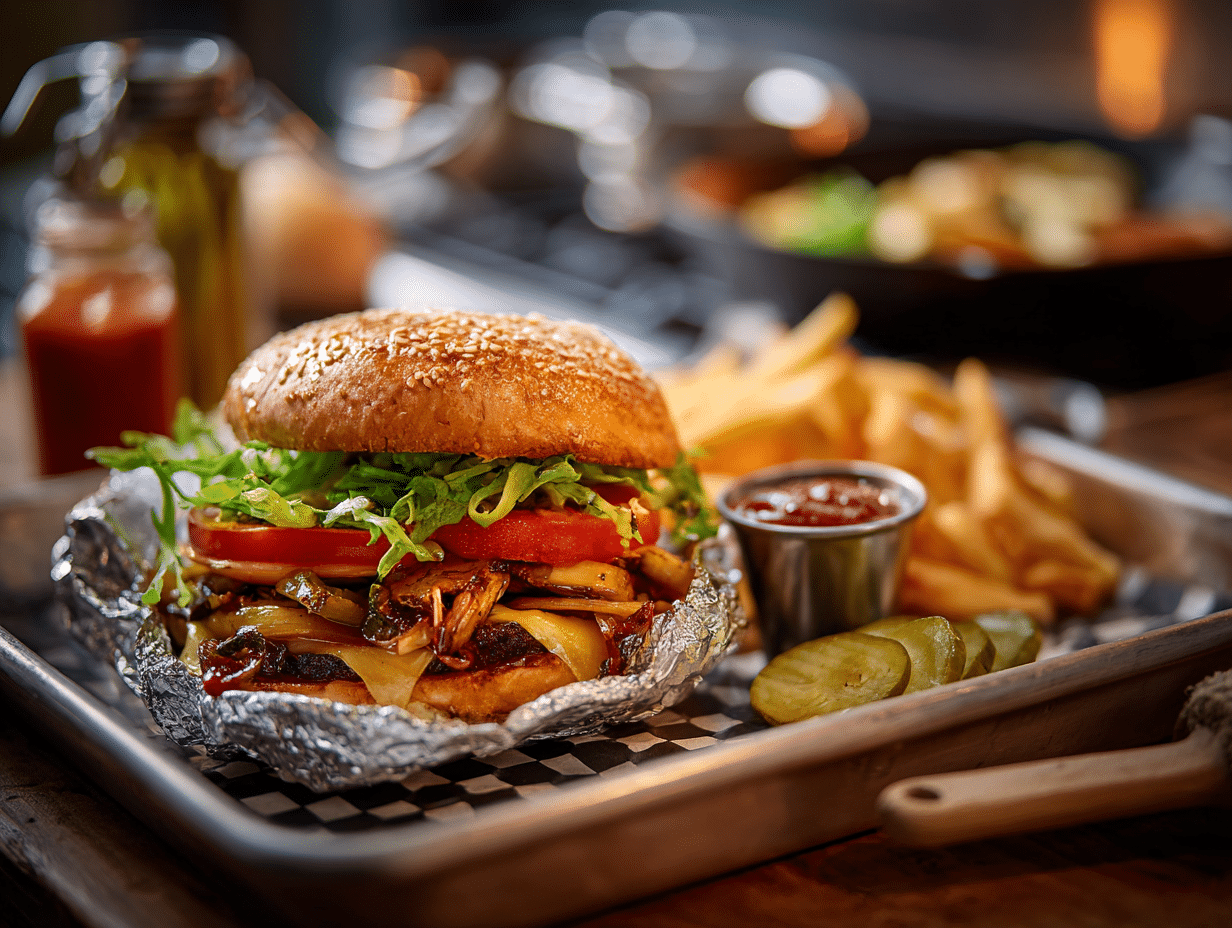
Five Guys Veggie Sandwich Burger Style

Ingredients
Mushroom Marinade & Veg Prep
- 1 tbsp low-sodium soy sauce Look for naturally brewed for cleaner flavor
- 1 tsp vegetarian Worcestershire sauce Ensure anchovy-free if vegetarian
- 1 tsp balsamic vinegar Adds subtle sweetness and depth
- ½ tsp smoked paprika Spanish-style for gentle smokiness
- ¼ tsp garlic powder Fine grind for even dispersion
- 8 oz cremini mushrooms, stemmed and sliced 1/4-inch Choose firm, dry caps for best sear
- 1 medium yellow onion, thinly sliced About 8 oz; sweet onions work well too
- 1 large green bell pepper, thinly sliced About 6 oz; red pepper adds sweetness if preferred
- 1 small jalapeño, thinly sliced (optional) For heat; remove seeds for milder flavor
Smoky-Diner Sauce
- 2 tbsp mayonnaise Full-fat for best body; Duke’s or Hellmann’s preferred
- 1 tbsp ketchup Thick brands cling better to the bun
- 2 tsp yellow mustard Classic diner tang
- 1 tbsp sweet relish (optional) For subtle crunch and sweetness
- ¼ tsp smoked paprika Echoes the grilled flavor in the sauce
Griddle & Assembly
- 2 tbsp neutral oil (canola or peanut), divided High smoke point for flat-top sear
- 2 tbsp unsalted butter For glossy, golden buns
- 2 buns sesame-seed hamburger buns, potato-style Soft, plush buns mimic the fast-casual texture
- 2 slices American cheese (optional) Ultra-melty, classic diner vibe; use cheddar for sharper flavor
- 1 cup shredded romaine lettuce Crisp, dry leaves for best texture
- 4 slices ripe tomato Vine-ripe for juiciness; blot excess moisture with a paper towel
- 8 slices dill pickles, sandwich cut Look for crinkle-cut for classic crunch
- ¾ tsp kosher salt Diamond Crystal preferred; adjust to taste
- ½ tsp freshly ground black pepper Medium grind for gentle bite
Instructions
- Preheat the griddle or skillet (2 minutes): Set a flat-top, large cast-iron skillet, or two skillets over medium-high heat to about 400°F (205°C). You want a quick, sizzling sear without scorching.
- Make the umami mushroom marinade (3 minutes): In a medium bowl, whisk together soy sauce, vegetarian Worcestershire, balsamic vinegar, smoked paprika, and garlic powder. Add sliced mushrooms and toss to coat. Let sit while you prep the veggies—5 to 10 minutes is enough to season and boost browning.
- Prep the vegetables (8 minutes): Thinly slice onion, bell pepper, and jalapeño (if using). Shred romaine, slice tomato, and set out pickles. Keep tomato slices on a paper towel to wick away excess moisture, preserving bun integrity.
- Mix the Smoky-Diner Sauce (3 minutes): In a small bowl, stir together mayonnaise, ketchup, yellow mustard, sweet relish (optional), and smoked paprika until smooth. Taste and adjust salt or mustard for balance. Refrigerate while cooking.
- Griddle onions and peppers (8–10 minutes): Lightly oil the hot surface with 1 tbsp neutral oil. Add onions and peppers with a big pinch of kosher salt. Cook, stirring occasionally, until translucent with browned edges and a sweet, griddled aroma. Add jalapeño in the last 2 minutes for a touch of heat. Sensory cue: the veggies should soften, glisten, and develop caramelized spots without going limp.
- Sear the mushrooms (6–8 minutes): Push onions/peppers to one side. Add remaining 1 tbsp oil and the marinated mushrooms to the open space in a single layer. Let them sizzle undisturbed for 2 minutes to brown, then toss. When most of the liquid cooks off and the mushrooms are glossy with deep edges, scrape any leftover marinade onto the pan to deglaze and coat. Combine mushrooms with onions/peppers and season with black pepper to taste.
- Toast the buns and melt cheese (2 minutes): Split buns and lightly butter the cut sides. Toast cut-side down until blotchy golden—about 60–90 seconds—on the griddle at 375–400°F (190–205°C). For a classic diner melt, place cheese on the hot veggie pile and cover with an inverted metal bowl or lid for 30–45 seconds until just melted.
- Assemble burger-style (2 minutes): Spread Smoky-Diner Sauce on bottom buns. Layer lettuce, then tomato. Mound the hot griddled veggies (and melted cheese if using) over the tomato. Top with pickle slices and a few jalapeños. If desired, add a light squiggle of ketchup and mustard for that burger-joint signature. Cap with the top bun smeared with a little extra sauce.
- Optional foil wrap (1–2 minutes): For the authentic fast-casual experience, wrap each sandwich snugly in foil and rest 1–2 minutes. The trapped steam melds flavors and softens the bun just slightly—exactly like a fresh hand-off at the counter.
Notes
Chef’s Tips
- Max sear, minimal stir: Let veggies sit for 60–90 seconds between tosses to build color and flavor.
- Boosted umami: Add 1 tsp tomato paste to the mushrooms during the last minute and sizzle briefly for a richer, burger-like depth.
- Dairy-free: Skip cheese or use a plant-based American-style slice that melts well.
- Gluten-free: Use gluten-free buns and tamari in place of soy sauce.
- Oil choice: Peanut oil gives the most authentic fast-casual aroma; canola is a fine neutral alternative.
- Faster caramelization: A small pinch of sugar on the onions early on accelerates browning without making them sweet.
- No griddle? Use two large skillets to avoid crowding, or roast the mushrooms and peppers on a sheet pan at 450°F (232°C) for 12–15 minutes, stirring once.
Serving Suggestions
Plate the wrapped sandwich on a small tray or board, then unpeel the foil halfway for a casual, street-food reveal. Garnish the plate with extra pickle chips and a ramekin of Smoky-Diner Sauce. Pair with skin-on fries or a crisp vinegar slaw, and pour a cold cola, root beer, or a hoppy non-alcoholic IPA for contrast. Visual cues of perfection: glossy, golden buns; melted cheese that lightly drapes the veggie stack; steam rising when you unwrap; and the sweet-savory aroma of onions and peppers off the flat-top.Culinary Context
This sandwich nods to the American fast-casual tradition—hand-smashed patties, hot griddles, and plenty of customization—while championing vegetables as the star. The technique is pure diner: high heat, quick edges of char, and a soft bun to cradle the fillings. I fell for this combo after a late service, when the craveable perfume of onions and peppers on the griddle made me skip the patty entirely—and I never looked back.Optional Advanced Instructions
- Make-ahead: Slice onions/peppers up to 24 hours in advance; store chilled. Mix sauce up to 3 days ahead.
- Batching: Cook veggies in two pans simultaneously to feed a crowd; keep finished veggies warm at 200°F (93°C) in the oven for up to 15 minutes.
- Beginner alternative: If juggling timing is tricky, toast buns first and keep them cut-side up on a rack, then focus entirely on the veggies.
Nutrition
Frequently asked questions
Can I use a regular frying pan instead of a griddle?
Yes — a heavy skillet works fine. Cast iron is the best home substitute because it holds heat when cold vegetables hit the surface, which is what gives you browning instead of steaming.
What cheese works best on a veggie sandwich like this?
American cheese melts the most evenly and is what you’d get at Five Guys. Provolone is a good alternative if you want something with a little more flavor and it still melts cleanly over hot vegetables.
Can I make the smoky diner sauce ahead of time?
Yes, and it actually tastes better after a few hours in the fridge once the flavors come together. It keeps for five days in a sealed container, so making a double batch at the start of the week saves time.
How do I stop the sandwich from getting soggy?
Toast the bun and let the cooked vegetables sit in the pan for a minute off the heat so some steam escapes before assembly. Storing sauce separately until you’re ready to eat is the most important step if you’re not eating immediately.
Can I add a plant-based patty to make it more filling?
You can — cook the patty separately according to its package instructions and add it under the vegetables. Keep in mind it changes the balance of the sandwich and the bun may not hold everything cleanly, so press the assembly down gently before wrapping.