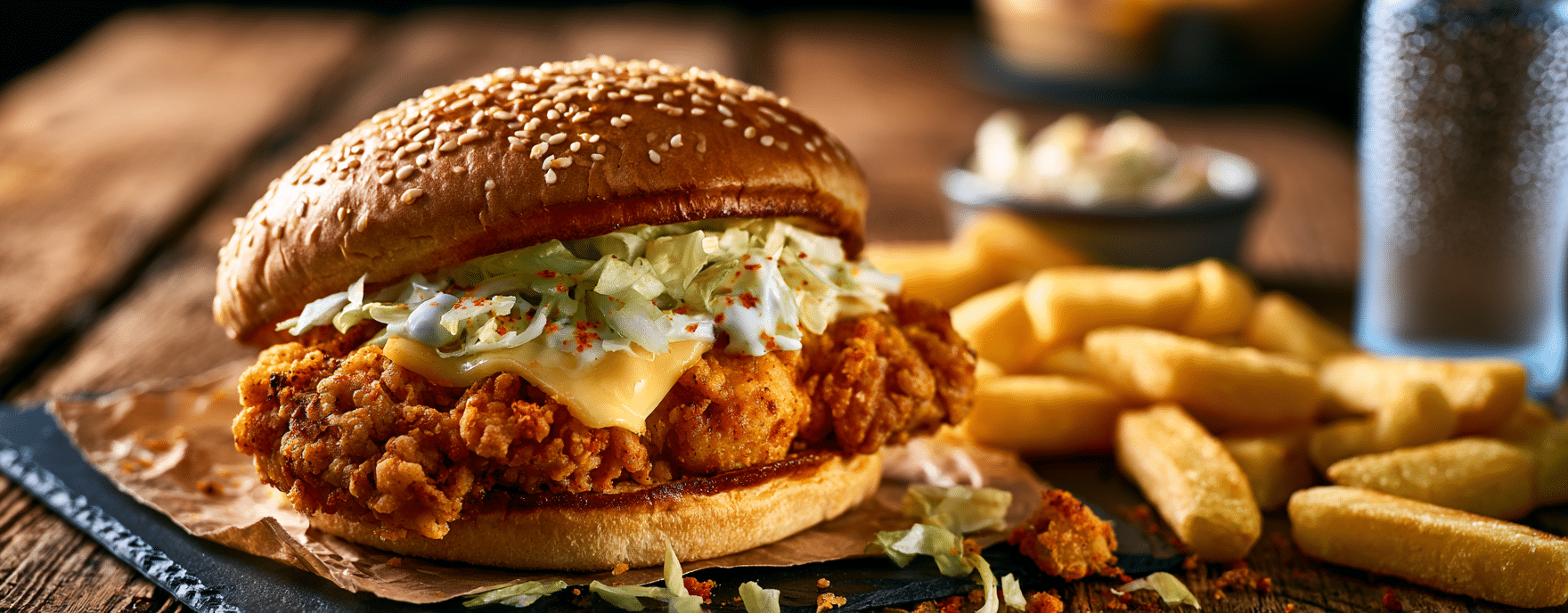
This is a homemade take on the KFC Zinger — a spiced, crispy fried chicken burger built on a yoghurt-based batter that gets dredged multiple times for a thick, craggy coating. The honest reason to make it at home: the ingredients cost a fraction of the drive-through price, and you control the heat level. Total time is about six hours, but nearly all of that is hands-off marinating.
What makes this version work
Two things actually drive the result here. First, the long dry-spice marinade — four to five hours minimum — pushes chilli and mustard flavour into the meat itself, so the coating isn’t doing all the work. Second, the multiple dredge passes (three to five times through the yoghurt and flour) are what build the thick, uneven crust that gives a Zinger its distinctive bite. Rushing either step produces a thin, pale coating that slides off the chicken. The baking powder in the flour mix reacts with the acidic yoghurt during frying and creates the lift that makes the crust light rather than dense — don’t leave it out.
Smart swaps
- Yoghurt: Full-fat plain yoghurt is ideal. If you only have low-fat, add a tablespoon of sour cream to thicken it up — the batter needs enough body to cling between dredge passes. Buttermilk also works well as a straight swap.
- Chilli powder: Standard mild chilli powder is fine. For more heat, swap half of it for cayenne. For less, use smoked paprika — you keep the colour without the burn.
- Mustard powder: This is the ingredient most people skip, and it’s a mistake — it adds a background sharpness that makes the coating taste complex. Dry mustard from the spice aisle is cheap and lasts for months.
- Burger buns: Any medium-sized soft bun works. Brioche adds a slight sweetness that plays well against the spice. A plain supermarket sesame bun is perfectly fine.
- Cheese: American or mild cheddar slices melt the fastest. Skip anything aged or crumbly — it won’t melt properly over hot fried chicken.
What can go wrong
- Coating falls off in the oil: The oil wasn’t hot enough when the chicken went in. Get it shimmering before you add the first piece. A drop of batter should sizzle immediately on contact.
- Crust is pale and greasy: The oil temperature dropped — usually from adding too many pieces at once. Fry one piece at a time if your pan is small, and let the oil come back up to heat between batches.
- Chicken is cooked outside but raw inside: Chicken breasts vary in thickness. Flatten the thicker end with your palm or a rolling pin before marinating so the breast is roughly even. Always verify the internal temperature reaches 165°F (74°C) — don’t rely on colour alone.
- Flour mix clumps into wet lumps: The yoghurt on your hands is contaminating the dry bowl. Use one hand for the wet dip and the other for pressing the flour — or use tongs throughout.
- Burger is soggy by the time you eat it: Don’t assemble until the chicken has rested on a wire rack (not paper towels) for two minutes. Paper towels trap steam underneath and soften the crust fast.
Make-ahead notes
The dry-spiced chicken can marinate in the fridge for up to 24 hours — longer than the recipe minimum actually deepens the flavour, so prepping the night before is a smart move. Once fried, the chicken keeps in the fridge for up to three days in an airtight container. To reheat, use an oven or air fryer at 375°F (190°C) for eight to ten minutes — this brings the crust back to life. Microwaving kills the texture completely, so skip it. The assembled burger doesn’t hold well; keep the components separate and build it fresh when you’re ready to eat.
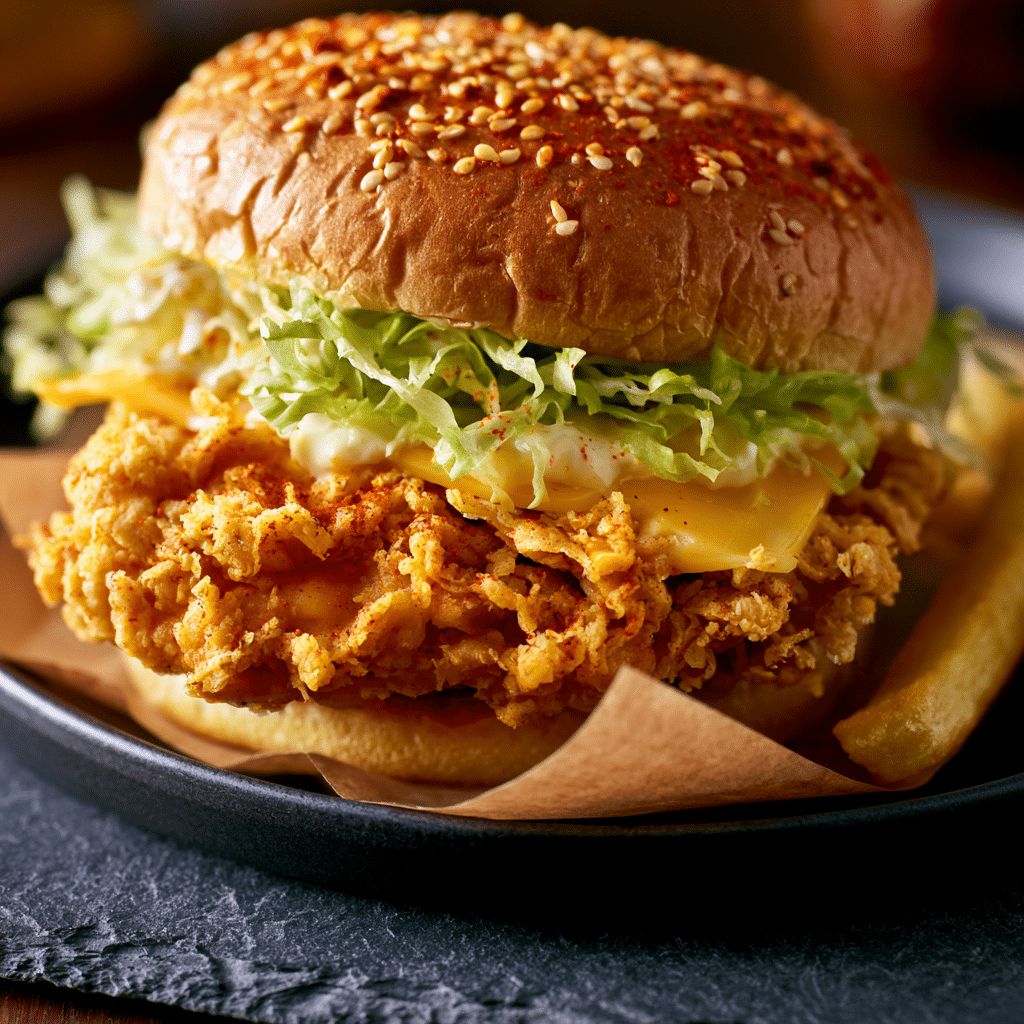
Homemade Zinger Burger (KFC Copycat Recipe)

Equipment
- Deep heavy-bottomed frying pan or Dutch oven (at least 3 inches deep)
- Instant-read thermometer
- Wire cooling rack set over a baking sheet
- Tongs (long-handled for frying safety)
- Cling film / plastic wrap
- Large mixing bowl (for flour dredge)
- Medium mixing bowl (for yoghurt batter)
Ingredients
Chicken Marinate Ingredients
- 1 teaspoon chilli powder
- 1 teaspoon mustard powder
- ½ teaspoon ground white pepper
- ½ teaspoon ground black pepper
- 1 teaspoon salt
- 2 pieces boneless skinless chicken breasts approximately 150–180g / 5–6oz each, butterflied or pounded to 3/4-inch / 2cm thickness
Batter Ingredients
- 1 cup natural plain yoghurt 245g, full-fat recommended
- 1 cup water 240ml
- 1 ½ teaspoons baking powder
- ½ teaspoon chilli powder
- ½ teaspoon mustard powder
- 1 teaspoon salt
- 1 dash ground black pepper
- 1 dash ground white pepper
- 1 cup plain flour 125g, all-purpose
- 2 cups vegetable oil for frying, enough to fill pan to approximately 1.5 inches / 4cm depth — roughly 475ml
Assembly Ingredients
- 2 whole burger buns
- 2 large iceberg lettuce leaves shredded
- 2 tablespoons mayonnaise 30g
- 2 slices cheese
Instructions
Marinate the Chicken
- Combine the chilli powder, mustard powder, white pepper, black pepper, and salt in a small bowl to make the dry marinade mix.1 teaspoon chilli powder, 1 teaspoon mustard powder, 1/2 teaspoon ground white pepper, 1/2 teaspoon ground black pepper, 1 teaspoon salt
- Rub the spice mix evenly over both sides of each chicken breast. Wrap each breast tightly in cling film (or place in a sealed zip-lock bag) and refrigerate for 4–5 hours, or up to 24 hours for deeper flavour.2 pieces boneless skinless chicken breasts
Prepare the Batter and Flour
- Take 1 cup of yoghurt and add 1 cup of water, so you get a paste that’s not quite as thick as the yoghurt itself. Keep this to one side.1 cup natural plain yoghurt, 1 cup water
- In a large bowl, whisk together the flour, baking powder, salt, mustard powder, white pepper, and black pepper until evenly combined.1 1/2 teaspoons baking powder, 1/2 teaspoon chilli powder, 1/2 teaspoon mustard powder, 1 teaspoon salt, 1 dash ground black pepper, 1 dash ground white pepper, 1 cup plain flour
Fry the Chicken
- Pour vegetable oil into a deep, heavy-bottomed frying pan to a depth of approximately 1.5 inches (4cm). Heat over medium-high heat until the oil reaches 350°F / 175°C — test with an instant-read thermometer or drop a small piece of batter in; it should sizzle immediately and float. Take a marinated chicken breast, dip it into the yoghurt mixture, shake off the excess, then press it firmly into the seasoned flour. Repeat this yoghurt-then-flour dredge 3–5 times to build a thick, craggy coating. Set the coated chicken on a wire rack for 5 minutes to let the coating set before frying.2 cups vegetable oil, 2 pieces boneless skinless chicken breasts, 1 cup natural plain yoghurt, 1 cup water, 1 cup plain flour
- Carefully lower the coated chicken into the hot oil. Fry for 6–8 minutes per side (12–16 minutes total), adjusting heat to maintain 325–350°F / 165–175°C oil temperature. The chicken is done when the crust is deep golden brown and the internal temperature reaches 165°F / 74°C. Transfer to a wire rack set over a baking sheet to drain — do not place on paper towels as the steam will soften the bottom crust.2 cups vegetable oil
Assemble the Burger
- Slice each burger bun in half and toast the cut sides in the pan or under a grill until golden. Place a fried chicken breast on each bottom bun. Top with a slice of cheese (the residual heat will soften it), shredded lettuce, and a tablespoon of mayonnaise. Close with the top bun and serve immediately.2 whole burger buns, 2 large iceberg lettuce leaves, 2 tablespoons mayonnaise, 2 slices cheese
Notes
Nutrition
Common questions
Can I use chicken thighs instead of chicken breasts?
Yes, and boneless skinless thighs are actually more forgiving — they stay juicier if you slightly overshoot the cook time. Flatten them to an even thickness before marinating, and still cook to an internal temperature of 165°F (74°C).
What oil is best for frying the chicken?
Any neutral high-smoke-point oil works — vegetable, canola, or sunflower are all fine and inexpensive. Avoid olive oil; its smoke point is too low for the temperature needed to get a crisp crust.
How do I know when the oil is hot enough without a thermometer?
Drop a small pinch of the flour mix into the oil — it should sizzle and float to the surface within two seconds. If it sinks and sits there, the oil needs more time.
Can I bake or air-fry the chicken instead of pan-frying?
Air-frying works reasonably well at 400°F (200°C) for 18 to 22 minutes, flipping halfway, though the crust won’t be quite as thick and craggy as the pan-fried version. Spray the coated chicken generously with oil before cooking or the flour coating will turn dry and powdery rather than crisp. Baking in a conventional oven produces a noticeably softer crust and isn’t recommended if texture is your priority.
My flour coating isn’t sticking after the first dredge — what am I doing wrong?
The yoghurt layer is probably too thin. Make sure the chicken is well coated in the yoghurt mix before each pass through the flour, and press the flour firmly onto the surface with your hand. If the yoghurt mix has thinned out as you work, stir it — the flour from previous dredges can settle and change the consistency.
Can I freeze the coated, uncooked chicken to fry later?
It’s better to freeze the marinated chicken before coating rather than after — the yoghurt-flour crust absorbs moisture as it thaws and the texture suffers. Freeze the spice-marinated raw chicken for up to two months, thaw fully in the fridge overnight, then coat and fry fresh.
More burger recipes to try
- KFC Double Crunch Perfected
- KFC Famous Chicken Sandwich
- Spicy Zinger Fried Chicken
- Ultimate Crispy Chicken Burger
1 comment
Wow, your homemade Zinger burger looks amazing! I love how you recreated the classic KFC flavor using fresh, free-range chicken and that perfect coating. It’s impressive how close it is to the real thing!