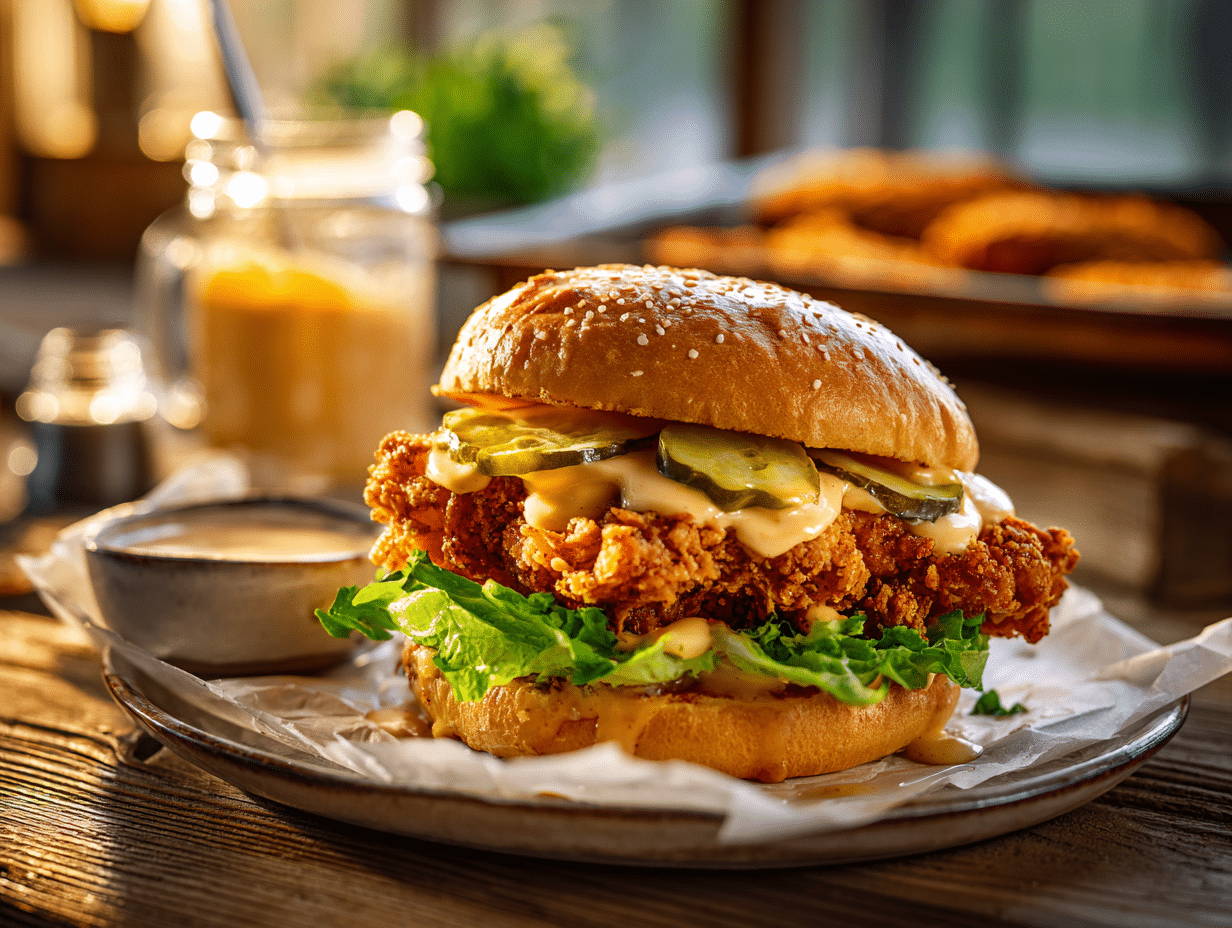
This is a copycat of KFC’s Double Crunch chicken burger — a thick-coated, double-fried chicken fillet with a genuinely shattering crust, served on a toasted bun with a tangy house sauce. The reason to make it at home is simple: you get that craggy, audible crunch without leaving the house, and you control the oil quality and seasoning level. It takes about an hour start to finish, and most of that is hands-off rest time.
The technique that matters
Two things drive the crunch here, and both are non-negotiable. First, the cornstarch-and-baking-powder coating: cornstarch cuts gluten development so the crust shatters instead of chewing, and baking powder creates micro-bubbles that give the surface its rough, craggy texture — that’s the surface area that crisps. Second, the double fry. The first fry cooks the chicken through and sets the crust. Then you pull it, rest it on a wire rack for a few minutes, and fry again at a slightly higher temperature to blast off any surface moisture and lock in the crunch. Skip the second fry and you get a good fried chicken sandwich. Do it and you get the real thing. Make sure your chicken hits 165°F (74°C) internal before it comes out of the oil — a cheap instant-read thermometer removes all guesswork.
Shopping notes
- Cornstarch: Standard supermarket cornstarch works fine. Don’t substitute arrowroot — it goes gummy at frying temperatures.
- Baking powder: Use aluminum-free if you have it; regular works but can leave a faint metallic edge on a thick coating like this.
- Chicken breast vs. thigh: Thigh is more forgiving in the fryer and stays juicier through two fry cycles. Breast works but needs closer attention on the second fry — pull it the moment it hits temp.
- Hot sauce for the house sauce: A vinegar-forward Louisiana-style hot sauce (like Crystal or Frank’s) gives the right balance of heat and acidity. Thicker sauces like Sriracha change the texture of the spread.
- Neutral oil: You need enough to deep-fry — at least 2 inches in the pot. Vegetable or canola oil is fine. Skip olive oil entirely; its smoke point is too low.
Mistakes to avoid
- Crowding the pot: Adding more than one or two pieces at a time drops the oil temperature sharply. The coating absorbs oil instead of crisping, and you end up with a greasy, pale crust. Fry in batches and let the oil recover between them.
- Skipping the wire rack: Resting the chicken on paper towels between fries traps steam underneath and softens the crust you just built. A rack — even a cooling rack set over a sheet pan — keeps air circulating all the way around.
- Wet chicken going into the dredge: Pat the chicken completely dry before the first flour dredge. Surface moisture turns the coating into a paste rather than a craggy shell, and it won’t adhere evenly. Skip the egg in the wet dip if the recipe allows a buttermilk soak instead — egg-based batters on thick cuts tend to slide and clump.
- Sauce going on too early: Spreading the house sauce on the bun and then letting it sit while you finish frying makes the bottom bun soggy. Sauce the bun right before assembly, not before.
- Pulling the chicken by color alone: The coating browns fast, especially on the second fry. A deep golden color can appear before the center is done. Always verify with a thermometer — 165°F (74°C) at the thickest point, no exceptions.
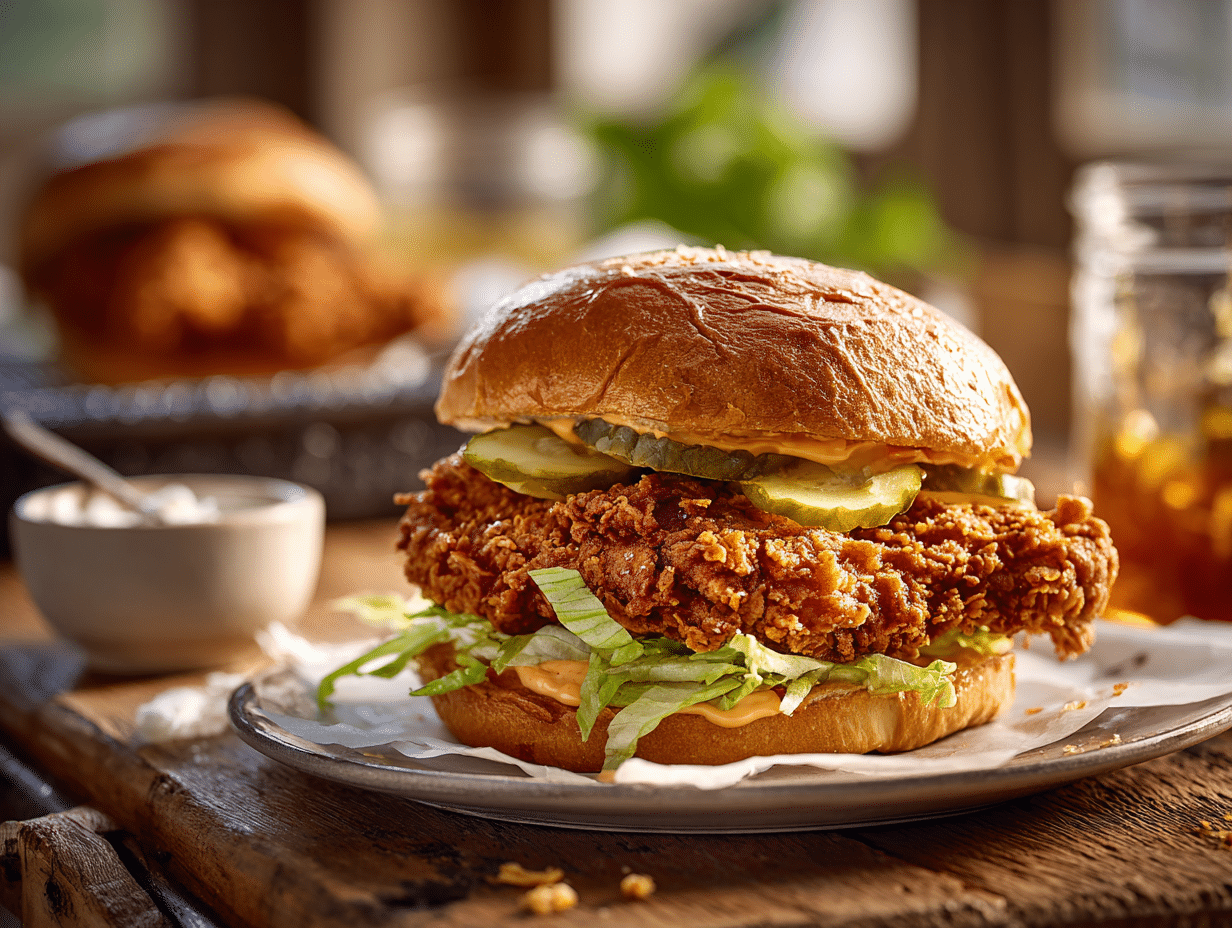
Double Crunch Chicken Burger (KFC-Inspired)

Ingredients
Chicken & Marinade
- 2 large boneless, skinless chicken breasts About 1.5 lb total; split horizontally to make 4 fillets; choose air-chilled for best texture
- 1 ½ cups buttermilk Full-fat preferred for tenderness
- 1 tablespoon hot sauce Frank’s RedHot or similar
- 2 teaspoons kosher salt Use Diamond Crystal; if using Morton, reduce slightly
- 1 teaspoon garlic powder
- ½ teaspoon onion powder
- ½ teaspoon white pepper For that classic fried-chicken profile
Zesty House Sauce
- ½ cup mayonnaise Duke’s or Kewpie recommended
- 1 tablespoon ketchup
- 2 teaspoons Dijon mustard
- 1 tablespoon finely chopped dill pickles or relish Adds tang and texture
- 1 teaspoon hot sauce Adjust to taste
- 1 teaspoon lemon juice Freshly squeezed
- 1 pinch smoked paprika Optional, for subtle smokiness
Seasoned Flour Dredge
- 2 cups all-purpose flour King Arthur recommended
- ½ cup cornstarch Boosts light, shattering crunch
- 2 teaspoons kosher salt
- 1 teaspoon baking powder Encourages craggy crispness
- 1 teaspoon paprika
- 1 teaspoon white pepper
- 1 teaspoon garlic powder
- 1 teaspoon onion powder
- ½ teaspoon cayenne pepper Adjust to heat preference
- ½ teaspoon dried thyme Crumble between fingers to release aroma
Wet Batter
- 2 large eggs Room temperature
- ½ cup buttermilk
- 2 tablespoons pickle juice From dill pickles; optional for extra tang
- 1 teaspoon hot sauce
Frying & Assembly
- 6 cups neutral frying oil Peanut, canola, or vegetable oil; enough for 2–3 inches depth
- 4 large burger buns Brioche or sesame; split
- 2 tablespoons unsalted butter For toasting buns
- 4 leaves crisp lettuce Iceberg or butter lettuce
- 8 slices dill pickles Plus extra to taste
- 4 slices American cheese Optional, for melty richness
Instructions
- Prep the chicken (10 minutes): Split 2 large chicken breasts horizontally to create 4 even fillets. Lightly pound to about 1/2 inch thickness for even cooking. Pat dry.
- Marinate (30 minutes): In a bowl, whisk 1 1/2 cups buttermilk, 1 tbsp hot sauce, 2 tsp kosher salt, 1 tsp garlic powder, 1/2 tsp onion powder, and 1/2 tsp white pepper. Submerge chicken. Cover and marinate 30 minutes (refrigerated). For deeper flavor, marinate up to 12 hours, but 30 minutes is included in the prep time.
- Make the sauce (5 minutes): Stir together 1/2 cup mayo, 1 tbsp ketchup, 2 tsp Dijon, 1 tbsp chopped pickles/relish, 1 tsp hot sauce, 1 tsp lemon juice, and a pinch of smoked paprika. Taste for salt/heat. Chill until needed.
- Seasoned flour & wet batter (10 minutes): In one bowl, combine flour, cornstarch, 2 tsp salt, baking powder, paprika, white pepper, garlic powder, onion powder, cayenne, and thyme. In a second bowl, whisk eggs, 1/2 cup buttermilk, pickle juice, and 1 tsp hot sauce. Set up a wire rack over a sheet pan for dredged cutlets.
- Heat the oil (10 minutes overlapping): In a deep, heavy pot, heat 2–3 inches of oil to 350°F (175°C). Keep the oven at 200°F (95°C) ready to hold fried chicken warm. Use a thermometer for accuracy.
- Double-dredge for “crunch crust” (8 minutes): Working one piece at a time, lift chicken from marinade, let excess drip, then press firmly into the seasoned flour. Dip into the wet batter, let excess drip, then return to the flour and press, squeezing to form shaggy, crinkled bits. Place on the rack to rest 2–3 minutes so the coating adheres.
- Double-fry (Batch 1, ~8 minutes total): Fry 2 cutlets at 350°F (175°C) for 3–4 minutes until pale golden and the bubbling slightly calms. Rest on the rack 3 minutes. Return to the oil for a second fry, 2 minutes, until deep golden and ultra-crisp. Internal temperature should reach 165°F (74°C). Hold on a rack in the 200°F (95°C) oven.
- Repeat frying (Batch 2, ~8 minutes total): Repeat the double-fry with the remaining 2 cutlets. Allow 1–2 minutes between batches for the oil to recover to 350°F (175°C) for consistent crunch.
- Toast buns (5 minutes): Split 4 buns, smear cut sides with 2 tbsp softened butter, and toast in a dry skillet over medium heat or briefly in the 200°F (95°C) oven until golden at the edges and fragrant.
- Assemble (4 minutes): Spread sauce on both bun halves. Layer lettuce on the bottom, add a hot, crispy chicken fillet, top with American cheese (optional) and pickle slices. Cap with the top bun, pressing gently to set.
- Sensory cues: Oil should bubble briskly but not violently; crust turns from pale blond to deep golden brown. You’ll smell toasted spice and hear a firm crackle when you tap the crust with tongs.
Notes
Chef’s Tips
- Extra shatter: After the first flour coat, drizzle a tablespoon of wet batter into the flour and toss to create little clumps—press these onto the chicken before the final dredge for a wildly craggy crust.
- Gluten-free: Use a 50/50 blend of fine white rice flour and cornstarch in place of AP flour; choose GF buns.
- Dairy-free: Substitute buttermilk with unsweetened oat milk mixed with 2 tsp white vinegar per cup; rest 10 minutes before using.
- Heat levels: Reduce cayenne for mild; add 1/4 tsp extra cayenne or a pinch of chili flakes to the dredge for spicy.
- Air fryer option: Skip the wet batter. Double-coat in seasoned flour, mist generously with oil. Air fry at 400°F (200°C) for 12–14 minutes, flipping halfway, until 165°F (74°C) internal and crisp.
- Oil management: Keep temperature at 350°F (175°C). If it drops under 325°F (165°C), the crust absorbs oil and softens.
- Bun choice: Slightly sweet brioche balances the savory heat; sesame buns give classic fast-food aroma.
Serving Suggestions
- Plate on a warm plate with a parchment square for a food-truck vibe. The ideal look: bronzed, crinkly crust; bright green lettuce; glossy sauce; and pickle pop.
- Sides: Seasoned fries, creamy coleslaw, or a tangy cucumber salad. Drinks: crisp lager, iced sweet tea, or a citrus soda.
Culinary Context
This burger channels Southern American fried chicken traditions—spice-forward seasoning, buttermilk tenderness—filtered through the irresistible, global fast-food “double crunch” style. I first engineered this crust for a pop-up where guests demanded extra texture and audible crackle; the key was a cornstarch-forward dredge and a quick second fry.Optional Advanced Instructions
- Make-ahead: Marinate chicken up to 12 hours. Mix the sauce up to 3 days ahead. Whisk dredge and batter just before frying for best lift.
- Parallel workflow: While the chicken marinates, make sauce, prep dredge/batter, and set up your frying station and rack.
- No thermometer? Drop a pinch of flour into the oil—if it sizzles immediately and floats, you’re near 350°F (175°C). Still, a thermometer is far more reliable.
Timing
- Prep time: 1 hour (includes 30 minutes marination and 30 minutes active prep)
- Cook time: 25 minutes (two double-fry batches, bun toasting, and brief oil recovery)
Course & Cuisine
- Course: Dinner or Lunch
- Cuisine/Origin: American, Southern-inspired, fast-food style
Nutrition
Common questions
Can I use an air fryer instead of deep-frying?
You can, but the crust won’t be the same — the air fryer produces a drier, lighter crisp rather than the shatteringly crunchy shell the double-fry method creates. If you go that route, spray the coated chicken generously with oil before each cook cycle and still verify 165°F (74°C) internal temperature.
Can I bread the chicken ahead of time and refrigerate it?
Yes — coat the chicken and refrigerate it uncovered on a rack for up to 4 hours before frying. The rest actually helps the coating adhere better. Don’t go much longer than that or the coating starts to absorb moisture from the chicken and gets gummy.
What’s the best way to reheat leftovers without losing the crunch?
A wire rack in a 375°F oven for 10–12 minutes is your best option — it re-crisps the crust without steaming it the way a microwave does. The microwave turns the coating soft in under a minute, so avoid it if crunch is the point.
My coating keeps falling off during frying — what am I doing wrong?
The most common cause is not pressing the coating firmly onto the chicken during dredging, or skipping the short rest after coating that lets it bond to the surface. Press the flour mixture on with your palm, then let the coated pieces sit for 5 minutes before they go in the oil.
What to cook next
- KFC Famous Chicken Sandwich
- Korean Fried Chicken Burger
- Crispy SmokeShack Chicken Burger
- Nashville Hot Chicken Perfected