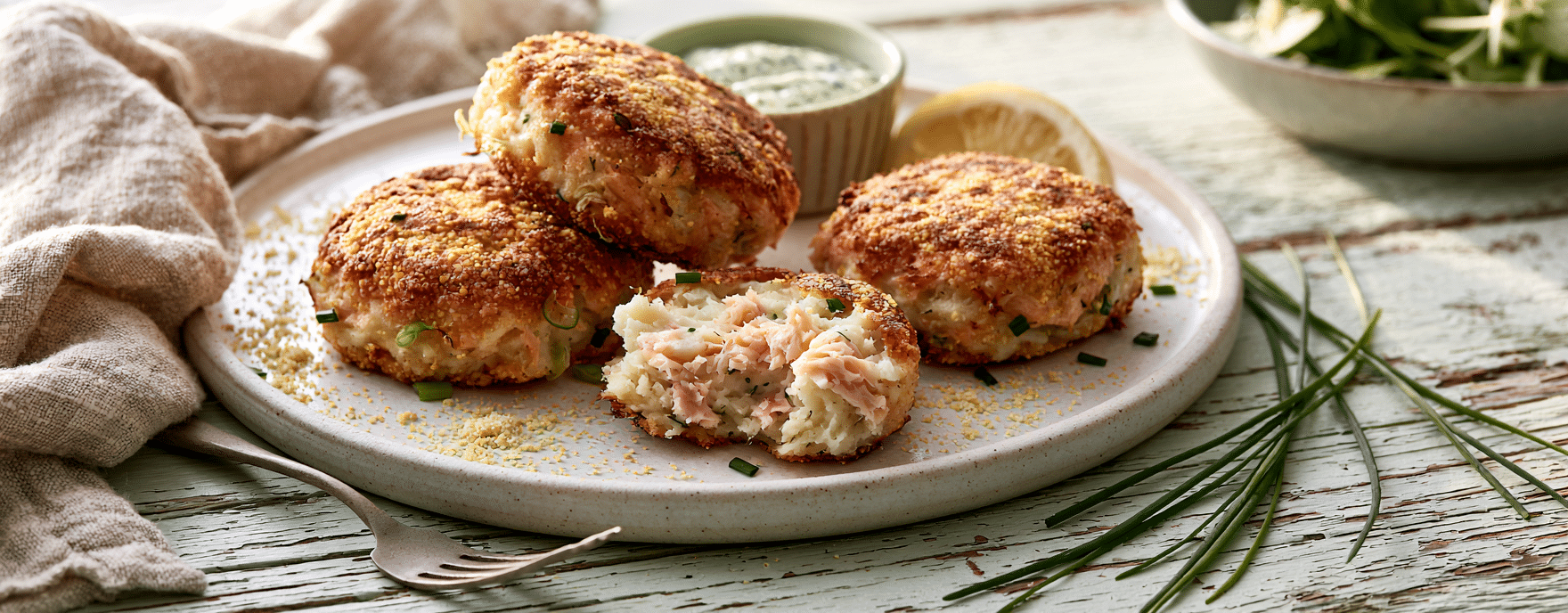
These are pan-fried salmon patties where mashed Yukon Gold potatoes do the binding work — no eggs, no flour in the mix, no crackers. The result is a patty that holds together cleanly, crisps up in about five minutes a side, and gets dinner on the table in an hour start to finish. If you have leftover mashed potatoes already in the fridge, that time drops significantly.
The technique that matters
The two things that determine whether these patties hold together or fall apart are moisture control and pan temperature. Potatoes that are too wet make a loose, sticky mix that won’t form a clean patty — drain them thoroughly and mash without adding much liquid. A small splash of the cooking water is fine if they look dry, but err on the side of firmer here. Pan temperature matters just as much: medium heat with shimmering oil means the cornmeal coating sets into a crust quickly, which is what locks the patty together. Too low and the patty sits in the oil, softens, and breaks when you try to flip it. Let the pan fully preheat before the first patty goes in, and don’t rush the flip — if it resists, it needs another minute.
Substitutions that actually work
- Canned salmon instead of fresh: Works well and cuts your total time by about 20 minutes. Drain it well, rinse it, and pick out any bones before mixing.
- Cornmeal vs. gluten-free flour for dusting: Cornmeal gives a crunchier exterior; certified gluten-free oat flour or rice flour gives a softer crust. Both work — skip the egg in the mix if you’re tempted to add one, it makes the patty mushy.
- Russet potatoes instead of Yukon Gold: Russets are starchier and absorb more moisture, so your patties may be slightly drier. Add a touch more mashed potato to the mix to compensate.
- Scallion substitutes: Finely minced shallot or a small amount of grated white onion works if scallions aren’t available, though the flavor is sharper.
Storage and reheating
Cooked patties keep in the fridge for up to 3 days in an airtight container. For freezing, arrange them in a single layer on a baking sheet, freeze until solid (about 2 hours), then transfer to a freezer bag — they’ll keep for up to 2 months. Reheat from the fridge in a dry skillet over medium heat for 2 to 3 minutes per side; this brings back the crust in a way the microwave won’t. From frozen, thaw overnight in the fridge first, then reheat the same way. Avoid stacking patties while storing — they’ll stick together and the crust softens.
Common problems and fixes
- Patties fall apart in the pan: The potato-to-salmon ratio is off, or the mix is too wet. Add a tablespoon or two more mashed potato and chill the formed patties in the fridge for 15 minutes before frying — this firms them up noticeably.
- Cornmeal coating burns before the inside is cooked through: The heat is too high. Wipe the pan between batches as the recipe directs, and keep the burner at medium — not medium-high. Burnt cornmeal bits left in the pan accelerate scorching on the next batch.
- Patties are bland all the way through: The potato and salmon both need salt seasoned in separately before mixing. Salting only at the end doesn’t penetrate the potato. Season the mash while it’s still hot.
- Exterior is crisp but center is cold or dense: Patties that are too thick take longer to heat through than the crust can handle. Keep them just under 1 inch thick and make sure the mashed potato was warm when you mixed it — cold potato straight from the fridge slows the cook.
- Patties stick even with oil in the pan: The pan wasn’t hot enough before the oil went in, or the oil wasn’t shimmering before the patties were added. Let the pan heat for a full minute before adding oil, then wait for the oil to shimmer before the first patty touches it.
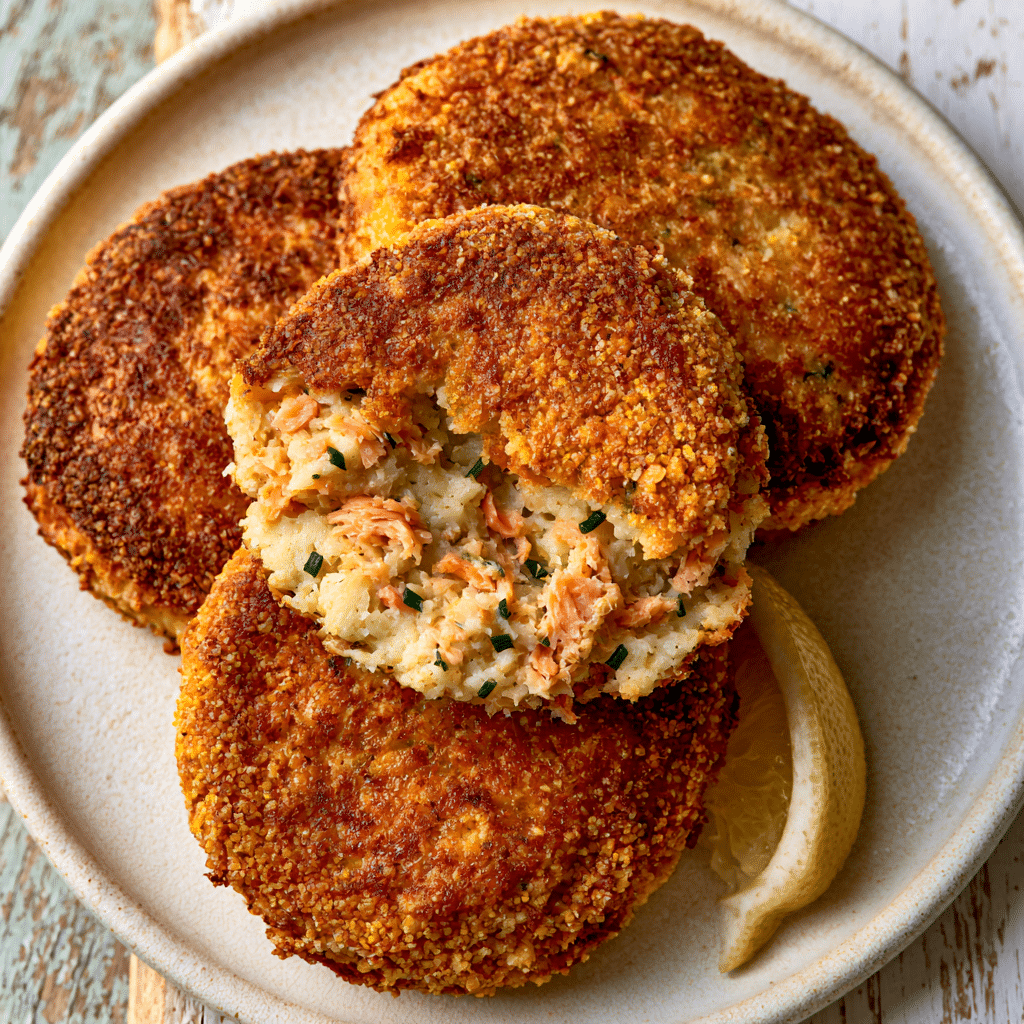
Gluten-Free Salmon Potato Patties (No Egg, No Flour)

Equipment
- Rimmed baking sheet
- parchment paper
- Medium saucepan
- Potato masher
- Large non-stick or cast-iron skillet (12-inch / 30cm)
- Fish spatula
- Instant-read thermometer
Ingredients
- 12 ounces Yukon Gold potatoes 340g, or new potatoes
- 12 ounces salmon fillets 340g, skin-on
- 4 stalks scallions (green onions) white and light green parts minced
- 1 tablespoon fresh chives finely chopped
- ½ cup fine cornmeal 70g, for dusting
- 1 pinch salt to taste
- 1 pinch freshly ground black pepper to taste
- 1 tablespoon neutral oil (canola, olive, or coconut) plus more for additional batches
Instructions
- Preheat your oven to 425°F / 220°C (200°C fan-forced). Pat the salmon fillets dry. Season both sides with salt and pepper. Line a piece of parchment paper or foil on a baking sheet. Place the seasoned fillets skin-side down on the sheet. If you want to add more flavour to the fish, lay a thin slice of lemon and a few chives spears on top.12 ounces salmon fillets, 1 pinch salt
- Bake the fish for 4 to 6 minutes per half-inch thickness. Most fillets are usually close to one inch thick, so check your fish for around 8 minutes to see if the salmon flakes easily with a fork. If not, continue to roast and check every few minutes. The salmon should be opaque and tender but observe so it does not overcook.12 ounces salmon fillets
- Remove the pan from the oven and allow the fillets to cool slightly. Flake the fish, pulling it away from the skin, and put the meat in a bowl. (Discard the skin.) If you’re using canned salmon, you can skip this step. Instead, make sure the fish is drained, rinsed, and flaked.12 ounces salmon fillets
- Chop the potatoes, place them in a saucepan and cover with cold water. Add a generous pinch of salt and set the pan over medium heat. Bring the water to a boil and cook the potatoes until they are fork-tender (about 10 to 20 minutes). Drain thoroughly and mash with a potato masher until smooth. If the potatoes seem very dry and crumbly, add 1–2 teaspoons of the reserved potato cooking water — no more. The mash should be stiff, not creamy. Cover the pan and set it aside.12 ounces Yukon Gold potatoes, 1 pinch salt
- Mix the flaked salmon and mashed potatoes together. Add the scallions and chives. Season with salt and pepper. Add the cornmeal to a wide, shallow bowl or plate for dusting.12 ounces Yukon Gold potatoes, 12 ounces salmon fillets, 4 stalks scallions (green onions), 1 tablespoon fresh chives, 1/2 cup fine cornmeal, 1 pinch salt
- Use your hands to form patties about 3 inches (7.5cm) in diameter and just under 1 inch (2cm) thick. Dust both sides generously with cornmeal. You should get about 10 patties.1/2 cup fine cornmeal
- Heat about 1 tablespoon of oil in a large skillet over medium heat until shimmering. Add your dusted patties to the pan. You probably need to work in batches depending on the size of your skillet. Let the patties fry on one side until they are easily loosened from the pan, about 4 to 6 minutes. If you move a patty and it seems stuck to the pan, give it a bit more time to cook. They should release without force when the side is browned and crisp.1 tablespoon neutral oil (canola, olive, or coconut)
- Flip them over and cook the other side for another 4 minutes or so until golden brown. Set the cooked patties aside. Between batches, carefully scrape out any burnt cornmeal bits from the pan with a spatula, then add another tablespoon of fresh oil and let it shimmer before adding the next batch. Repeat with any remaining patties.1 tablespoon neutral oil (canola, olive, or coconut)
Notes
Nutrition
Your questions, answered
Can I use canned salmon instead of baking a fresh fillet?
Yes — canned salmon works well here and saves about 20 minutes. Drain and rinse it thoroughly, then check for any bones before adding it to the mix.
How do I know when the salmon patties are cooked through?
The patties are done when both sides are golden brown and the center feels firm rather than soft when pressed lightly. Since the salmon is already cooked before it goes into the mix, you’re really just heating through and building a crust — about 4 to 6 minutes per side over medium heat is enough.
Can I make the patties ahead of time and cook them later?
Yes — form the patties, place them on a parchment-lined tray, cover with plastic wrap, and refrigerate for up to 24 hours before frying. Chilling them actually helps them hold together better when they hit the pan.
Is this recipe truly gluten-free?
It is, as long as you use certified gluten-free cornmeal or a gluten-free flour for dusting. Standard cornmeal is naturally gluten-free, but cross-contamination during processing is possible, so check the label if you’re cooking for someone with celiac disease.
Can I bake these instead of pan-frying them?
You can, but the crust won’t be as crisp. If you bake them, use a 425°F oven on a lightly oiled baking sheet for about 15 to 20 minutes, flipping once halfway through.
What can I serve with salmon and potato patties to make a complete meal quickly?
A simple green salad or quickly roasted broccoli or asparagus work well and can cook while you’re frying the patties. Ketchup, a lemon-herb mayo, or plain sour cream are all fast dipping options that need no prep.
If you liked this one
- Crispy Fish King Burger
- Korean Rice Bulgogi Burger
- Veggie Sauce Burger Perfection
- Halloumi King Burger Homage