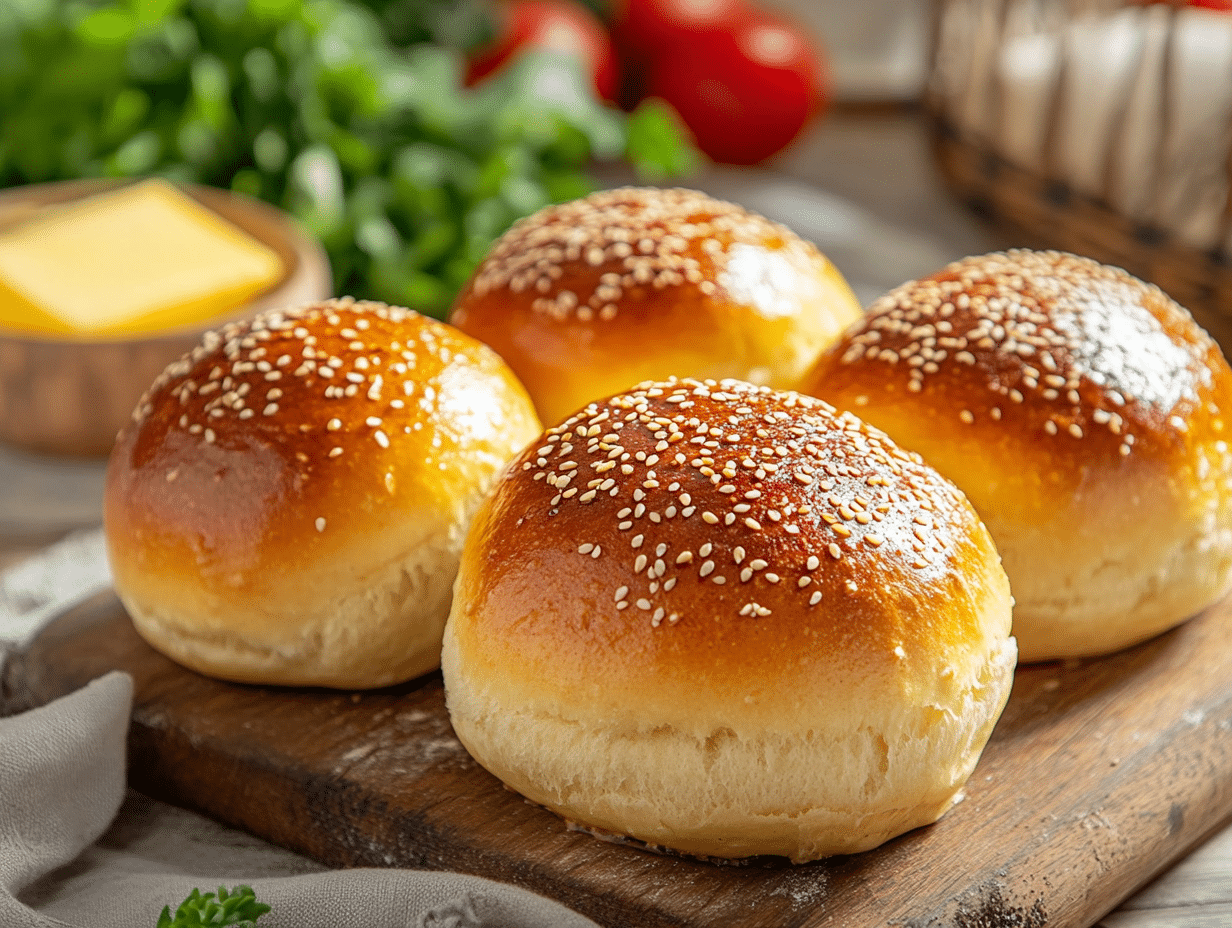
These are enriched, lightly sweetened hamburger buns made with bread flour, whole milk, eggs, and butter — the kind of bun that actually holds up under a loaded patty without turning to mush. Store-bought buns are fine, but they dry out fast and compress under anything juicy. Making your own takes about two hours start to finish, and the difference in texture and flavor is real enough to be worth the effort on any day you’re already firing up the grill.
What makes this version work
Two things matter most here. First, adding the butter after the dough has come together — not at the start — lets the gluten network build before fat coats the proteins and slows that process. The result is a dough that’s both rich and elastic, which means buns that hold their shape under a heavy, sauced-up patty instead of collapsing. Second, the slight flattening before the second proof is not optional. Skipping it gives you dinner rolls, not burger buns — the dome stays too high and the patty slides around. Press each ball gently to about three-quarters of an inch before that final rise and you’ll get the wide, flat-topped shape that actually works as a burger platform.
About the ingredients
- Bread flour vs. all-purpose: Bread flour has more protein (around 12–13%), which means more gluten and a sturdier crumb. All-purpose will work in a pinch but produces a softer, more fragile bun that tears under a juicy patty.
- Dairy-free swap: Full-fat oat milk is the closest substitute for whole milk here — it has enough body to keep the crumb tender. Thin plant milks like rice milk produce a noticeably drier bun. Use vegan butter rather than olive oil if you can; olive oil changes the flavor profile.
- Sesame seeds: Purely optional, but they add grip that helps condiments and toppings stay put rather than sliding out the back of the burger.
Mistakes to avoid
- Milk that’s too hot: Above 115°F the yeast dies and the dough won’t rise. Use an instant-read thermometer — guessing by feel is how batches get wasted.
- Under-proofing the first rise: The dough needs to genuinely double. In a cool kitchen that can take 90 minutes. Don’t rush it by the clock — go by size.
- Crowding the baking sheet: Buns that touch while baking fuse at the sides and don’t brown evenly. Leave at least two inches between each one.
- Skipping the egg wash: Without it the crust stays pale and matte and the sesame seeds won’t stick. Egg yolk plus a teaspoon of water is all it takes.
- Cutting buns while hot: Steam is still escaping for at least 15 minutes after they come out. Slice too early and the crumb compresses and turns gummy. Let them cool fully on a rack first.
Keeping and reheating
Buns keep well at room temperature in an airtight bag for up to three days — refrigerating them actually speeds up staling, so skip the fridge unless your kitchen is very warm. For longer storage, freeze them in a zip-lock bag for up to three months; freeze them whole and unsplit so they don’t dry out. To reheat from frozen, wrap loosely in foil and warm in a 325°F oven for about 12 minutes, or split and toast them straight from frozen in a dry skillet over medium heat until the cut side is golden. The skillet method is faster and gives you a lightly crisped interior surface that holds up better against burger juices than a microwaved bun ever will.
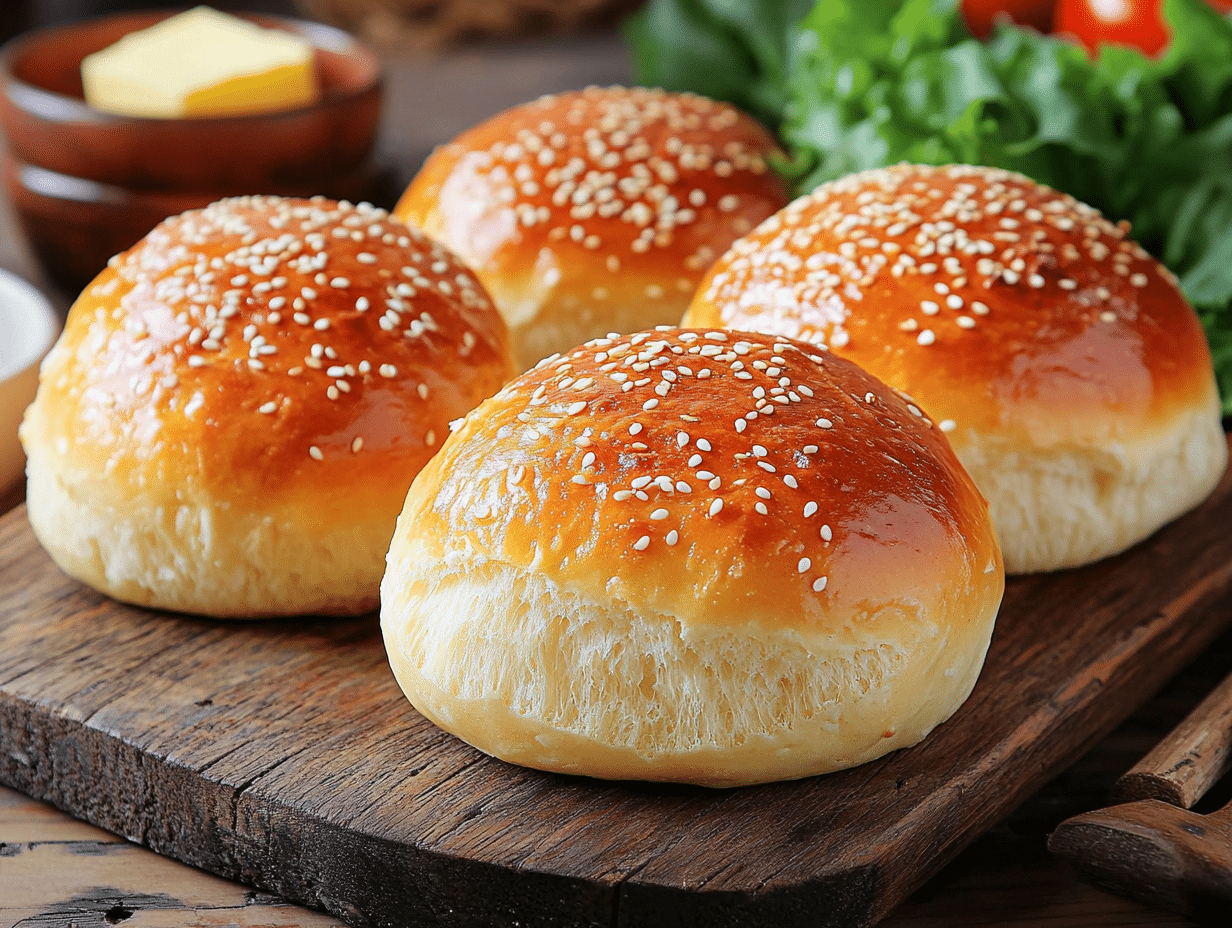
Easy Homemade Hamburger Buns

Ingredients
For the Homemade Hamburger Bun Dough:
- 1 cup whole milk warm to 110°F
- 2 ¼ teaspoons active dry yeast (1 packet)
- 2 tablespoons granulated sugar
- 1 large egg room temperature
- 3 cups bread flour plus more for kneading
- 1 teaspoon kosher salt
- 3 tablespoons unsalted butter softened
For the Topping:
- 1 large egg yolk beaten with 1 tablespoon of water for egg wash
- 1 tablespoon white sesame seeds optional, for topping
Instructions
- In a large bowl, warm the milk until it reaches about 110°F (43°C). Sprinkle in the active dry yeast and sugar. Stir gently and let stand for 5–7 minutes, until foamy. This indicates the yeast is active.
- Whisk in the egg until fully incorporated. Then add the bread flour and kosher salt. Using a wooden spoon or dough hook on a stand mixer, mix until a shaggy dough forms.
- Add the softened butter. Knead by hand on a floured surface for about 8–10 minutes or use a stand mixer with a dough hook for about 6 minutes until the dough is smooth, glossy, and elastic.
- Form the dough into a ball and place it in a lightly greased bowl. Cover with a clean kitchen towel or plastic wrap and let rise in a warm place until doubled in size, about 1 hour.
- Punch down the dough gently. Divide it into 8 equal portions (use a kitchen scale for precision) and shape each into a smooth ball by tucking the edges under and rolling against the counter.
- Place the dough balls on a parchment-lined baking sheet, spacing them at least 2 inches apart. Flatten each slightly with your palm to form a dome shape. Cover loosely with a towel and let rest for another 30 minutes.
- Preheat oven to 375°F (190°C). Brush each bun with the beaten egg yolk mixture and sprinkle with sesame seeds if using.
- Bake for 14–16 minutes, or until the buns are golden brown and sound hollow when tapped on the bottom. Remove and let cool completely on a wire rack before slicing.
Notes
- For a dairy-free version, substitute whole milk with oat milk and butter with olive oil or a vegan butter.
- Buns can be stored at room temperature in an airtight container for up to 2 days or frozen for up to 1 month.
- To make slider buns, simply divide dough into 12 pieces instead of 8 and reduce baking time to 10–12 minutes.
Nutrition
Common questions
Can I make the dough the night before?
Yes — after the first knead, cover the dough tightly and refrigerate it overnight instead of doing the first room-temperature proof. The cold slows the yeast rather than stopping it, so you get a slow rise with slightly more developed flavor. Pull it out the next day, let it come to room temperature for about 30 minutes, then shape and do the second proof as normal.
How do I know when the buns are fully baked?
The tops should be deep golden brown and the buns should sound hollow when you tap the bottom — that’s the most reliable check. An instant-read thermometer inserted into the center of a bun should read around 190°F; anything lower and the crumb is still wet and will compress when you slice it.
What internal temperature should my burger patty hit?
Ground beef patties need to reach 160°F (71°C) internal temperature — that’s the USDA safe minimum for any ground meat, including pork blends. Poultry burgers need to hit 165°F (74°C) and should never be served pink. Use an instant-read thermometer rather than judging by color; a patty can look done on the outside while the center is still undercooked.
If you liked this one
- BBQ Cheeseburger Recipe
- Ultimate Avocado Bacon Smash Burger
- Hawaiian Teriyaki Burger Recipe
- Perfect Bacon Double Cheeseburger
3 comments
I made these buns & they are great! i was wondering if i cud make them in a loaf. thank you, melisa
Hi Melissa, you could but you would need to make some changes to the recipe. Here are the changes BUT we have not tested so let us know how you go.
First add another half cup more of flour as you will need to have some more strength in the dough and optional but add a teaspoon of milk powder for softness.
Second you will need a loaf pan (9×5 inches or 23x13cm). Grease tin with butter. Let the dough rise until it is an inch or 2 to 3 cms above the rim.
Third lower the cooking temperature to 175 °C / 350 °F and increase the cooking time to 30 to 35min.
Fourth Brush the top of then loaf with melted butter immediately after baking to make it glossy.
Let us know how you go.
Thank you! i did make a loaf & forgot to add the entire half cup, but it did come out great! and i even used whole wheat flour for half of the bread flour! i have made alot of bread & this one is my favorite! im also going to use this dough to make donuts & see how that works out lol. Thank you so much for the recipe! melissa