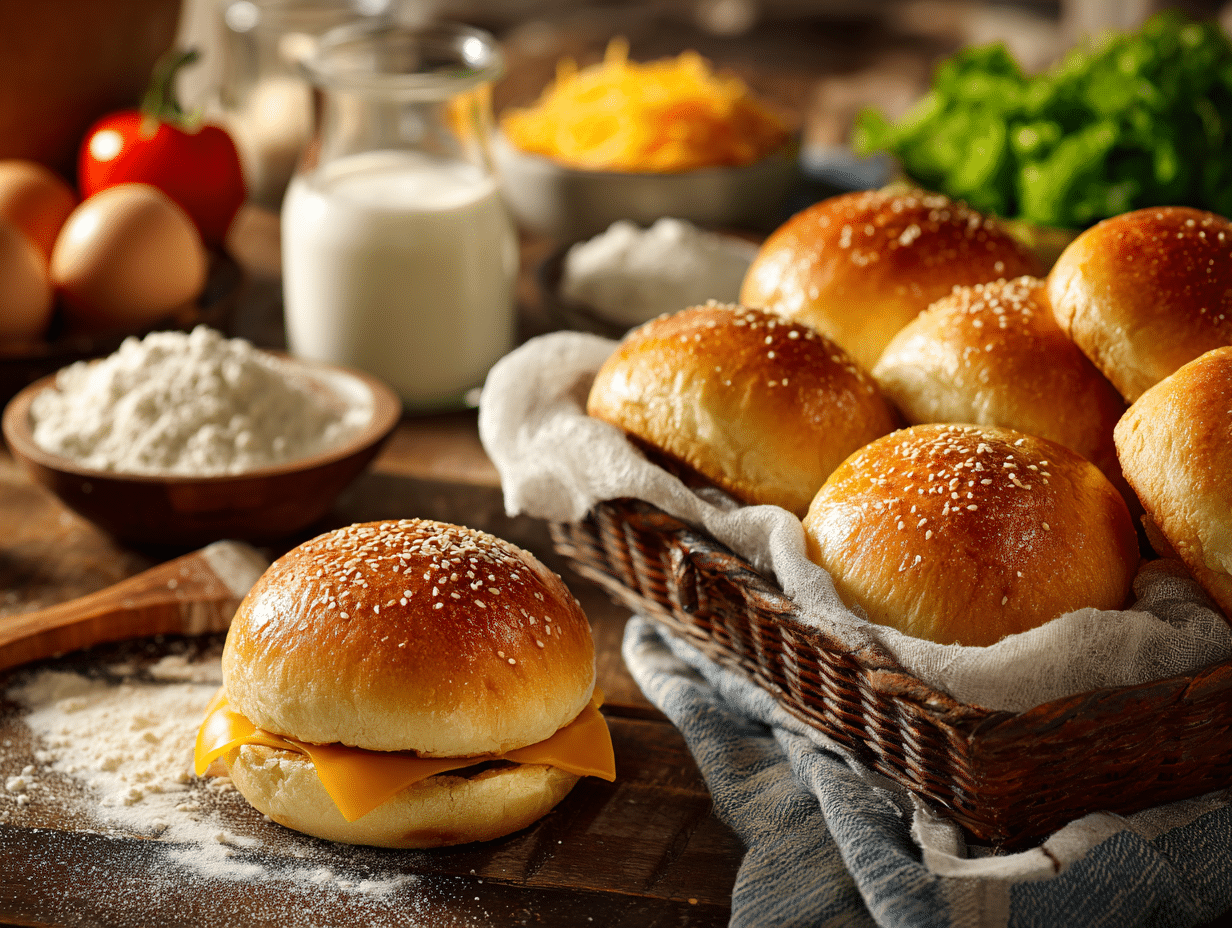
These are yeasted hamburger buns made with a bread flour and all-purpose flour blend, enriched with milk, butter, and egg, then finished with an egg-wash glaze. They take a few hours start to finish, but the active work is maybe 20 minutes. If you’ve been settling for store-bought buns that turn to mush the moment a patty hits them, this recipe is worth your afternoon.
The short version of why this works
Two things carry this recipe. First, the flour split: bread flour gives the buns enough gluten structure to hold up under a juicy patty without turning dense, while all-purpose flour keeps the crumb from getting chewy or tough. Get that ratio wrong in either direction and you end up with either a roll that falls apart or one that feels like a dinner roll. Second, the two-proof process — one bulk rise, one after shaping — is what builds flavor and gives the buns their domed top. Skipping the second proof is the single fastest way to end up with flat, dense buns. Skip the sesame seeds if you’re in a hurry — they add nothing structural and toasting the buns plain works just as well on a weeknight.
Mistakes to avoid
- Overheating the milk. If the milk is too hot when it hits the yeast, you’ll kill it before the dough even comes together. Aim for 105–110°F — warm to the touch but not uncomfortable. If you don’t have a thermometer, err on the cooler side.
- Shaping the balls too loosely. A slack dough ball spreads sideways instead of rising upward. When you roll each portion, use enough tension against the counter to get a tight, smooth surface. That surface tension is what pushes the rise up into a dome.
- Flattening too much before the second proof. Press each ball down gently — just enough to get a disc shape. If you press them flat, they proof flat and bake flat. You want them to look slightly puffed, not pancake-thin, going into the oven.
- Cutting into them straight out of the oven. The crumb needs 15–20 minutes to set. Slice too early and the interior is gummy and collapses. Let them cool on a wire rack so steam escapes from all sides, not just the top.
- Skipping the egg wash. It’s not just cosmetic. The wash helps the crust set to a thin, firm layer that holds up to toasting without crumbling. A bun without it comes out pale and the surface stays soft in a way that doesn’t grip fillings well.
Leftovers and meal prep
Baked buns keep at room temperature in an airtight bag for 2 days — after that the crumb starts to dry out. For longer storage, freeze them: wrap each bun individually in plastic wrap, then put them all in a zip-lock freezer bag, and they’ll hold for up to 3 months. To reheat from frozen, unwrap and microwave for 30–40 seconds, then split and toast cut-side down in a dry skillet for a minute. That two-step brings back most of the original texture. If you want to get ahead on a weeknight, you can also freeze the shaped, unproofed dough balls after the first rise — thaw overnight in the fridge, let them proof at room temperature for about 90 minutes, then bake as normal.
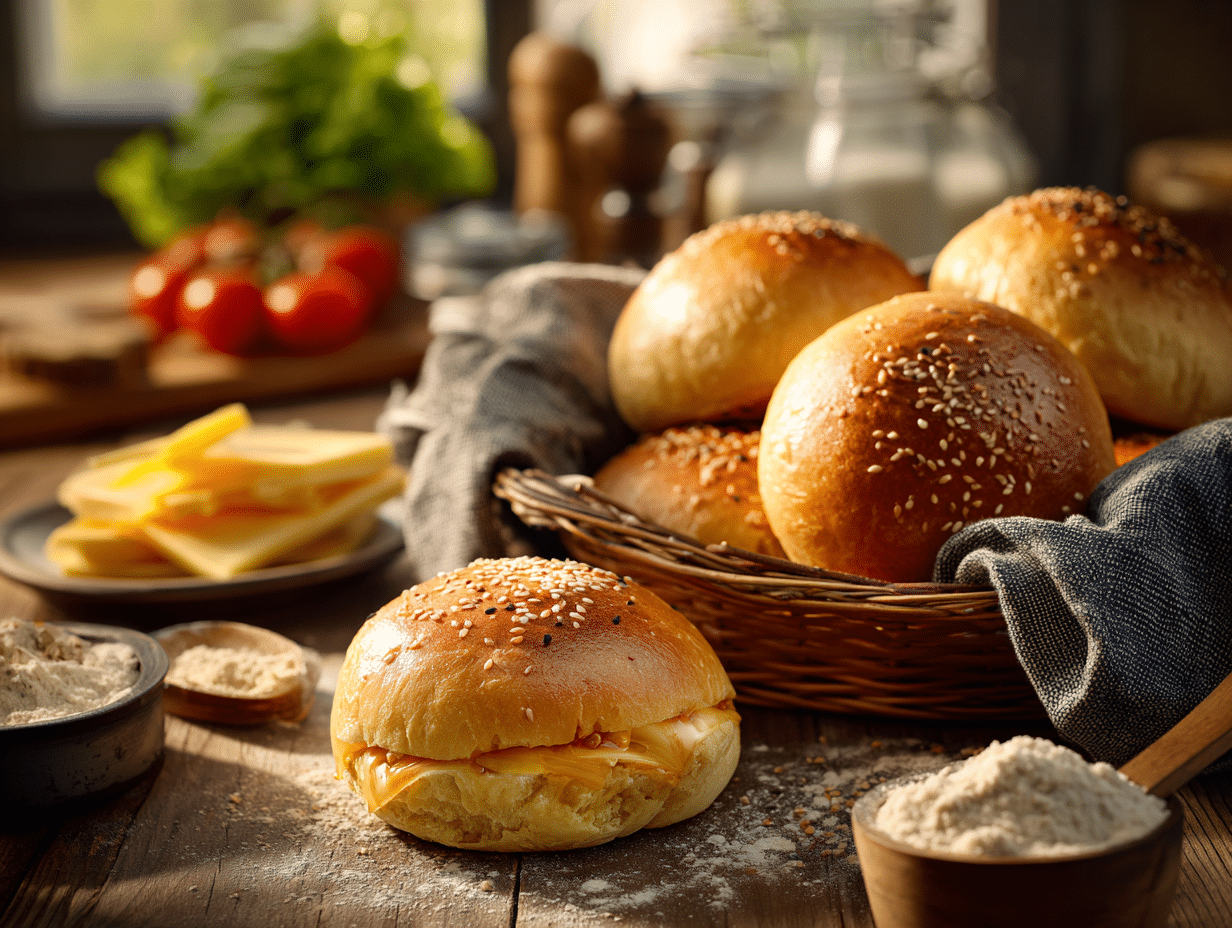
Artisan Hamburger Buns

Ingredients
For the Dough:
- 1 cup warm whole milk about 110°F, not hot to the touch
- 2 ¼ teaspoons active dry yeast one packet
- 2 tablespoons granulated sugar
- 3 cups bread flour plus more for kneading
- ½ cup all-purpose flour
- 1 ½ teaspoons kosher salt
- 1 large egg room temperature
- 3 tablespoons unsalted butter softened
For the Topping:
- 1 large egg for egg wash, beaten with 1 tablespoon water
- 2 tablespoons sesame seeds optional, for garnish
Instructions
- In a large mixing bowl, combine warm milk and sugar, then sprinkle yeast on top. Let it sit for 5–10 minutes, or until frothy—this indicates the yeast is active.
- Add bread flour, all-purpose flour, salt, egg, and softened butter to the yeast mixture. Mix with a wooden spoon or in a stand mixer with a dough hook until a shaggy dough forms.
- Knead the dough by hand on a floured surface for about 10 minutes (or 6 minutes with a stand mixer) until the dough is smooth, elastic, and slightly tacky, but not sticky.
- Place dough in a lightly greased bowl, cover with a damp towel or plastic wrap, and let it rise in a warm area until doubled in size—about 1 to 1.5 hours.
- Once risen, punch down the dough and divide it into 8 equal pieces. Shape each piece into a tight ball, then flatten slightly into a disk about 3 inches wide.
- Place buns 2 inches apart on a parchment-lined baking sheet. Cover loosely with plastic wrap and let rise for another 30–40 minutes, until puffy and nearly doubled again.
- Preheat oven to 375°F (190°C). Brush tops of buns with egg wash and sprinkle with sesame seeds if using.
- Bake for 18–20 minutes, or until buns are golden brown and sound hollow when tapped. Cool on a wire rack before slicing.
Notes
- Use bread flour for a chewier texture and better rise, but if unavailable, all-purpose will suffice.
- For a richer flavor, replace half the milk with buttermilk.
- To accelerate proofing, place the bowl in an oven with the light on—it creates a gentle warmth ideal for fermentation.
Nutrition
Common questions
Can I use instant yeast instead of active dry yeast?
Yes — use the same amount and skip the proofing step with the warm milk. Just mix it directly into the dry ingredients. The buns will rise a bit faster, so watch the dough rather than the clock.
Why is my dough too sticky to shape?
Flour absorbs liquid at different rates depending on humidity and brand, so sticky dough usually just needs a little more flour worked in — add it a tablespoon at a time until the dough pulls away from the bowl cleanly. Avoid the urge to dump in a lot at once, which makes the buns tight and dense.
Can I make the dough the night before?
Yes, and it actually improves flavor. After the first knead, cover the bowl tightly and refrigerate overnight instead of doing the first room-temperature rise. Pull it out the next day, let it come to room temperature for about 30 minutes, then shape, proof, and bake.
How do I know the buns are fully baked?
The internal temperature should reach 190°F (88°C) — a probe thermometer is the most reliable check. The tap test (hollow sound on the bottom) works too, but the thermometer removes all guesswork, especially for your first batch.
Can I make slider-sized buns with this dough?
Yes — divide the dough into smaller portions, roughly 1.5 oz each instead of the standard size, and reduce the bake time by about 4–5 minutes. Check them early; smaller buns brown faster and can go from golden to overdone quickly.
Try these next
- Animal Style Burger Recipe
- Ultimate Avocado Bacon Smash Burger
- Angus Bacon Guacamole Burger
- Hawaiian Teriyaki Burger Recipe