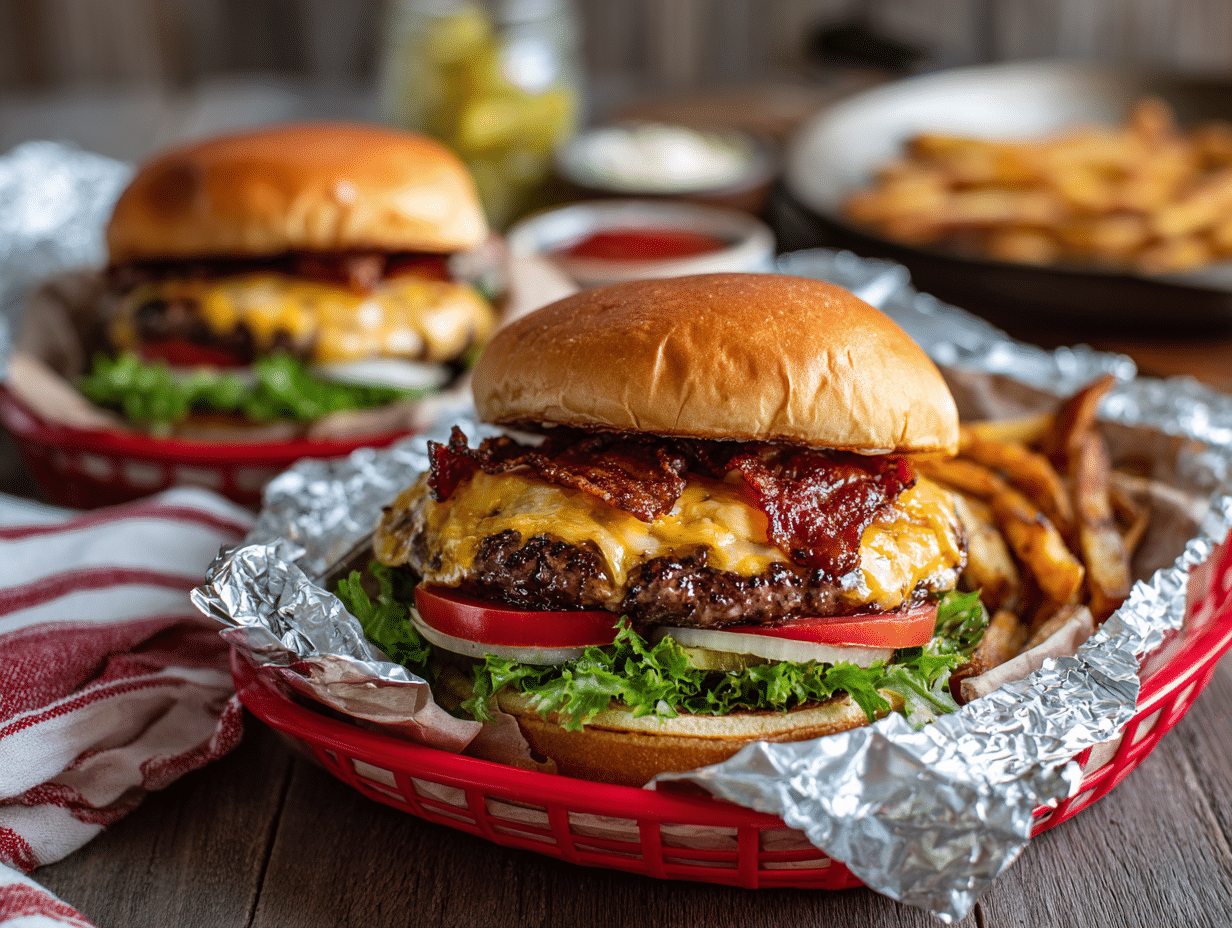
This is a copycat of Five Guys’ Little Bacon Cheeseburger — a single smash patty with American cheese, crispy bacon, and whatever toppings you like on a soft toasted bun. It takes about 35 minutes start to finish, and the technique is straightforward enough that if you’ve never made a smash burger before, this is a good place to start.
What makes this version work
Two things matter most here. First, the griddle or cast-iron pan needs to be genuinely hot before the beef goes in — not warm, not medium, but ripping hot. That heat is what creates the crispy, lacy-edged crust that makes this burger taste like the real thing instead of a steamed hockey puck. Second, the smash itself has to happen fast and hard within the first 10 seconds of the ball hitting the pan, while the meat is still soft enough to spread. Once it starts to set, pressing it just squeezes out juice without adding any crust. Use a flat, heavy spatula and lean your weight into it. Those two steps — screaming-hot surface, immediate smash — are what separate a good result from a great one.
Common problems and fixes
- Patty shrinks into a thick puck: The beef ball was too cold or the pan wasn’t hot enough. Pull the beef out of the fridge 10 minutes before cooking, and let the pan preheat for at least 3 minutes on high before anything touches it.
- Cheese won’t melt properly: Add the cheese slice right after you flip, then immediately place a metal bowl or pan lid over the patty for 30 seconds. The trapped steam does the work fast.
- Bacon comes out chewy instead of crisp: Cook bacon in a cold pan and bring the heat up gradually — this renders the fat before the meat seizes. Drain on a paper towel and don’t stack the strips while they’re hot or they’ll steam each other soft.
- Bun gets soggy before you finish eating: Toast the cut sides in the same pan after the bacon comes out. Thirty seconds on medium heat is enough to build a light crust that holds up against condiments and juice.
- Burger falls apart when you pick it up: Skip the egg in the mix — it makes the patty mushy and doesn’t hold a smash burger together anyway. The smash itself bonds the meat; just use 80/20 ground chuck and handle it as little as possible.
Leftovers and meal prep
A cooked smash patty keeps in the fridge for up to 3 days in an airtight container. Store the patty, bacon, and bun separately — assembling ahead turns everything soggy. To reheat the patty, put it in a dry skillet over medium heat for about 2 minutes per side until it hits 160°F (71°C) internally; the microwave works in a pinch but softens the crust. Bacon reheats well in the same skillet for 30 to 60 seconds. Raw beef balls can be shaped, wrapped individually in plastic wrap, and frozen for up to 2 months — cook straight from frozen, just give the smash an extra 30 seconds per side and confirm the internal temp reaches 160°F (71°C) before eating.
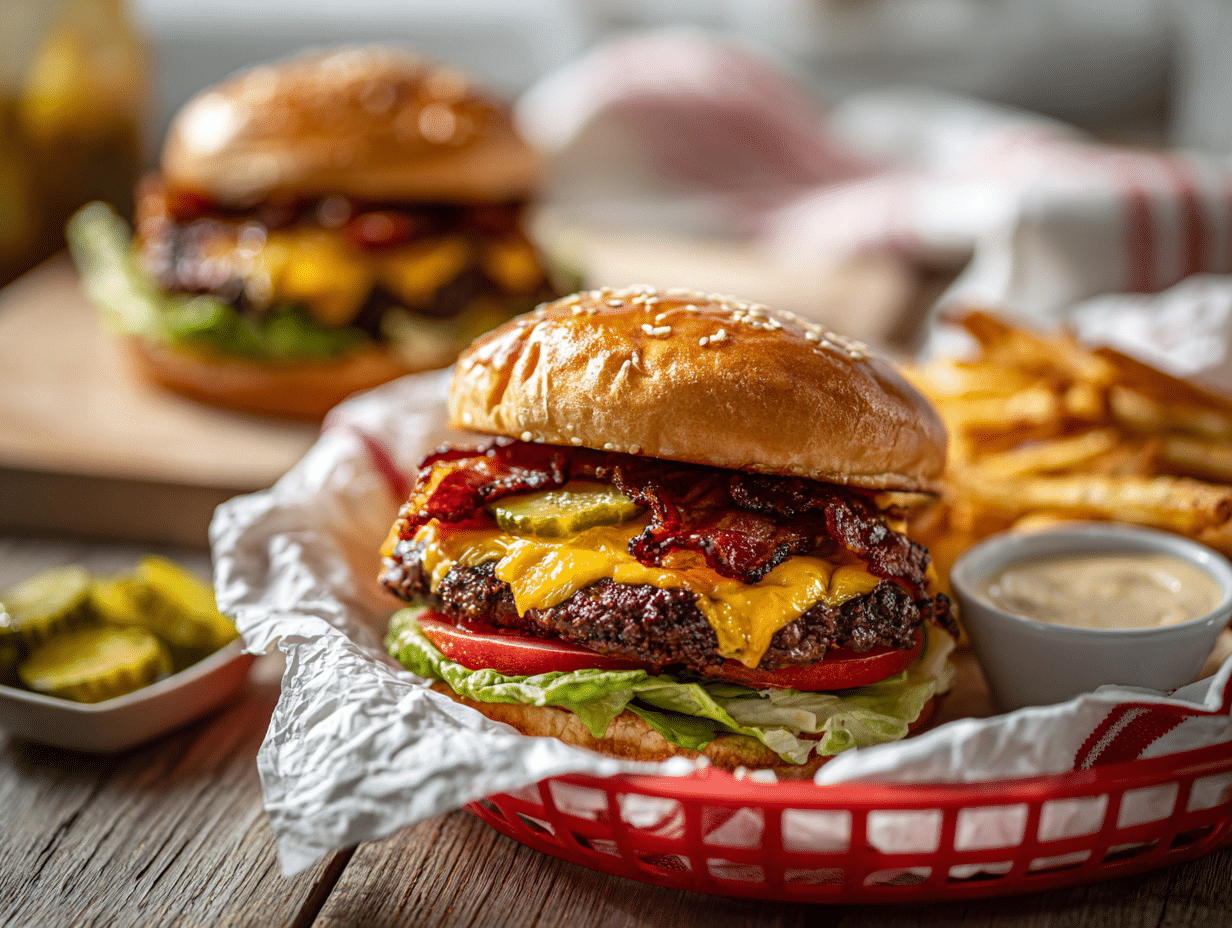
Five Guys Little Bacon Cheeseburger (Copycat)

Equipment
- 2 squares parchment paper for smashing patties without sticking
- 2 sheets aluminum foil optional, for a classic steam-wrap finish
Ingredients
- 1 tbsp neutral oil (canola or peanut) high smoke point, for the griddle or skillet
- 4 slices thick-cut bacon applewood-smoked recommended
- 0.25 cup yellow onion, thinly sliced for quick griddled onions (optional)
- 0.5 cup white button mushrooms, sliced optional, for a diner-style upgrade
- 2 buns soft burger buns (sesame seed or potato) split
- 2 tsp unsalted butter softened, for toasting buns
- 7 oz ground beef (80/20 chuck) kept very cold; divide into two 3.5 oz portions
- 0.5 tsp kosher salt divided, for seasoning patties and veg
- 0.5 tsp freshly ground black pepper divided
- 2 slices American cheese deli-style American for best melt
- 1 tbsp mayonnaise
- 1 tbsp ketchup
- 1 tsp yellow mustard
- 2 leaves iceberg lettuce shredded or left whole
- 2 slices ripe tomato cut 1/4-inch thick
- 4 slices dill pickle chips drained
Instructions
- Mise en place (about 20 minutes total): Keep the ground beef cold; divide into two even 3.5 oz portions and gently form into loose balls without compressing. Slice onions and mushrooms; split buns and spread cut sides with butter. Prep lettuce, tomato, and pickles. Set out mayonnaise, ketchup, and mustard.
- Heat the griddle or skillet (2 minutes): Place a flat-top griddle or heavy cast-iron skillet over medium-high heat and film with 1 tbsp neutral oil. Aim for surface temperature around 400°F (205°C); the oil should shimmer but not smoke excessively.
- Crisp the bacon (5 minutes): Lay 4 bacon slices on the hot surface and cook at roughly 375–400°F (190–205°C), turning once, until deep mahogany and crisp, about 5 minutes. Transfer to a rack or paper towels to drain. Sensory cue: listen for a lively sizzle; reduce heat if the fat smokes heavily.
- Griddle onions and mushrooms (2–3 minutes): In the bacon drippings, cook onions (and mushrooms, if using) with a pinch of salt and pepper until lightly golden and sweet, 2–3 minutes. Push to a cooler corner of the griddle to keep warm.
- Toast the buns (1 minute): Place buns, buttered side down, on the hot surface and toast until the edges turn golden and the centers feel crisp, 45–60 seconds. Remove and spread top buns with mayonnaise, ketchup, and mustard so the heat gently wakes their aromas.
- Smash and sear the patties (about 3 minutes total): Increase heat slightly to maintain 400°F (205°C). Place a beef ball on the griddle, cover with a square of parchment, and press firmly with a sturdy spatula (or two stacked spatulas) to about 1/4 inch thick. Season with salt and pepper. Cook until the edges are deeply browned and lacy, 45–60 seconds. Using a sharp metal spatula, scrape under the crust and flip. Immediately top with American cheese and cook 30–60 seconds more until the cheese melts and the patty reaches about 160°F (71°C). Repeat with the second patty.
- Assemble (1–2 minutes): On each bottom bun, place a cheesy patty, then bacon, griddled onions/mushrooms, pickle chips, tomato, and lettuce. Cap with the sauced top bun. For an authentic touch, wrap each burger in a sheet of foil for 1 minute to gently steam, marrying flavors and softening the bun.
- Serve: Unwrap, inhale the buttery, smoky aroma, and enjoy immediately while the cheese is glossy and the edges of the patty are still crisp.
Notes
Chef’s Tips
- Use 80/20 beef and keep it cold; cold fat = better browning and juiciness.
- Smash once, right away. Pressing later can squeeze out juices.
- If you lack a heavy spatula, stack two spatulas or place a small pan on top to press evenly (use parchment to prevent sticking).
- Speed up onion browning with a tiny pinch of sugar; deglaze with a teaspoon of water if the pan dries.
- Dietary swaps: gluten-free buns; turkey or plant-based patties; lactose-free American-style slices.
- Brand cue: deli American melts silk-smooth and gives that classic diner flavor.
- Foil wrap for 1–2 minutes softens the bun and fuses layers—just like the real thing.
Serving Suggestions
- Plate in a parchment-lined basket or tray; present cut in half to showcase the lacy crust, molten cheese, and colorful layers.
- Garnish with extra pickle chips and a ramekin of fry sauce (2 parts ketchup, 1 part mayo, splash of pickle brine).
- Perfect sides: crispy salted fries or Cajun-spiced fries, and a vanilla or chocolate milkshake.
- Visual cues of perfection: bronzed bun edges, glossy cheese, crisp rippled bacon, and a deep brown patty crust.
Culinary Context
Born from the American diner tradition and popularized by Five Guys (founded in Virginia in 1986), the “Little” denotes a single patty. The hallmark is a hot flat-top sear that creates a lacy, crackly crust while keeping the interior succulent, plus classic condiments and add-ons tailored to taste.Optional Advanced Instructions
- Make-ahead: Cook bacon up to 2 days ahead and re-crisp on the griddle for 30 seconds. Pre-portion beef balls, cover, and refrigerate up to 24 hours.
- Parallel workflow: While bacon cooks, prep buns and sauces; while patties sear, toast buns in a second skillet to save time.
- No griddle? Use a heavy cast-iron skillet. For indoor smoke control, keep heat at 400°F (205°C) and work in batches.
Nutrition
Frequently asked questions
Do I need a special smash burger press or will a regular spatula work?
A regular flat metal spatula works fine. The key is that it’s rigid and flat — a slotted or flexible spatula won’t let you apply enough even pressure. Press straight down with both hands if you need to, and hold for a full 10 seconds.
How do I know when the patty is done without cutting it open?
Use an instant-read thermometer and check for 160°F (71°C) in the center — that’s the safe internal temperature for ground beef. On a screaming-hot pan, a smashed single patty usually hits that in about 2 minutes per side, but thickness varies, so the thermometer is the only reliable check.
Can I use leaner ground beef like 90/10 to make it a bit healthier?
You can, but the burger will be noticeably drier and the edges won’t crisp the same way. The fat in 80/20 is what renders on contact with the hot pan and creates the crust — leaner beef just doesn’t behave the same at high heat.
More burger recipes to try
- Five Guys BLT Smash Burger
- Five Guys Cajun Burger
- Ultimate Avocado Bacon Smash Burger
- Perfect Bacon Double Cheeseburger