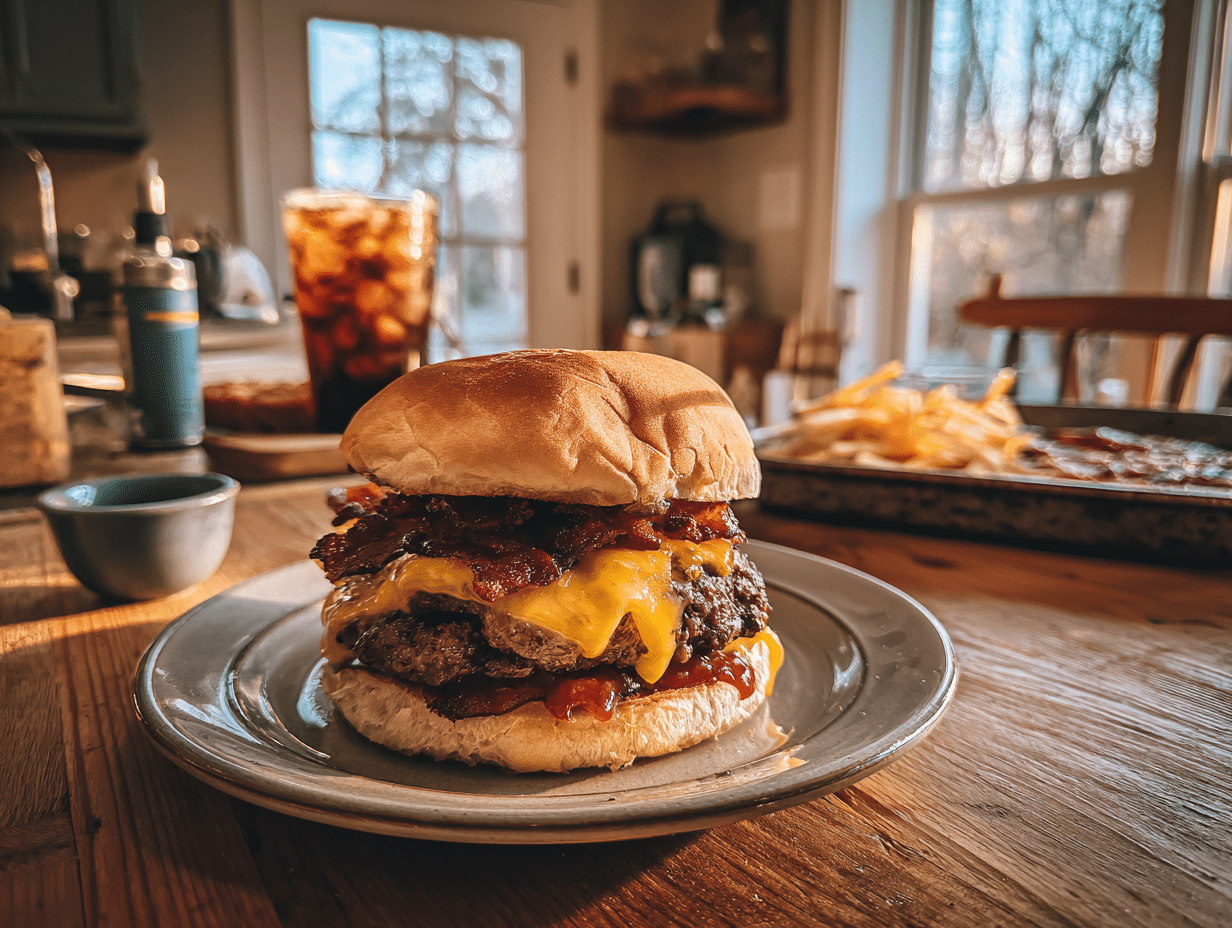
This is a double smash burger built around two thin, crispy-edged beef patties and four strips of bacon — a straightforward copycat of Wendy’s Son of Baconator made on your own griddle. The smash technique does the heavy lifting: maximum crust, fast cook time, and results that beat the drive-through every time. Make a batch on Sunday and you’ll have lunches sorted for the first half of the week.
Why this recipe works
Two things actually matter here. First, the smash itself: pressing a cold, loosely packed beef ball hard against a screaming-hot griddle creates a wide, thin patty with serious surface contact. That contact is what builds the crust — the part that makes a smash burger taste different from a regular flat patty. Second, the bacon goes in the oven first, not the pan. Oven-cooked bacon stays flat, cooks evenly, and doesn’t fight for space on the griddle when you’re managing four patties at once. Both steps are especially useful when you’re cooking multiple burgers in one session.
About the ingredients
- 80/20 ground chuck: The fat content is non-negotiable for a smash burger. Leaner beef won’t render enough fat to fry those edges properly and the patty will taste dry.
- Thick-cut applewood-smoked bacon: Thin-cut bacon disappears under the patties. Thick-cut holds its texture after reheating, which matters if you’re prepping ahead. Skip the egg in the mix — it makes the patty mushy.
- American cheese: It melts faster and more evenly than cheddar on a thin patty. If you swap in cheddar, give it an extra 20 seconds under a dome lid with a splash of water to help it melt.
- Brioche buns: A standard sesame bun works fine. Toast it cut-side down on the griddle until golden — a pale bun turns soggy fast under mayo and beef fat.
Mistakes to avoid
- Not preheating the griddle long enough: A cast-iron griddle needs at least 3 minutes over high heat before the first patty goes down. If the surface isn’t hot enough, the beef steams instead of searing and you lose the crust entirely.
- Smashing more than once: Press the ball down firmly once and leave it alone. A second press squeezes out the juices you just sealed in.
- Crowding the griddle when batch cooking: Cook in rounds of two patties maximum. Crowding drops the surface temperature and you’re back to steaming, not searing.
- Undercooking the patties: These are thin, so it’s tempting to pull them early. Ground beef must reach 160°F (71°C) internal — use an instant-read thermometer, especially when cooking a large batch where you might lose track of timing.
- Assembling burgers you plan to store: If you’re prepping ahead, keep the components separate. A fully assembled burger stored overnight turns the bun into a soggy mess.
Storage and reheating
Store cooked patties and bacon separately in airtight containers in the fridge for up to 4 days — this is the move if you’re planning weekday lunches. Reheat patties in a dry skillet over medium heat for about 90 seconds per side; they’ll crisp back up better than they would in a microwave. Bacon reheats well in the same skillet for 30–45 seconds. For longer storage, freeze cooked patties in a single layer on a baking sheet, then transfer to a zip bag once solid — they keep well for up to 2 months. Thaw overnight in the fridge before reheating. Don’t freeze assembled burgers or pre-sauced buns.
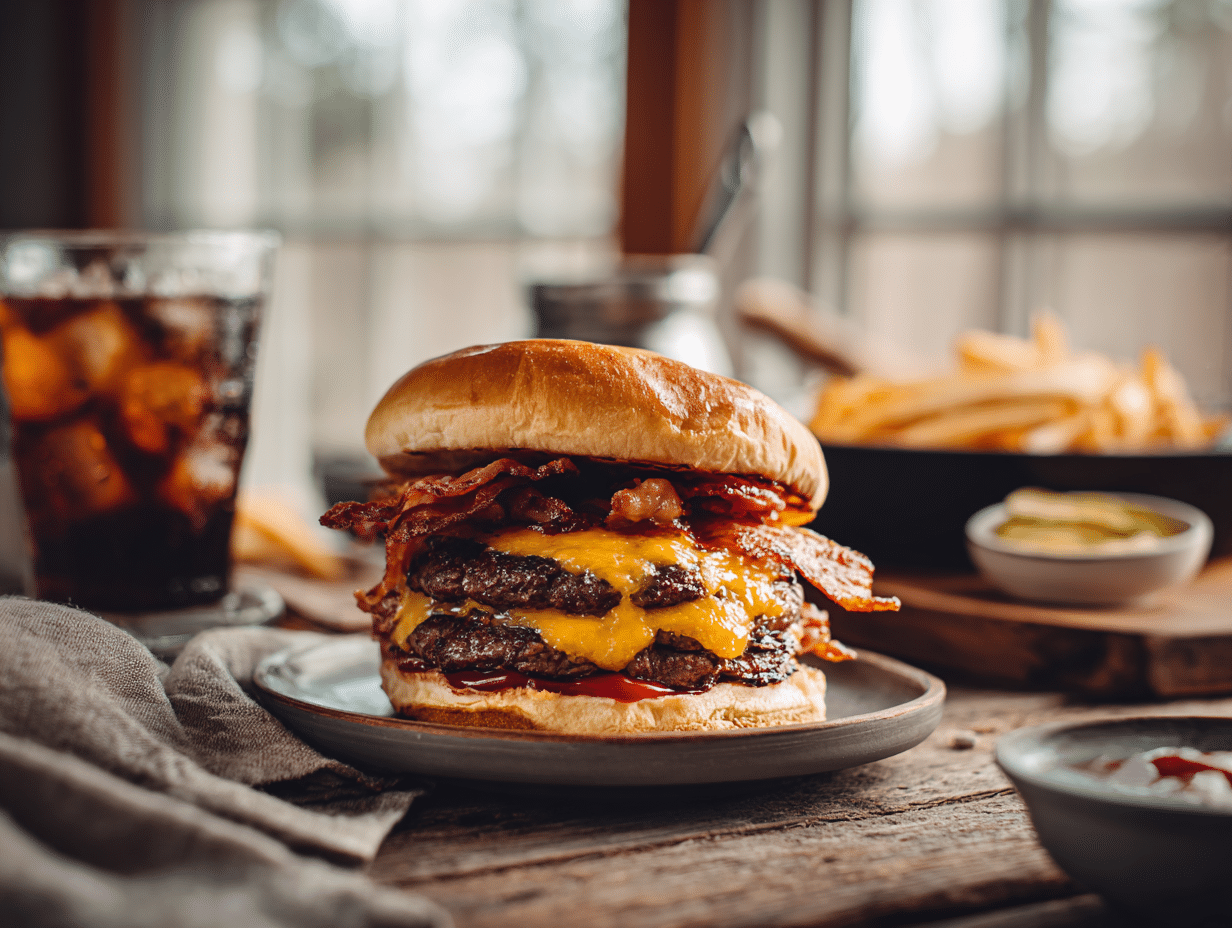
Son of Baconator-Style Double Bacon Smash Burgers

Ingredients
- 16 slices thick-cut bacon Applewood-smoked recommended; nitrate-free if possible
- 4 buns potato or brioche burger buns, split Potato buns give classic fast-food softness
- 2 tbsp unsalted butter, softened For toasting buns
- ¼ cup ketchup Heinz recommended
- ¼ cup mayonnaise Duke’s or Hellmann’s
- 1.5 lb 80/20 ground chuck, very cold Freshly ground if possible for best texture and flavor
- 2 tsp kosher salt Diamond Crystal; use 1 1/2 tsp if using Morton
- 1 tsp freshly ground black pepper
- 1 tsp garlic powder Optional, for subtle savory depth
- 8 slices American cheese Deli American or classic singles for optimal melt
- 1 tbsp neutral oil Canola or grapeseed, for griddle or skillet
Instructions
- Cook the bacon (16–18 minutes): Heat oven to 400°F (205°C). Arrange bacon on a wire rack set over a foil-lined sheet pan. Bake until crisp, 16–18 minutes. Transfer to paper towels to drain. Keep warm in a 200°F (95°C) oven, or tent loosely with foil.
- Toast the buns (1–3 minutes): Spread the cut sides with softened butter. Toast cut-side down in a dry skillet over medium heat (about 350°F/175°C surface temp) until golden at the edges, 1–3 minutes. Set aside.
- Portion the beef (5 minutes): Divide the cold ground chuck into 8 equal portions (about 3 oz each). Lightly shape into loose balls—do not compact. Keep chilled until searing.
- Preheat the cooking surface (3–5 minutes): Heat a cast-iron griddle or heavy skillet over medium-high until just smoking (425–450°F / 220–230°C). Add a thin film of neutral oil.
- Smash and sear the first batch (3 minutes): Place 4 beef balls onto the hot surface. Immediately press each with a stiff metal spatula (or a burger press) to ~1/4-inch thickness, applying firm pressure for 10–15 seconds to set the edges. Season the exposed side with kosher salt, black pepper, and a whisper of garlic powder. Cook without moving until the edges are mahogany and lacy-crisp, about 2 minutes; you’ll smell deep roast aromas and see rendered fat bubbling at the edges.
- Flip, cheese, and finish (1 minute): Flip the patties; top each with a slice of American cheese. Cook 45–60 seconds more, until the cheese is glossy and fully melted. Transfer to a warm plate. Repeat Steps 5 and 6 with the remaining 4 patties.
- Sauce the buns (1 minute): Spread mayonnaise on the top buns and ketchup on the bottom buns. If chilled, stir each condiment first so it spreads smoothly.
- Build the stack (2 minutes): On each bottom bun: place a cheese-topped patty, add 2 bacon slices in a crisscross, set a second cheese-topped patty, then 2 more bacon slices. Cap with the mayo-brushed top bun.
- Rest briefly (1 minute): Let the assembled burgers sit for 1 minute so juices settle and the cheese bonds the layers. Serve immediately while the edges are still audibly crisp.
- Timing note: Active cooking time aligns as follows: bacon 16–18 minutes, buns 1–3 minutes, patties 2–3 minutes per batch × 2 batches (about 6 minutes total), assembly 3–4 minutes. Prep time about 20 minutes; total cook time about 30 minutes.
Notes
Chef’s Tips
- Smash technique: Use a stiff, flat-edged spatula and press firmly within the first 15 seconds; that’s when the crust sets. For leverage, place a sheet of parchment over the meat before pressing.
- Seasoning smart: Season only the exposed side right after smashing; seasoning too early draws out moisture.
- Bacon efficiency: Oven-baking yields even crispness. For faster stovetop bacon, start in a cold pan over medium heat and render 8–12 minutes, turning as needed.
- Bun choice: Potato buns mimic the classic softness; brioche adds a buttery sweetness. Always toast for structure.
- Substitutions: Use sharp American, mild cheddar, or Colby for a similar melt. Turkey bacon works, though it won’t render like pork—add a touch of oil when crisping.
- Dietary tweaks: For gluten-free, choose GF buns. For dairy-free, use a meltable plant-based American-style cheese and mayo.
- Flavor twist: Add a pinch of smoked paprika to the ketchup for extra smokiness, or a splash of hot sauce for gentle heat.
Serving Suggestions
- Plating: Serve on a pre-warmed plate. Let the double stack lean slightly to reveal the cross of bacon and the molten cheese layers.
- Garnish: A few dill pickle chips on the side add brightness without straying from the minimalist spirit.
- Sides & drinks: Pair with crisp shoestring fries or a vinegar-dressed slaw. A cold cola, root beer, or a bright pilsner balances richness.
- Doneness cues: Look for dark, lacy edges on the patties, glossy melted cheese, and bacon that snaps without shattering.
Culinary Context
This burger channels the exuberance of American roadside fare—simple components elevated by technique. The smash method, born in diners and griddle joints, maximizes browned flavor while keeping the interior juicy. My first restaurant-stage mentor called it “alchemy by contact”—get the metal hot, press with purpose, and chase that edge crunch.Optional Advanced Instructions
- Make-ahead: Portion beef balls up to 24 hours ahead; cover and refrigerate. Cook bacon in advance and re-crisp at 375°F (190°C) for 3–4 minutes.
- Parallel workflow: While bacon bakes, toast buns and preheat the griddle. Have cheese unwrapped and ready so it melts instantly after the flip.
- No burger press? Double up two sturdy spatulas or use a small saucepan wrapped in foil to press evenly.
Timing, Course, and Cuisine
- Prep Time: 20 minutes
- Cook Time: 30 minutes
- Course: Dinner or Lunch
- Cuisine/Origin: American
Nutrition
FAQ
Can I cook the patties ahead of time and reheat them later?
Yes, and it works well. Cook the patties fully to 160°F (71°C), let them cool, then refrigerate for up to 4 days. Reheat in a hot dry skillet rather than a microwave — you’ll get some crust back instead of a steamed, grey patty.
What if I don’t have a griddle — can I use a regular skillet?
A heavy cast-iron skillet works fine. Use the bottom of a smaller pan or a metal spatula to smash the ball down; just make sure the skillet is fully preheated before the beef touches it.
How do I keep the patties from sticking when I smash them?
A light wipe of neutral oil on the griddle surface is usually enough. If you’re still getting sticking, place a small square of parchment paper between the spatula and the beef ball for the smash, then peel it away before flipping.
Can I make the bacon ahead and store it separately?
Absolutely — oven-cooked bacon stores well in the fridge for up to 5 days in an airtight container. Reheat it in a dry skillet for 30–45 seconds per side, which brings back the texture better than a microwave does.
Try these next
- Perfect Bacon Double Cheeseburger
- Ultimate Avocado Bacon Smash Burger
- NYC Bacon Smash Burger
- Wendy’s Style Bacon Cheeseburger