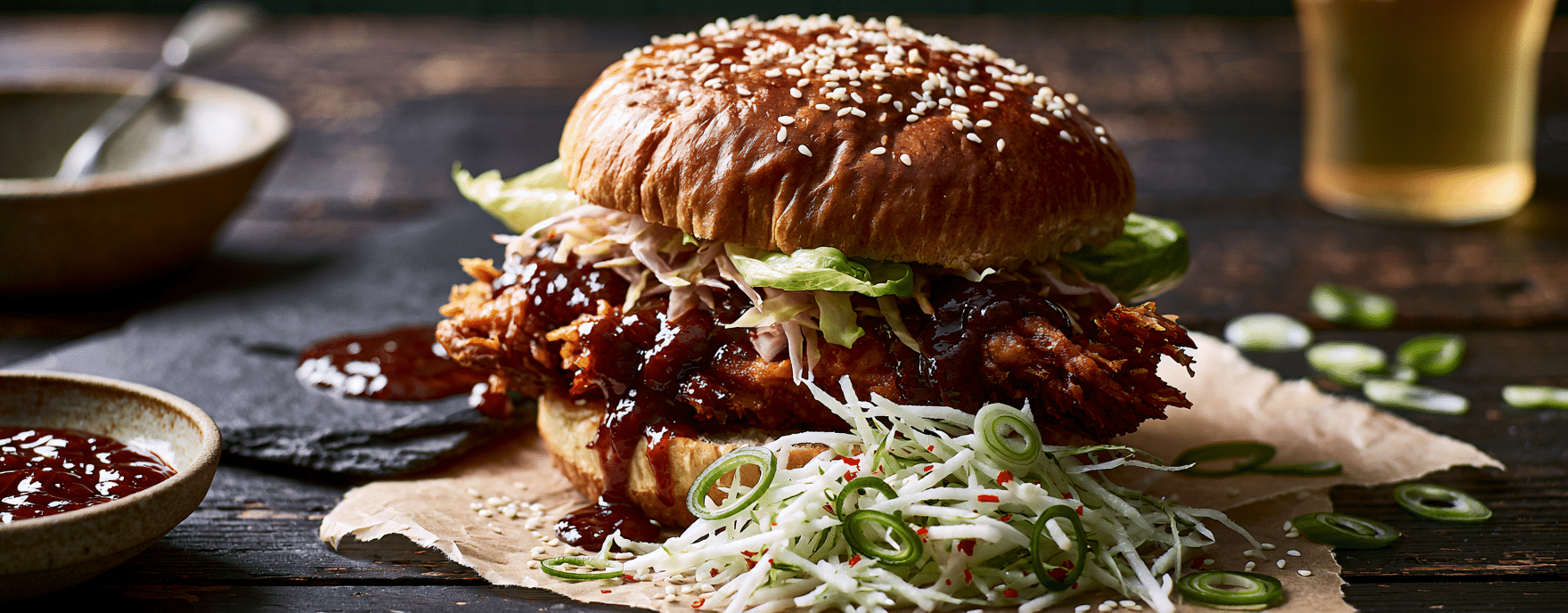
This is a crispy fried chicken burger built around a gochujang-based glaze and a quick kimchi-style slaw. The whole thing comes together in 25 minutes, and the sauce and slaw can be made days ahead — which makes it genuinely useful on a busy weeknight, not just a weekend project.
What makes this version work
Two things matter here. First, the double-fry: you cook the cornflour-coated thighs through, rest them briefly, then drop them back in hot oil until they crackle. That second fry drives out residual moisture and sets a crust that stays crisp long enough to survive assembly and reheating. Second, the sauce is simmered until syrupy before it goes anywhere near the chicken. A thin sauce soaks straight into the crust and ruins it; a reduced, sticky sauce coats the surface and clings. Get both of those right and the rest is just stacking.
About the ingredients
- Gochujang: Sold in most large supermarkets now, usually in a red tub in the Asian foods aisle. Heat level varies by brand — taste yours before committing to 2 tablespoons. Some are significantly hotter than others.
- Mooli (daikon radish): A long white radish. If you can’t find it, shredded kohlrabi or extra white cabbage works fine in the slaw — the texture is close enough.
- Cornflour (cornstarch): This is what gives the crust its light, shatter-crisp texture. Plain flour alone produces a thicker, doughier coating, so don’t swap it out.
- Sesame oil: Goes into the sauce off the heat. Adding it while the pan is still hot kills the flavour fast, so stir it in after you remove the pan from the burner.
- Brioche buns: Soft enough to compress without fighting the crust. Sesame seed buns work equally well here.
Mistakes to avoid
- Crowding the pan: Frying more than two thighs at a time drops the oil temperature sharply. The coating absorbs oil instead of crisping, and you end up with greasy, pale chicken. Fry in batches.
- Skipping the rest between fries: The two-minute rest isn’t optional. It lets steam escape from the crust before the second fry. Rush it and the steam blows out during the re-fry, leaving soft patches.
- Saucing too early: Toss or drizzle the sauce right before serving, not while the chicken is resting. Sauce sitting on the crust for more than a couple of minutes softens it noticeably.
- Under-cooking the chicken: Thighs vary in thickness. Always check that the internal temperature hits 165°F (74°C) — don’t rely on colour alone. A cheap instant-read thermometer removes all guesswork.
- Over-dressing the slaw ahead of time: The mayonnaise draws moisture out of the cabbage. If you’re prepping the slaw in advance, keep the dressing separate and combine within an hour of serving — skip the egg in the mix if you’re adapting this for a homemade mayo, it makes the slaw watery.
Leftovers and meal prep
The sauce keeps in a sealed jar in the fridge for up to five days — make a double batch on Sunday and you have it ready for the week. The undressed slaw vegetables (cabbage, mooli, spring onion) hold well for three days refrigerated; add the mayo and seasoning the day you use them. Cooked chicken thighs store in the fridge for up to three days. To reheat and recover the crust, use an air fryer at 375°F for four to five minutes, or a wire rack in a 400°F oven for eight minutes — both work well. A microwave will reheat the meat but the crust won’t survive it. The sauce reheats in a small pan in under two minutes. Uncooked, cornflour-coated thighs don’t freeze well; freeze the raw unseasoned thighs instead and coat them fresh when you’re ready to cook.
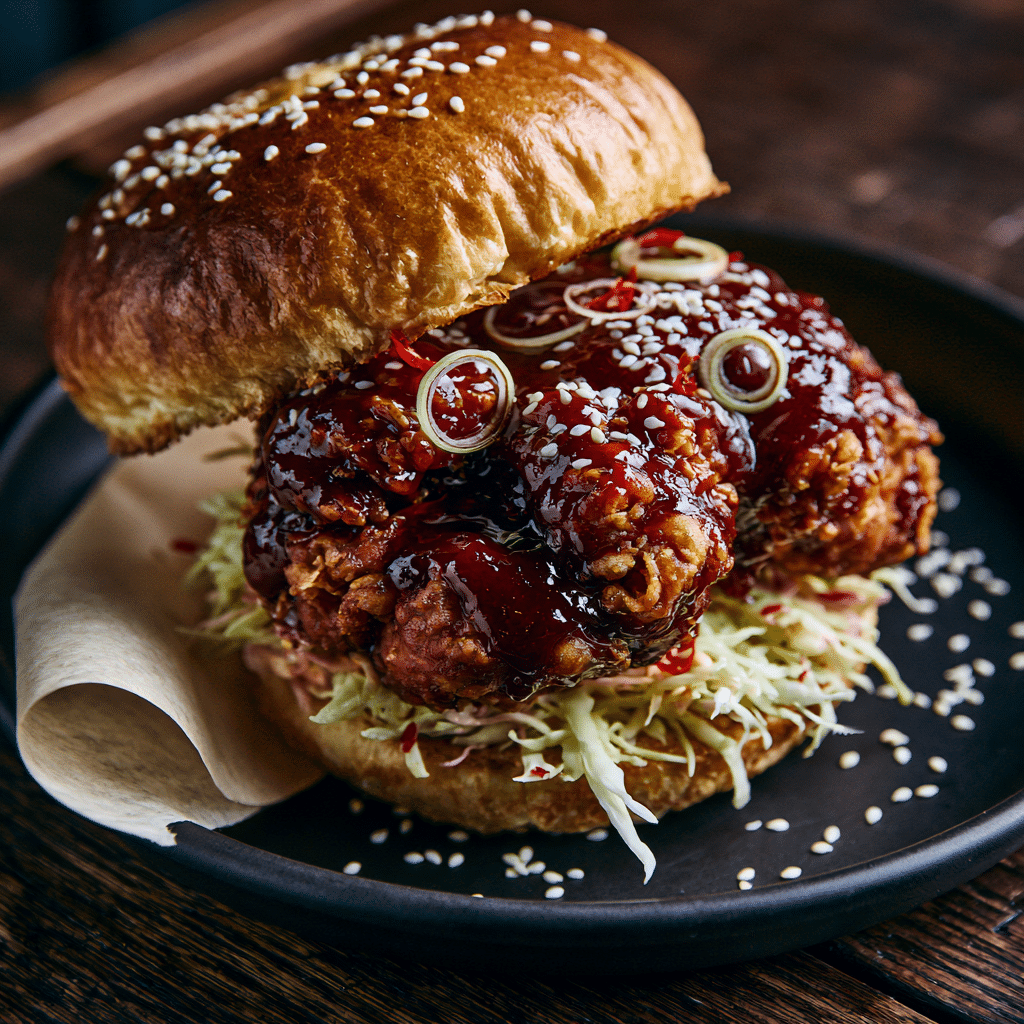
Korean Fried Chicken Burgers

Equipment
- Large deep frying pan or heavy-based skillet (12-inch / 30cm)
- Small saucepan for the gochujang glaze
- Instant-read thermometer (to check oil temperature)
- Wire cooling rack set over a baking tray (for draining fried chicken)
- Large mixing bowl for the slaw
- Fine grater or Microplane (for ginger)
Ingredients
Chicken Ingredients
- 4 pieces boneless, skinless chicken thigh fillets
- 1 tablespoon fresh ginger finely grated, about a 2-inch / 5cm piece
- ½ cup cornflour 65g
- 2 cups vegetable oil for frying, approximately 500ml — enough for 2cm / 3/4 inch depth in the pan
- 1 pinch salt to season
- 1 pinch ground black pepper to season
Sauce Ingredients
- 6 tablespoons dark brown sugar 75g
- 2 tablespoons gochujang Korean chilli paste, 35g
- 2 tablespoons soy sauce 30ml
- 2 large garlic cloves squashed
- 1 teaspoon fresh ginger finely grated, about a 1-inch / 2.5cm piece
- 2 teaspoons sesame oil 10ml
Kimchi-Style Slaw Ingredients
- ½ small white cabbage finely shredded, approximately 200g / 7oz
- 1 small mooli daikon radish, approximately 150g / 5oz, shredded into thin matchstick strips
- 4 stalks spring onions finely sliced
- 1 teaspoon fresh ginger finely grated, about a 1-inch / 2.5cm piece
- 1 teaspoon golden caster sugar 5g
- 1 clove garlic crushed
- 2 tablespoons mayonnaise 30g
- ¼ teaspoon Korean chilli flakes gochugaru, or hot chilli powder, plus more to taste
Burger Assembly
- 1 small Little Gem lettuce separated into leaves
- 4 whole brioche buns or sesame seed burger buns, split and lightly toasted
Instructions
- Make the slaw: in a large bowl, toss together the shredded cabbage, mooli, spring onions, grated ginger, caster sugar, crushed garlic, mayonnaise, and chilli powder until evenly combined. Taste and add more chilli powder if you want extra heat. Cover and refrigerate until ready to assemble.1/2 small white cabbage, 1 small mooli, 4 stalks spring onions, 1 teaspoon fresh ginger, 1 teaspoon golden caster sugar, 1 clove garlic, 2 tablespoons mayonnaise, 1/4 teaspoon Korean chilli flakes
- Make the sauce: place the dark brown sugar, gochujang, soy sauce, garlic, ginger, and sesame oil in a small saucepan over medium-low heat. Stir until the sugar dissolves, then simmer gently for 3-4 minutes until the sauce thickens to a syrupy consistency — it should coat the back of a spoon. Remove from the heat and set aside.6 tablespoons dark brown sugar, 2 tablespoons gochujang, 2 tablespoons soy sauce, 2 large garlic cloves, 1 teaspoon fresh ginger, 2 teaspoons sesame oil
- Trim any excess fat from the chicken thighs. Season generously on both sides with salt, pepper, and the grated ginger. Toss the thighs in the cornflour until completely and evenly coated, shaking off any excess.4 pieces boneless, skinless chicken thigh fillets, 1 tablespoon fresh ginger, 1/2 cup cornflour, 1 pinch salt
- Heat approximately 2cm (3/4 inch) of vegetable oil in a large, deep frying pan over medium-high heat until it reaches 350°F / 175°C (drop a pinch of cornflour into the oil — it should sizzle immediately and float). Fry the coated chicken thighs for 4-5 minutes on each side until golden and cooked through. Transfer to a wire rack set over a baking tray and rest for 2 minutes. Increase the oil temperature to 375°F / 190°C, then return the chicken to the oil and fry for a second time, about 1-2 minutes per side, until the crust is deeply golden, ultra-crisp, and crackling. Transfer back to the wire rack to drain briefly.2 cups vegetable oil
- Briefly reheat the gochujang sauce if it has cooled. To assemble, place a few Little Gem lettuce leaves on the bottom half of each toasted bun, spoon on a generous amount of kimchi-style slaw, top with a piece of crispy double-fried chicken, and drizzle generously with the sticky gochujang sauce. Press on the top bun and serve immediately.1 small Little Gem lettuce, 4 whole brioche buns
Notes
Nutrition
Your questions, answered
Can I use chicken breast instead of thighs?
You can, but thighs are the better choice here. Breast meat dries out faster during the double-fry, and it has less fat to carry the ginger seasoning. If you use breast, pound it to an even thickness before coating so it cooks through without over-browning the outside.
How do I know the oil is hot enough before frying?
Drop a pinch of cornflour into the oil — it should sizzle immediately and float. If it sinks and sits there, the oil isn’t ready. Frying in oil that’s too cool means the coating absorbs fat before it sets, which gives you a greasy result.
Can I make the sauce less sweet?
Yes — reduce the dark brown sugar to 4 tablespoons instead of 6. The sauce will be less syrupy and slightly more savory, which works well if your gochujang is already on the sweeter side. Taste it as it reduces and pull it off the heat when it coats the back of a spoon.
Can I bake or air-fry the chicken instead of deep-frying?
An air fryer gets you closest to the fried result — coat the chicken as directed, spray lightly with oil, and cook at 400°F for 10 to 12 minutes, flipping once, until the internal temperature reaches 165°F (74°C). Baking works but produces a noticeably softer crust; the double-fry technique doesn’t translate to an oven.
Is there a substitute for gochujang if I can’t find it?
A mix of sriracha and a small amount of miso paste is the closest swap — use roughly 1.5 tablespoons sriracha and half a tablespoon of white miso in place of the 2 tablespoons gochujang. It won’t be identical, but it gives you the fermented heat the sauce needs.
Can I prep the coated chicken ahead and fry it later?
Yes, up to a point. You can coat the thighs in cornflour, lay them on a rack, and refrigerate uncovered for up to two hours before frying. Beyond that, the coating starts to absorb moisture from the chicken and loses its crispness. Don’t stack them or they’ll stick.
More burger recipes to try
- Korean Rice Bulgogi Burger
- Sweet Chili Chicken Burger
- Nashville Hot Chicken Perfected
- Ultimate Crispy Chicken Burger