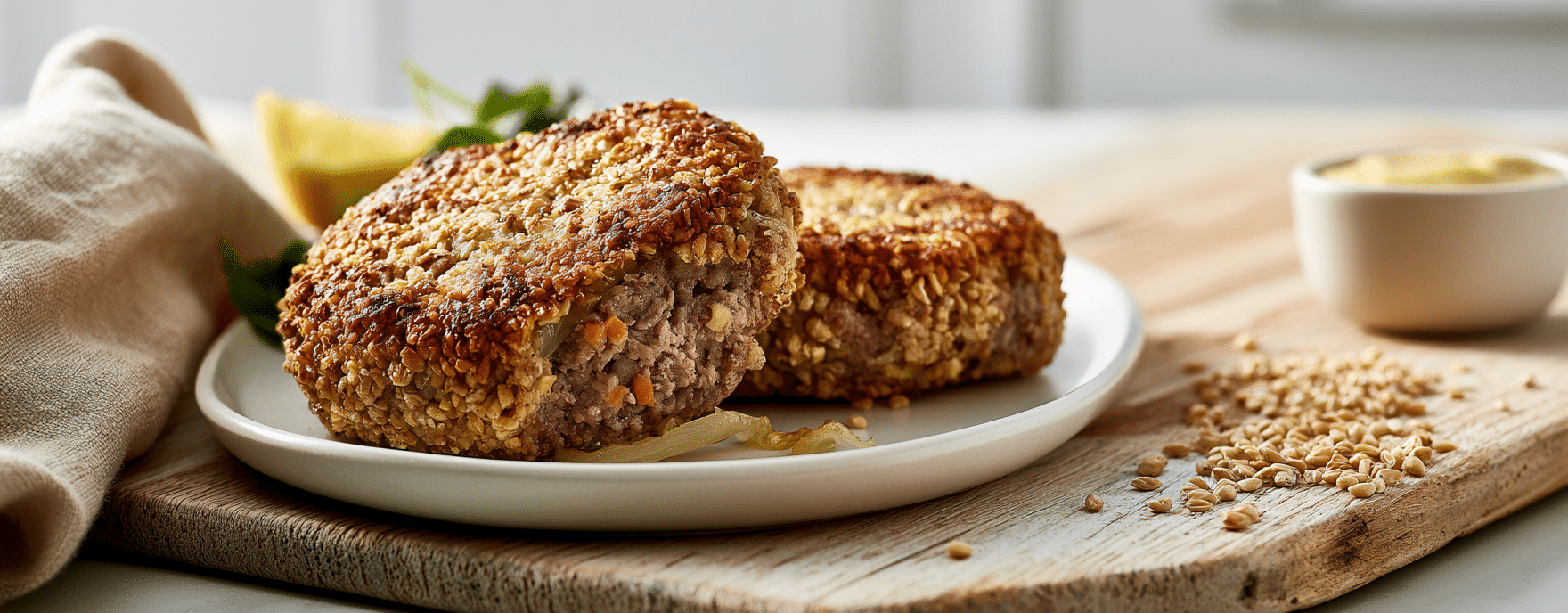
This is a lean beef patty built with wheatgerm coating, caramelised onions, cooked quinoa, and finely diced carrots — no added salt, no seasoning beyond what the vegetables bring. The honest reason to make it: it’s a genuinely mild, low-sodium patty that works well when you’re feeding people who can’t handle heavy seasoning, and it batches up and freezes cleanly so you can have a stack ready before anyone shows up hungry.
The technique that matters
Two things decide whether these patties hold together or fall apart on the baking pan. First, the carrots and onions need to be as dry as possible before you mix them into the beef. After poaching the carrots, spread them on a paper towel and press out the moisture — same goes for the caramelised onions. Wet vegetables steam the patty from the inside and break the bind. Second, the wheatgerm coating only sticks if you press it firmly into both faces of the patty rather than just dusting it on. Press flat, flip, press again. That crust is what keeps the patty intact when you flip it in the oven at the 10-minute mark, and it adds the only real texture contrast in the whole bite.
What can go wrong
- Patties puff up and crack in the oven: This happens when the meatballs aren’t pressed flat enough before coating. Aim for an even thickness of about 1 cm — thicker centres cook unevenly and the outside dries out before the middle reaches 160°F (71°C).
- Wheatgerm burns before the beef is cooked through: Oven temperature matters here. Above 400°F (200°C) the coating scorches fast. Stick to 375°F (190°C) and use the drizzle of olive oil on the pan — not on top of the patties — to prevent sticking without over-browning the crust.
- Patties stick to the baking pan when you try to flip them: Line the pan with parchment, not foil. Foil conducts heat unevenly and the wheatgerm bonds to it. Parchment releases cleanly every time.
- The mix is too loose to form patties: If your quinoa was cooked with extra water and is still wet, it loosens the mix. Use quinoa that’s been cooked, then cooled and drained. A tablespoon of chilled mix should hold its shape when squeezed — if it doesn’t, refrigerate the whole batch for 20 minutes before forming.
- Internal temperature hard to check on small patties: At roughly 2 cm diameter pressed flat, these are thin. Use an instant-read thermometer inserted horizontally through the edge into the centre — not from the top — to get an accurate read. Pull them at 160°F (71°C).
Smart swaps
- Wheatgerm: This is the unusual one. Raw wheatgerm (not toasted) is what you want — it coats and crisps without the bitterness of toasted. Find it in the cereal or health food aisle. If you genuinely can’t get it, fine breadcrumbs work as a coating, but skip the egg in the mix — it makes the patty mushy and you don’t need it here since the quinoa already helps bind.
- Quinoa: Any cooked grain works in the same quantity — finely cooked bulgur or even cold cooked rice. The job is binding and a little bulk, not flavour.
- Lean mince beef: This recipe is built around lean beef specifically because fat renders out during baking and can make the wheatgerm coating greasy and loose. Stick with 90/10 or leaner for best results.
Leftovers and meal prep
These patties were designed with freezing in mind, and that’s genuinely their best feature for batch cooking. Form and coat all the patties, wrap each pair in cling film, and freeze flat on a tray before transferring to a freezer bag — they’ll keep for up to 3 months. Bake straight from frozen at 375°F (190°C) for about 20–22 minutes, flipping at the 12-minute mark, and verify 160°F (71°C) internal before serving. If you’ve already baked them, cooked patties keep in the fridge for up to 3 days in an airtight container. Reheat in a 350°F (175°C) oven for 8–10 minutes — microwaving softens the wheatgerm crust and you lose the only real texture the patty has.
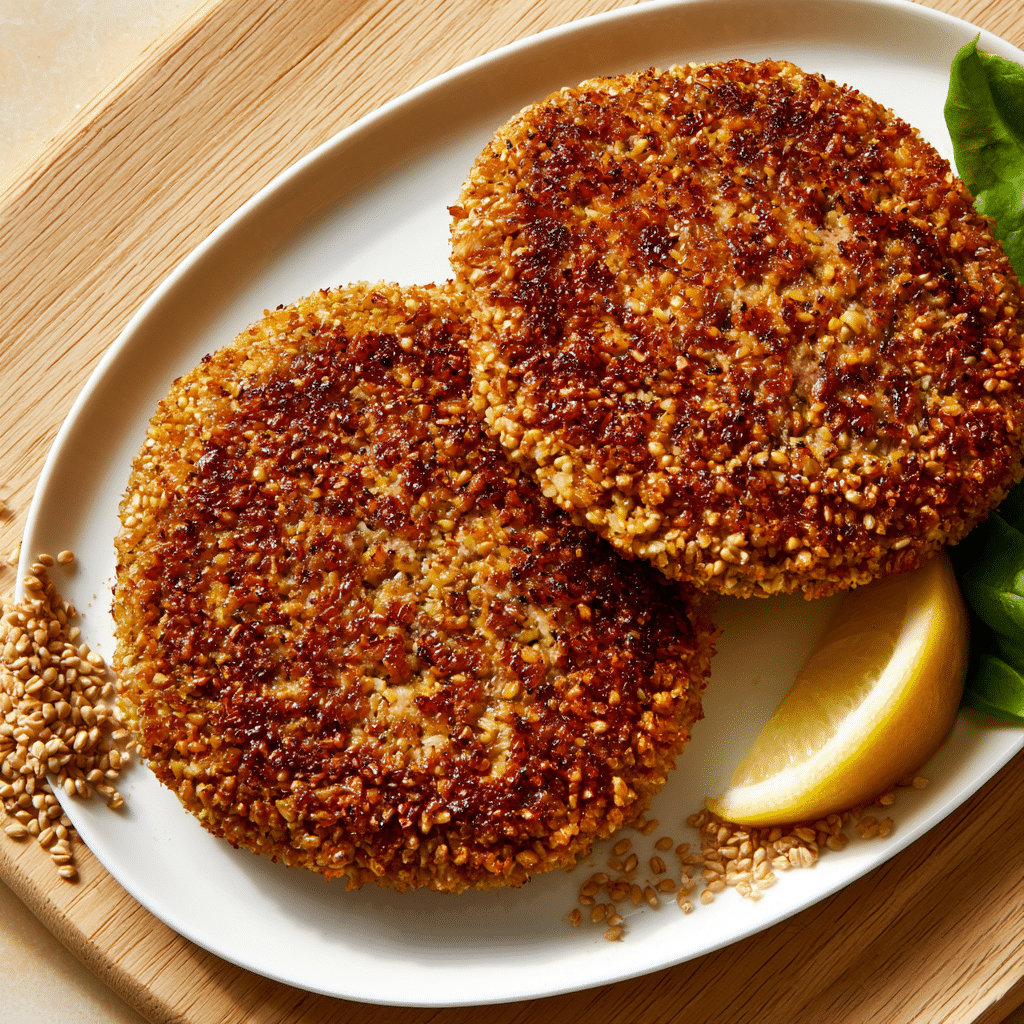
Wheatgerm-Crusted Beef Patties – Low Sodium & Freezer Friendly

Equipment
- Rimmed baking sheet
- 10-inch non-stick skillet
- Small saucepan
- Instant-read thermometer
- Mixing bowl (medium)
- Cling film / plastic wrap
Ingredients
- ½ lb lean ground beef 90% lean or higher, about 225g
- ¼ cup onion finely diced, about 40g
- ¼ cup carrots finely diced, about 30g
- 1 tablespoon quinoa cooked, about 10g
- 2 tablespoons wheatgerm for coating patties
- 1 tablespoon olive oil plus extra for drizzling
Instructions
- Heat 1 teaspoon of olive oil in a non-stick skillet over medium-low heat. Add the finely diced onions and cook, stirring occasionally, for 8–10 minutes until deep golden brown and caramelised. Transfer to a paper towel and press to remove excess moisture.1 tablespoon olive oil, 1/4 cup onion
- Measure 1 tablespoon of cooked quinoa and set aside to add to the beef mixture.1 tablespoon quinoa
- Bring a small saucepan of water to a gentle simmer. Add the diced carrots and poach for 8–10 minutes until semi-soft but not mushy. Drain, spread on a paper towel, and press firmly to remove all moisture.1/4 cup carrots
- In a medium bowl, combine the ground beef, caramelised onions, drained carrots, and cooked quinoa. Mix gently with clean hands until just combined — do not overwork. Divide the mixture into 2 equal portions and roll each into a ball roughly 4–5cm (1.5–2 inches) in diameter.1/2 lb lean ground beef, 1/4 cup onion, 1/4 cup carrots, 1 tablespoon quinoa
- Spread 1 tablespoon of wheatgerm on a plate. Place one ball on the wheatgerm and press it flat to form a patty about 1cm (½ inch) thick. Flip and press firmly so both sides are evenly coated with wheatgerm. Repeat with the remaining ball and wheatgerm.2 tablespoons wheatgerm
- To freeze: wrap each pair of patties tightly in cling film and freeze flat on a tray. Once solid, transfer to a freezer bag. To cook fresh, proceed to the next step.
- Preheat the oven to 375°F / 190°C (170°C fan-forced). Place patties on a lightly oiled rimmed baking sheet. Drizzle a small amount of olive oil over the tops. Bake for 15 minutes, flipping carefully after 10 minutes. Check with an instant-read thermometer — ground beef must reach 160°F (71°C) at the centre before serving. For frozen patties, bake for 20–22 minutes, flipping at the 12-minute mark.1 tablespoon olive oil
Notes
Nutrition
FAQ
Do I really need to caramelise the onions, or can I just use them raw?
Raw onion will not work well here — it stays sharp and releases water into the patty as it bakes, which weakens the bind and makes the interior wet. Caramelising drives off that moisture and converts the sharpness into the mild sweetness that does the flavour work in a recipe with no added seasoning.
How do I know when these are fully cooked if I’m making a big batch?
Use an instant-read thermometer and check every patty in the batch — don’t assume they all cook at the same rate, especially if some are slightly thicker. Ground beef must reach 160°F (71°C) at the centre; there’s no safe visual shortcut with these since the wheatgerm coating browns independently of the meat.
Can I cook these on a grill or stovetop instead of the oven?
A flat cast-iron skillet on medium heat works — about 5–6 minutes per side with a light oil coating — but an open grill grate is risky because these patties are small and the wheatgerm crust can crumble through the bars. If you’re grilling for a crowd, use a grill pan or a sheet of perforated grill foil.
Can I double or triple the recipe for a larger group?
Yes, and this recipe scales well because the mix is forgiving. The main thing to watch when scaling up is keeping your formed patties a consistent size and thickness — uneven patties in the same oven batch will have some overcooked and some underdone. Use a kitchen scale and weigh each portion before pressing.
Try these next
- Hawaiian Teriyaki Burger Recipe
- Korean Rice Bulgogi Burger
- Angus Bacon Guacamole Burger
- Veggie Sauce Burger Perfection