The Story Behind the McDonald’s Katsu Curry Chicken Burger
A Culinary Phenomenon is Born
When McDonald’s Japan first introduced the Katsu Curry Chicken Burger as a limited-edition menu item, it created a sensation that rippled far beyond Japan’s borders. This innovative creation represents a fascinating intersection of American fast-food culture and Japanese culinary tradition, embodying the concept of “glocalization” – adapting global products to local tastes.
Understanding Yōshoku: The Foundation
To truly appreciate this burger, we must first understand yōshoku (洋食), literally meaning “Western food.” This cuisine emerged during Japan’s Meiji Restoration (1868-1912) when the country opened its doors to Western influence after centuries of isolation. Japanese chefs began adapting European dishes to local palates, creating entirely new categories of comfort food that felt simultaneously foreign and familiar.
Chicken katsu itself is a prime example of yōshoku. Inspired by European schnitzel, Japanese cooks replaced veal with more accessible proteins like pork (tonkatsu) and chicken, coating them in distinctively light and crispy panko breadcrumbs rather than traditional Western breadcrumbs. The result was something uniquely Japanese that has become a cornerstone of modern Japanese cuisine.
The Evolution of Japanese Curry
Japanese curry, or karē (カレー), has an equally fascinating history. Introduced by the British Navy in the late 19th century, curry arrived in Japan not from India but from Britain, where it had already been adapted into a mild, flour-thickened stew. The Japanese further modified it, adding sweetness from apples and honey, creating a gentler, more umami-rich sauce that appealed to Japanese tastes.
By the 1960s, instant curry roux blocks made curry rice one of Japan’s most popular home-cooked meals. The combination of curry with fried cutlets – katsu curry – became a beloved comfort food served everywhere from school cafeterias to specialized curry houses.
The Fast-Food Innovation
McDonald’s Japan has long been known for its creative localized menu items, from the Teriyaki McBurger to seasonal sakura-themed desserts. The Katsu Curry Chicken Burger represents perhaps their boldest fusion yet, transforming a sit-down comfort food into a handheld fast-food item.
The engineering challenge was significant: how to maintain the crispy texture of the katsu while incorporating the potentially soggy curry sauce, all within the constraints of fast-food service. The solution involved careful sauce consistency, strategic layering, and the addition of crisp cabbage slaw to provide textural contrast and prevent the bun from becoming saturated.
Cultural Significance
This burger represents more than just a menu item – it’s a symbol of modern Japan’s relationship with global culture. It demonstrates how Japanese cuisine continues to evolve, taking influences from around the world and making them distinctly its own. The fact that an American fast-food chain could create such an authentically Japanese-tasting product speaks to the deep cultural exchange that has occurred over decades.
The Limited-Edition Strategy
McDonald’s Japan’s use of limited-edition items creates a sense of urgency and exclusivity that drives consumer behavior. These special menu items often coincide with seasons or cultural events, making them feel like special occasions rather than everyday meals. The Katsu Curry Chicken Burger typically appears for just a few weeks, creating long lines and social media buzz each time it returns.
Culinary Techniques and Flavor Profile
The genius of this burger lies in its balance. The curry sauce must be thick enough to cling to the crispy coating without making it soggy, sweet enough to appeal to Japanese palates without being cloying, and spiced gently enough to complement rather than overpower the delicate chicken. The use of apple in the curry sauce is particularly Japanese, adding natural sweetness and a fruity depth that distinguishes Japanese curry from its Indian and British predecessors.
The panko coating on the chicken provides a distinctively light, crispy texture that regular breadcrumbs cannot achieve. This Japanese innovation, now used worldwide, creates larger, flakier crumbs that stay crispy longer – essential for a burger that might sit for a few minutes before being consumed.
Global Influence and Home Recreation
The popularity of McDonald’s Japan’s creation has inspired home cooks worldwide to recreate and elevate the concept. Food bloggers and chefs have developed their own versions, often using higher-quality ingredients and traditional cooking techniques while maintaining the essential character of the original.
This recipe represents one such elevation, incorporating classic French roux technique for the curry sauce, careful temperature control for optimal frying, and fresh ingredients throughout. It honors the fast-food original while showcasing what’s possible when time and technique constraints are removed.
The Future of Fusion
The McDonald’s Katsu Curry Chicken Burger exemplifies the future of global cuisine – not a homogenization of flavors, but a celebration of local tastes expressed through international formats. It shows how fast food can be a vehicle for cultural expression and how traditional flavors can find new life in unexpected forms.
As global palates become more adventurous and cultural boundaries continue to blur, we can expect more innovations like this – foods that respect tradition while embracing modernity, that feel both comfortingly familiar and excitingly new. The Katsu Curry Chicken Burger isn’t just a sandwich; it’s a delicious symbol of our interconnected culinary world.
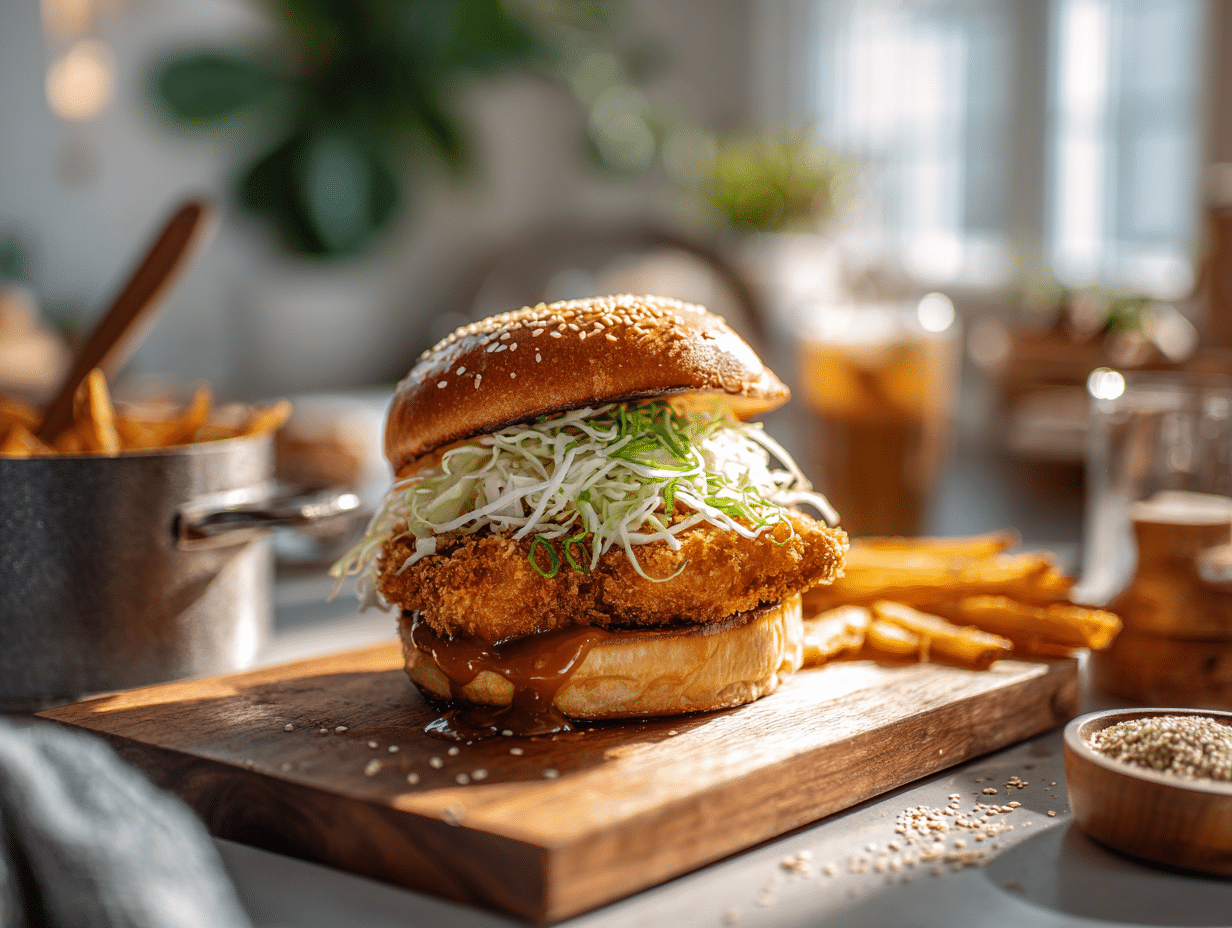
McDonalds-Style Katsu Curry Chicken Burger

Ingredients
For the Katsu Curry Sauce:
- 1 tablespoon neutral oil (canola or sunflower) fresh, high–smoke point oil for clean flavor
- 1 tablespoon unsalted butter adds roundness to the roux; high-quality butter preferred
- 1 cup yellow onion, finely diced about 1 small onion; dice evenly for even sautéing
- 2 cloves garlic, minced fresh cloves, not jarred, for best aroma
- 1 tablespoon fresh ginger, finely grated microplane for a juicy paste
- 2 tablespoons all-purpose flour forms a light roux to thicken the curry
- 2 teaspoons Japanese-style curry powder S&B brand recommended for classic flavor
- 1 teaspoon garam masala adds warmth and depth
- 1 cup low-sodium chicken stock warm before adding for a smoother sauce
- ½ cup coconut milk (unsweetened) full-fat for silkier texture; can sub whole milk
- 1 teaspoon tomato paste concentrated umami and color
- 1 tablespoon soy sauce shoyu preferred; low-sodium if sensitive
- 1 tablespoon Worcestershire sauce classic Japanese curry accent
- 1 teaspoon honey balances spice; adjust to taste
- ½ cup apple, finely grated Fuji or Gala for gentle sweetness
- ½ teaspoon kosher salt Diamond Crystal preferred; season to taste
- ¼ teaspoon freshly ground black pepper crack fresh for aroma
For the Crispy Chicken:
- 4 pieces boneless, skinless chicken thighs about 1.25 lb total; choose similar sizes
- 1 teaspoon kosher salt for seasoning the chicken
- ½ teaspoon white pepper classic katsu seasoning; black pepper works too
- ½ cup all-purpose flour for dredging
- 2 large eggs beat well; add a splash of milk for better adhesion
- 1 tablespoon whole milk whisk into the eggs
- 1 ½ cups panko breadcrumbs Japanese-style panko for maximum crunch
- 2 cups neutral oil (canola or peanut) for frying enough for 1/2–3/4 inch depth
For the Slaw & Assembly:
- 1 cup green cabbage, very finely shredded ice-cold and dried for crispness
- 2 tablespoons Japanese mayonnaise (Kewpie) for signature tang and richness
- 1 teaspoon unseasoned rice vinegar brightens and balances
- 1 pinch kosher salt to season slaw lightly
- 4 pieces brioche burger buns soft, slightly sweet; sturdy enough for sauce
- 1 tablespoon unsalted butter for toasting buns
- 2 tablespoons scallions (thinly sliced) green parts only; for garnish
- 1 teaspoon toasted sesame seeds optional garnish for nutty aroma
Instructions
Make the Katsu Curry Sauce (about 12–14 minutes):
- Set a medium saucepan over medium heat (about 350°F / 175°C surface temp). Add 1 tbsp neutral oil and 1 tbsp butter. When the butter foams, add the diced onion and a pinch of salt. Sauté 6–8 minutes, stirring, until translucent and lightly golden—the edges should look blond and smell sweet. Add garlic and ginger; cook 30 seconds until fragrant.
- Sprinkle in 2 tbsp flour; stir constantly 1–2 minutes to form a blond roux. Add curry powder and garam masala; toast 30 seconds for deeper aroma. Whisk in warm chicken stock gradually to avoid lumps, then add coconut milk, tomato paste, soy sauce, Worcestershire, honey, and grated apple. Bring to a gentle simmer (small lazy bubbles) and cook 5–6 minutes, stirring, until the sauce thickly coats the back of a spoon. Season with salt and pepper to taste. Keep warm on low.
Prep the Chicken (about 8 minutes):
- Place chicken thighs between two sheets of parchment and gently pound to an even 1/2-inch thickness for uniform cooking. Season both sides with 1 tsp kosher salt and 1/2 tsp white pepper.
- Set up a 3-part breading station: flour in the first dish; eggs whisked with milk in the second; panko in the third. Dredge each thigh in flour (shake excess), dip in egg, then press firmly into panko, ensuring full coverage. Rest breaded chicken on a rack 5 minutes to set the crust.
Fry the Chicken (about 6–8 minutes):
- Pour neutral oil into a large skillet to 1/2–3/4 inch depth and heat to 350°F / 175°C. Fry 2 pieces at a time to avoid crowding, 3–4 minutes per side, until deeply golden. Internal temperature should reach 165°F / 74°C. Transfer to a rack and season lightly with salt while hot.
- Alternative: Air fryer at 400°F / 205°C for 10–12 minutes, flipping halfway; mist lightly with oil before cooking. For oven-baked, place on a rack over a sheet pan and bake at 425°F / 220°C for 14–16 minutes, flipping once; broil 30–60 seconds for extra color if needed.
Make the Quick Slaw (3 minutes):
- In a small bowl, toss shredded cabbage with Japanese mayo, rice vinegar, and a pinch of salt until lightly creamy but still crisp.
Toast the Buns (2 minutes):
- Spread cut sides of brioche with 1 tbsp butter. Toast in a dry skillet over medium heat until golden and fragrant, 60–90 seconds.
Assemble (2 minutes):
- Spoon 1–2 tbsp warm curry sauce on the bottom bun. Add a crispy chicken thigh, spoon more curry sauce over the cutlet, then crown with a tuft of cabbage slaw. Sprinkle with scallions and sesame seeds (optional). Cap with the toasted top bun and serve immediately while audibly crisp.
Notes
Chef’s Tips:
- Extra-Crunch Panko: Lightly crush panko with your hands for better packing, then press firmly onto the chicken.
- Oil Temperature Control: Keep between 325–350°F (165–175°C). If it drops, the crust absorbs oil; if it spikes, it browns before the chicken cooks.
- Sauce Gloss: Whisk a teaspoon of cold butter at the end for a restaurant-style sheen.
- Heat Level: Add a pinch of cayenne or hot curry powder if you crave a spicier profile.
- Dairy-Free: Swap butter for oil and use coconut milk only.
- Gluten-Free: Use rice flour in dredge and gluten-free panko; thicken sauce with sweet rice flour.
- For a closer fast-food vibe, add a thin swipe of tonkatsu sauce beneath the curry for extra tang.
- Always rest breaded chicken briefly before frying so the coating adheres and fries up evenly.
Serving Suggestions:
Plate on a warm, neutral-toned plate. Let the curry sauce gently cascade over the cutlet so it glistens without sogging the bun. Add a small ramekin of extra curry sauce on the side for dipping. For color and snap, garnish with bright green scallions and pale toasted sesame. Serve with crisp fries or sweet potato wedges and a chilled Japanese lager or iced green tea. Perfect execution shows a shattering crust, glossy sauce, and steam escaping when cut.Culinary Context:
Chicken katsu—born from Japan’s yōshoku movement—pairs Western-style breaded cutlets with Japanese flavor logic. Katsu curry, a beloved staple of homes and curry houses, layers a gentle, slightly sweet curry over crisp cutlet. This burger channels that comfort into a handheld form, echoing a famous fast-food release while honoring the textures and balance that make the original dish timeless.Optional Advanced Instructions:
- Make-Ahead Sauce: Curry sauce improves overnight. Reheat gently to serving temp; add a splash of stock if thick.
- Double-Fry Technique: For maximum crunch, fry at 325°F / 165°C until pale golden, rest 5 minutes, then fry 45–60 seconds at 360°F / 182°C to finish.
- Parallel Workflow: Start the sauce first; while it simmers, bread the chicken and prep slaw; toast buns while the chicken rests after frying.
- Holding: Keep fried cutlets crisp on a rack in a 200°F / 95°C oven for up to 20 minutes.
Timing:
- Prep Time: 35 minutes (0 hours 35 minutes)
- Cook Time: 20 minutes (0 hours 20 minutes)
- Total Time: 55 minutes (0 hours 55 minutes)
Course & Origin:
- Course: MainCourse; suitable for Lunch or Dinner.
- Cuisine: Japanese-inspired Fusion.